
AI voice agents are becoming an important part of business communication, especially for sales, customer support, lead qualification, appointment management, and follow-up calls.
However, building a voice agent that works reliably in real-world conversations requires more than simply connecting speech recognition with a language model.
Two of the most important components in a voice calling pipeline are Speech-to-Text (STT) and Text-to-Speech (TTS). STT converts the caller's spoken words into text that the system can understand, while TTS converts the AI-generated response back into natural speech.
Understanding how these two layers work, where they can fail, and how they affect latency and conversation quality is essential when designing production-ready voice systems.
What Are STT and TTS in an AI Voice Agent?
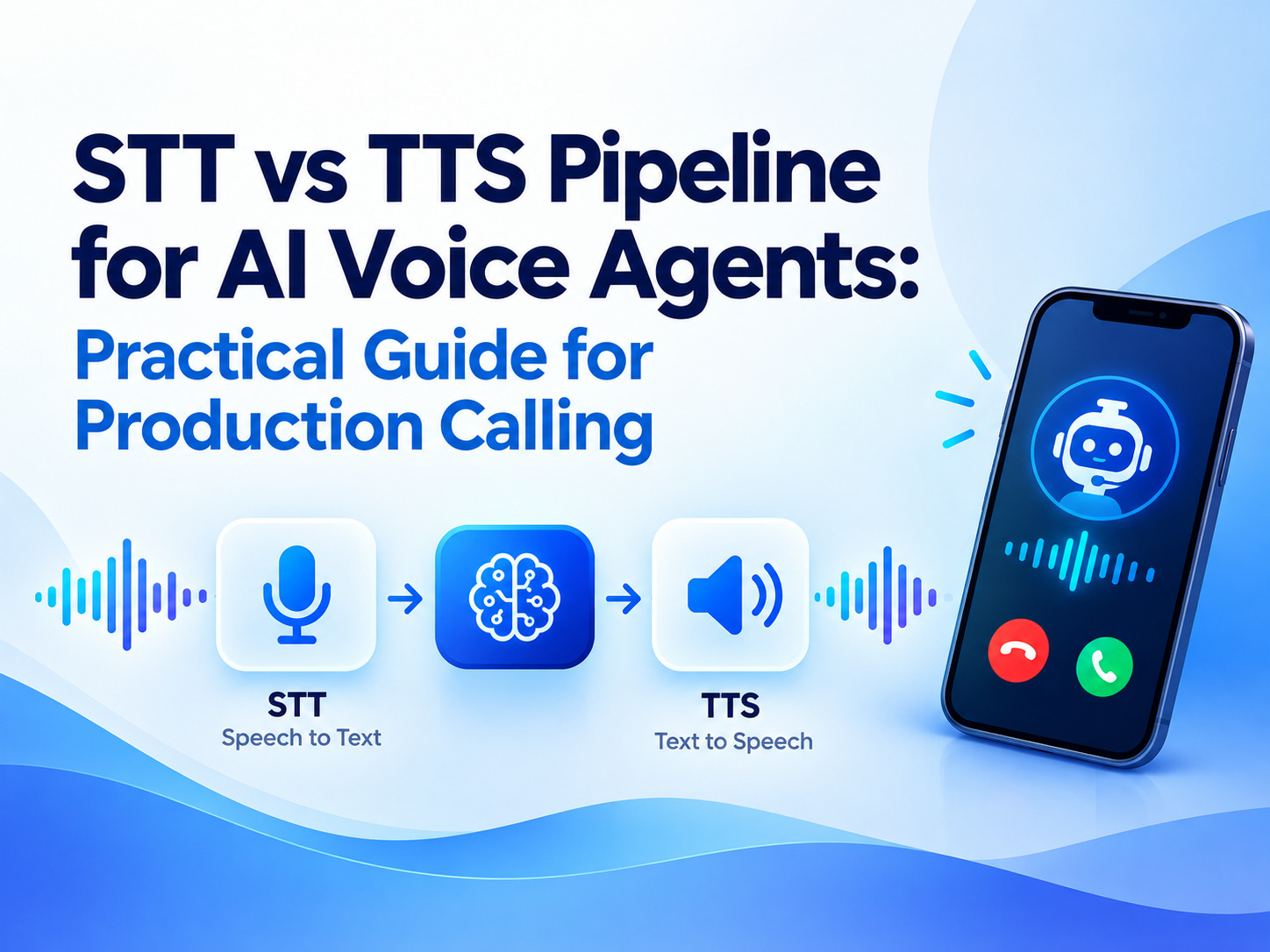
A typical voice agent follows a simple flow:
Caller speaks → STT converts speech into text → AI processes the request → TTS generates speech → Caller hears the response
Although STT and TTS are part of the same pipeline, they perform completely different jobs. STT focuses on accurately understanding what the caller says. It needs to handle background noise, different accents, speaking speeds, network quality, and mixed-language conversations.
TTS focuses on delivering the AI's response naturally. It needs appropriate pronunciation, pacing, pauses, tone, and language support so that the conversation does not sound robotic. A strong AI voice agent architecture must therefore consider both components independently while also optimising the complete conversation flow.
How Speech-to-Text Works in Production Calling
Speech-to-Text is the input layer of a voice agent. Its job is to continuously process the caller's speech and provide usable text to the AI system.
STT Accuracy in Real-World Calls
Production calls are very different from controlled demonstrations. Customers may speak from busy roads, offices, homes, or areas with inconsistent network connectivity. Background noise and different speaking styles can affect transcription accuracy.
Indian businesses also need to consider Hindi-English code-switching and regional accents. If an STT system repeatedly misinterprets important words, names, product terms, or locations, the AI may generate an incorrect response.
Streaming STT and Lower Latency
For real-time calling, streaming transcription is generally more suitable than waiting for the caller to finish an entire conversation segment before processing it.
Streaming allows the system to process speech continuously, helping reduce unnecessary delays and making interruptions easier to handle. Lower latency is especially important when the goal is to create a natural back-and-forth conversation.
Domain Vocabulary Matters
Generic speech recognition may struggle with industry-specific terms, product names, locations, or technical vocabulary. Production systems should therefore be evaluated using the actual language and terminology used by customers.
How Text-to-Speech Affects Voice Agent Quality
TTS forms the output layer of the voice pipeline. Even if the AI understands a customer perfectly, poor speech generation can make the overall experience feel unnatural.
Natural Voice and Prosody
A production voice agent should not sound flat or mechanically generated. Natural pauses, appropriate emphasis, pacing, and intonation can make responses easier to understand and more comfortable for callers.
For example, a question should sound like a question rather than a statement. Similarly, important information should not be delivered with the same emphasis as every other word.
Language and Accent Support
Businesses serving Indian customers may need support for English, Hindi, regional languages, and mixed-language conversations. TTS should deliver pronunciation and rhythm that feel appropriate for the intended audience.
This becomes particularly important for customer support calls, where unnatural pronunciation can affect trust and make conversations harder to follow.
TTS Generation Speed
TTS latency directly affects the time a caller waits before hearing a response. Even a high-quality voice can create a poor experience if the system takes too long to generate audio.
Streaming audio generation can help the agent begin speaking sooner instead of waiting for an entire response to be generated.
STT vs TTS: Which One Should You Optimise?
Both components are important, but they solve different problems. If callers are frequently misunderstood, the issue may be related to STT accuracy, background noise, accents, code-switching, or domain vocabulary.
If callers understand the agent but find its voice robotic, unnatural, or slow, the TTS layer may need attention. A production system should therefore evaluate STT and TTS separately before analysing the complete conversation.
What Should You Test Before Production Deployment?
Before choosing an AI platform for production calling, businesses should test voice agents under conditions that closely resemble actual customer calls.
Test Real Phone Conditions
Use real phone audio rather than relying only on studio-quality recordings. Mobile networks, background noise, and different devices can significantly affect voice quality.
Test Languages and Accents
Evaluate the system using the languages, accents, and speaking patterns of your actual customers. This is particularly important for Indian businesses handling multilingual calls.
Measure End-to-End Latency
Do not measure only individual STT or TTS processing speed. Measure the complete time between the caller finishing a statement and the AI beginning its response.
Test Longer Conversations
A short demonstration may not reveal problems that appear during longer calls. Evaluate consistency in voice quality, pronunciation, response timing, and conversation flow across complete interactions.
Building a Production-Ready AI Voice Calling Pipeline
A production-ready voice system needs reliable speech recognition, fast response generation, natural speech output, and an architecture capable of handling real-world phone conversations.
Vomyra provides an AI voice agent platform designed around real Indian calling conditions, including multilingual conversations, accents, code-switched speech, and mobile network variability. Businesses can use AI voice agents for activities such as outreach, qualification, customer conversations, and follow-ups.
For companies evaluating an AI Voice Agent, testing the complete pipeline under real calling conditions is more valuable than judging voice quality from a short demo alone.
AI Voice Agents for Customer Support
Customer support requires both accurate understanding and natural communication. An AI voice bot for customer support India can help businesses handle repetitive queries, collect information, provide updates, qualify requests, and manage routine conversations through voice.
The quality of STT and TTS directly affects these interactions. Accurate transcription helps the system understand the customer's request, while natural speech makes the response easier to follow.
Vomyra brings these components together to support real-time AI voice conversations for businesses looking to automate calling workflows while maintaining a more natural customer experience.
Conclusion
STT and TTS are two foundational components of a production voice agent. STT determines how accurately the system understands callers, while TTS determines how naturally the system communicates its responses.
Businesses should evaluate accuracy, latency, language support, accent handling, domain vocabulary, voice quality, and long-conversation consistency before deploying a voice agent at scale.
A well-designed AI voice agent architecture does not treat STT and TTS as isolated features. Instead, both should work together with the rest of the calling pipeline to deliver fast, accurate, and natural conversations.
With the right technology and realistic testing, AI voice agents can become a practical solution for customer support, sales, qualification, outreach, and other business calling requirements. Vomyra helps businesses move from voice AI experimentation toward production-ready calling experiences.
FAQs
1. What is the difference between STT and TTS in an AI voice agent?
STT converts spoken language from the caller into text that the AI can process. TTS converts the AI's text response back into spoken audio that the caller can hear.
2. Why is low latency important for AI voice agents?
Low latency helps the agent respond quickly after the caller finishes speaking. Long delays can make conversations feel unnatural and may cause callers to interrupt or lose engagement.
3. Does STT need to support Indian accents and languages?
Yes. Businesses serving Indian customers may need STT that can handle different accents, Hindi-English code-switching, regional languages, speaking speeds, and real-world mobile call conditions.
4. How can TTS make an AI voice agent sound more natural?
Natural TTS depends on factors such as pronunciation, pacing, pauses, intonation, language support, and consistent voice quality. These elements help create a smoother and more human-like conversation.
5. What should businesses test before deploying an AI voice agent?
Businesses should test real phone audio, STT accuracy, TTS naturalness, response latency, languages and accents, domain-specific vocabulary, interruption handling, and performance during longer conversations before production deployment.
Comments
Log in or sign up to join the conversation.