

If you're preparing for the PE Civil exam, chances are you've already spent money on study materials that promised results but delivered confusion instead. Maybe you bought a PE Civil practice exam that felt nothing like the real thing. Maybe you signed up for an FE review course packed with hours of video but no real strategy. You're not alone, and it's not your fault.
The truth is, most exam prep products are built to look thorough, not to actually get you licensed. Let's break down why that happens, and what real, effective prep should look like instead.
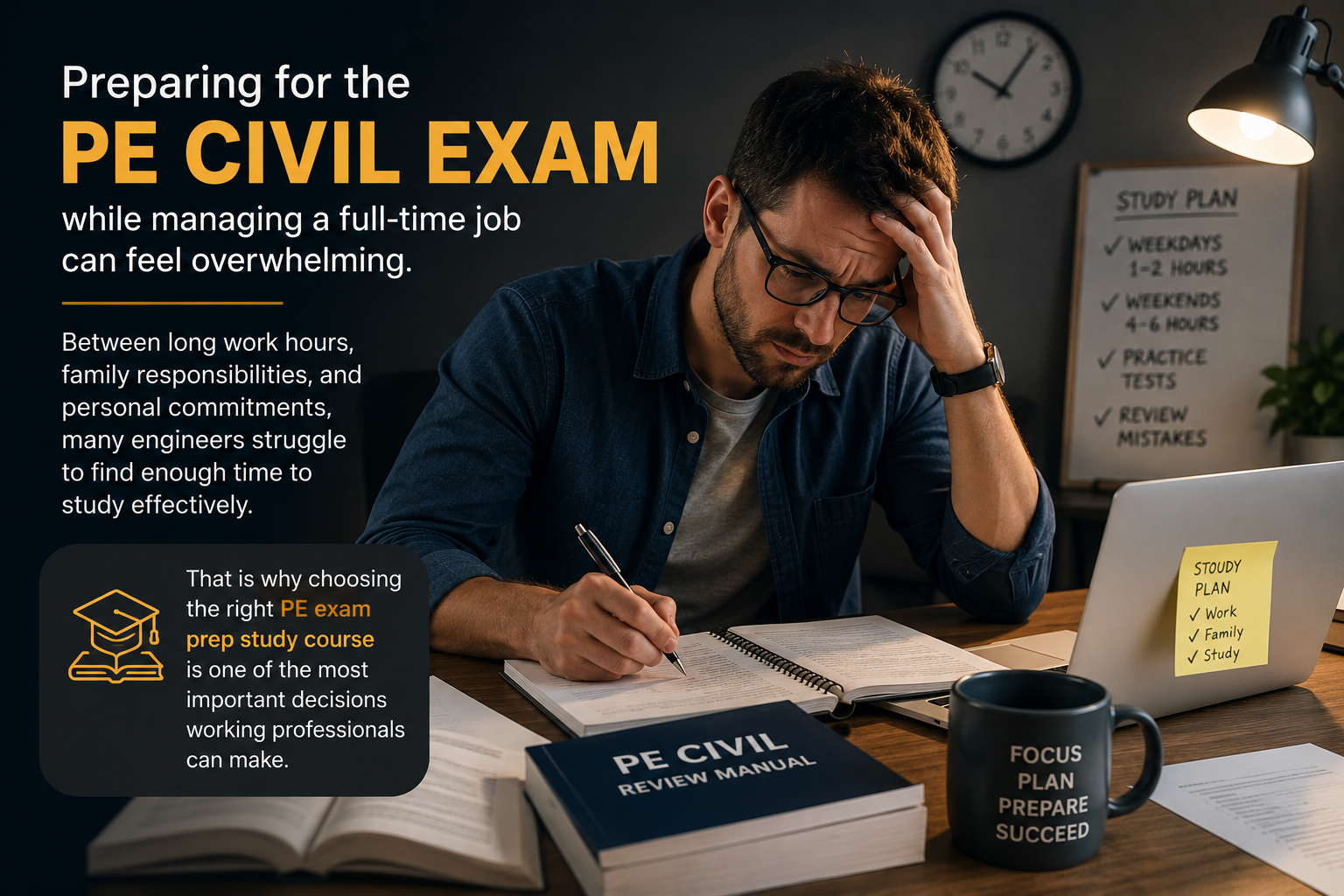
Why So Much Exam Prep Fails You
Studying hard doesn't guarantee passing. What matters is studying the right material, in the right way. Many engineers spend weeks working through outdated content, mismatched practice questions, or generic review videos that don't reflect how the exam is actually structured.
This is especially true for anyone jumping between an FE exam prep study course and later, PE-level material. If your foundation wasn't built the first time correctly, every step after that becomes harder than it needs to be.
3 Warning Signs Your Prep Course Isn't Working
1. It's Just a Content Dump
A lot of courses re-teach concepts you already learned in school instead of training you to apply them under exam conditions. The PE Civil exam doesn't just test memory it tests whether you can solve realistic problems quickly using your references.
If your course spends more time lecturing than practicing, that's a red flag.
2. The Practice Exams Don't Match Reality
This is one of the most common (and costly) mistakes. A PE Civil practice exam should mirror the difficulty, format, and phrasing of the real NCEES exam. The same goes for an FE Civil practice exam if it doesn't feel challenging in the same way the real test does, you're not actually preparing for exam day. You're just doing busywork.
3. No Feedback or Explanation
Getting an answer wrong isn't useful unless you understand why. Good prep materials explain the reasoning behind each solution, helping you spot patterns in your mistakes whether it's a concept gap, a timing issue, or simply not knowing how to navigate your reference materials fast enough.
What Effective PE and FE Prep Actually Looks Like
The good news? Solid exam prep isn't complicated. It comes down to three essentials.
1. Realistic, High-Quality Practice Exams
Whether you're taking a PE Civil practice exam or an FE Civil practice exam, the questions need to closely resemble what you'll see on test day. This builds pattern recognition the ability to quickly identify problem types and solve them efficiently, which is critical when you're working against the clock.
2. Targeted Review, Not Total Review
You don't need to relearn your entire degree. A strong FE review course or PE-level study program should help you quickly identify your weak spots — structural, geotechnical, water resources, whatever it may be and focus your energy there instead of wasting time on material you already know.
3. A Real Study System, Not Just Content
An effective FE exam prep study course does more than hand you information. It gives you a structured plan: what to study, in what order, and how to measure your progress along the way. Without structure, even good content becomes overwhelming.
Exam Strategy Matters Just as Much as Knowledge
Here's something most prep courses skip entirely: strategy. Knowing the material isn't enough if you don't know how to:
Manage your time across the exam sections
Quickly navigate your reference materials
Decide when to skip a tough question and return to it later
These are skills you can practice and improve but only if your prep course actually teaches them, instead of assuming you'll figure it out under pressure on exam day.
The Real Cost of Choosing the Wrong Course
Failing the PE Civil exam doesn't just cost you the retake fee. It costs you:
Months of delayed licensure
Missed raises or promotions tied to your PE status
The mental fatigue of starting your study routine all over again
More money spent on new materials the second time around
This is exactly why a "cheap" course often ends up being the most expensive choice. Spending less upfront but failing and having to buy another PE Civil practice exam package or FE review course costs far more in time, money, and stress than investing in the right resource the first time.
How to Choose the Right Prep Course
Before spending money on any FE exam prep study course or PE-level program, ask yourself:
Does it include full-length practice exams that reflect the real test format?
Is the content updated to match current NCEES specifications?
Does it explain why answers are right or wrong, not just show the solution?
Does it teach exam-day strategy, not just technical concepts?
Do recent test-takers actually recommend it?
If a course checks these boxes, it's likely worth your investment. If it doesn't, you're probably paying for material that feels productive but won't move the needle when it matters most.

Final Thoughts
The PE Civil exam and FE Civil practice exam process can feel overwhelming, but it doesn't have to be. Engineers who pass on their first attempt usually aren't smarter they simply study smarter, using resources built around the actual exam instead of generic textbook reviews.
Before you spend another dollar on prep material, ask yourself honestly: is this built to help me pass, or just built to be sold?
Your time and money are valuable. Make sure both are working toward a program that's actually designed to get you licensed.
Click here for clearer information: Stop Studying Wrong, The PE Civil Exam Method Nobody Talks About
FAQ
1. What's the best way to prepare for the PE Civil exam?
The most effective approach combines targeted content review with realistic PE Civil practice exam questions. Focus on your weak areas first, then build speed and confidence through timed practice that mirrors the actual NCEES format.
2. How is the FE exam different from the PE exam?
The FE exam tests broad engineering fundamentals and is typically taken right after graduation, while the PE exam focuses on applied, discipline-specific knowledge for licensed practice. A solid FE review course builds the foundation you'll rely on later when studying for the PE.
3. How many practice exams should I take before test day?
There's no single magic number, but most successful candidates complete at least 2–3 full-length PE Civil practice exam or FE Civil practice exam simulations before test day, along with dozens of topic-specific practice sets to reinforce weak areas.
4. Do I need a separate FE exam prep study course if I already have my PE materials?
Yes, if you haven't taken the FE yet. The FE and PE exams test different levels of knowledge, so an FE exam prep study course is built specifically around fundamentals, while PE materials assume that foundation is already in place.
5. Why do people fail the PE Civil exam even after months of studying?
Usually it's not a lack of effort it's a mismatch between what they studied and what the exam actually tests. Using outdated materials, skipping realistic practice exams, or ignoring exam-day strategy are the most common reasons capable engineers don't pass on their first attempt.
6. How long should I study before taking the PE Civil exam?
Most candidates spend 8–12 weeks preparing, dedicating several hours per week to practice problems and targeted review. The right timeline depends on how comfortable you already are with the material and how much time you can consistently commit each week.
7. Are online FE and PE review courses actually worth it?
They can be, but only if they include realistic practice exams, clear explanations, and a structured study plan not just recorded lectures. A quality FE review course or PE program should save you time by focusing your energy where it matters most.
Comments
Log in or sign up to join the conversation.