
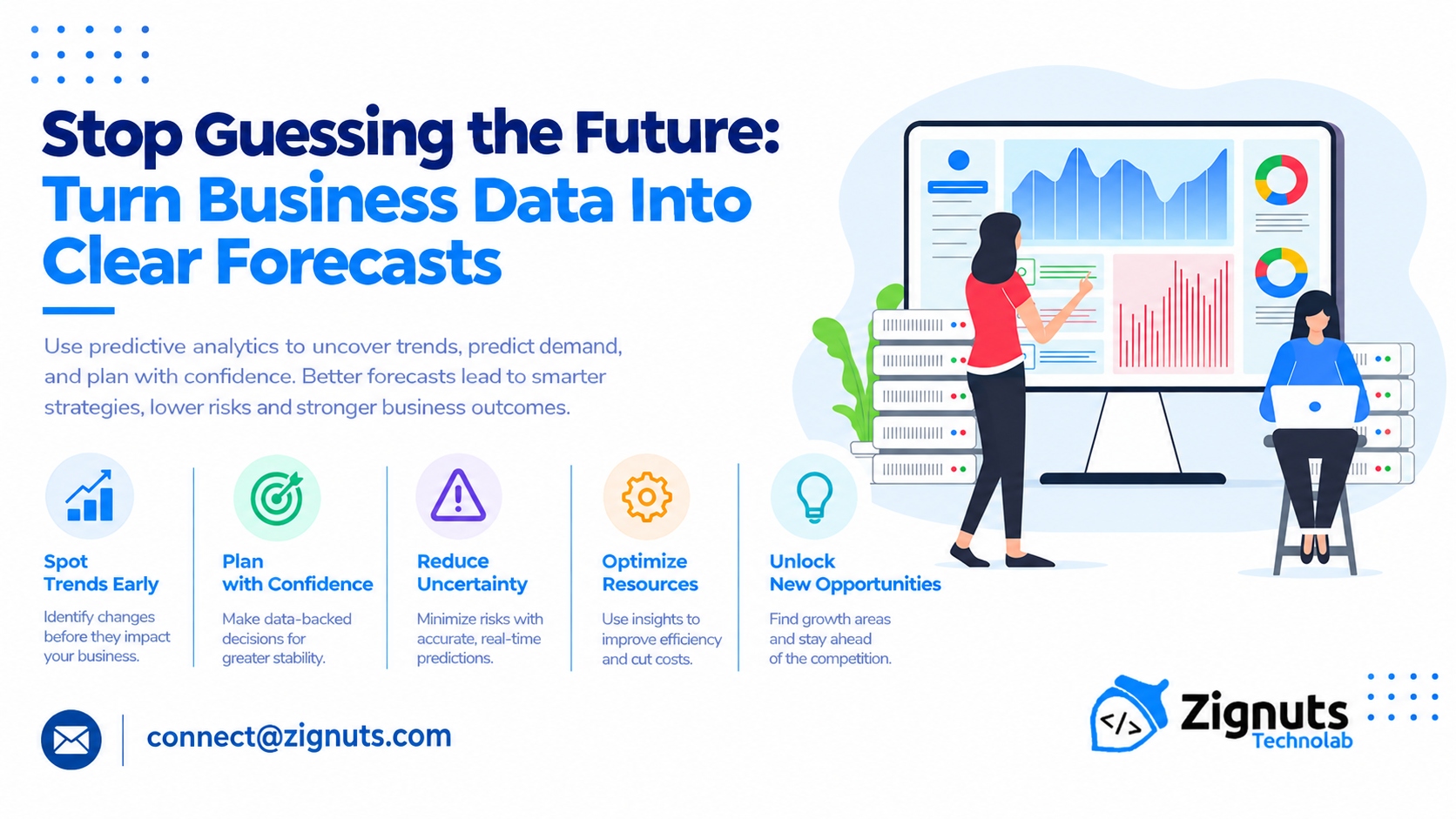
A forecast can influence hiring, inventory purchases, marketing budgets, production capacity, and investment decisions, yet many businesses still build forecasts around spreadsheets, historical averages, and individual judgment. Those methods can work when conditions are stable, but they become harder to rely on when customer behavior, demand, costs, and market conditions shift quickly. The real challenge is not predicting everything. It is making important decisions with a clearer view of what could happen next.
By 2027, businesses are expected to place greater emphasis on forward-looking decision support rather than relying exclusively on historical reporting. Business Forecasting Analytics can help organizations examine patterns across sales, customers, operations, finance, and other relevant data to develop more informed expectations about future outcomes. These forecasts are not guarantees. Their value comes from helping leaders understand potential scenarios early enough to adjust their plans.
For founders, C-Suite executives, and business owners, better forecasting can influence much more than a finance report. It can affect how much inventory a company holds, where sales teams focus, how resources are allocated, when new employees are hired, and which risks receive management attention. The objective is to turn business data into practical signals that improve decisions without creating a false sense of certainty.
2027 Insight | Business Impact | What Leaders Should Do |
|---|---|---|
Forecasting is expected to become more connected to operational decisions | Businesses can adjust resources earlier when conditions change | Integrate forecasts with planning and operational workflows |
More data sources may contribute to business forecasts | Forecasts can consider broader customer, sales, and operational signals | Establish reliable data pipelines and consistent data definitions |
Scenario-based forecasting is likely to become more valuable | Leaders can evaluate multiple possible outcomes instead of relying on one forecast | Build best-case, expected-case, and downside scenarios where useful |
Forecast governance will become increasingly important | Poor assumptions or unreliable data can lead to costly decisions | Document assumptions, monitor performance, and assign clear accountability |
Why Business Forecasting Needs to Evolve
A forecast is only useful if it helps a business make a better decision.
Consider a company planning its next quarter. Leadership needs to estimate revenue, staffing requirements, marketing investment, inventory, and operating expenses.
A simple historical average may provide a starting point, but it may overlook recent customer behavior or changes in the sales pipeline.
Modern forecasting approaches can combine historical information with additional signals to provide a more informed view.
Instead of asking only:
What happened last quarter?
What was our average monthly demand?
How much did customers purchase previously?
Leaders can also ask:
What is current demand indicating?
Which sales opportunities are most likely to convert?
Which customers may change their purchasing behavior?
What could happen if demand rises or falls?
Where should resources be allocated under different scenarios?
This moves forecasting from a static reporting exercise toward a decision-support capability.
What Business Forecasting Analytics Can Do
Business forecasting analytics combines historical data, statistical methods, predictive models, business assumptions, and relevant external or operational signals to estimate future outcomes.
The appropriate approach depends on the business problem.
A sales forecast may rely heavily on pipeline activity and historical conversion behavior. An inventory forecast may depend on product demand, seasonality, purchasing patterns, and supply constraints. A workforce forecast may consider workload, staffing levels, productivity, and expected demand.
The goal is not to use the most complicated model available.
The goal is to produce a forecast that is sufficiently reliable, understandable, timely, and useful for the decision being made.
The Business Value of Better Forecasting
More Confident Resource Planning
Businesses have limited resources.
Leaders need to decide where to allocate employees, capital, inventory, technology budgets, and management attention.
Better forecasts can help organizations prepare for likely changes instead of reacting after those changes become obvious.
Improved Revenue Planning
Revenue forecasting influences targets, hiring, marketing budgets, cash planning, and strategic investments.
A more structured forecasting process can help management identify where expectations are strong and where uncertainty is higher.
Better Inventory Decisions
For retailers, manufacturers, and e-commerce businesses, inventory decisions have direct financial consequences.
Holding too much stock can increase carrying costs, while holding too little can lead to missed sales.
Forecasting can provide additional evidence for purchasing and capacity decisions.
Earlier Risk Identification
Forecasting is not only about growth.
Businesses can also forecast potential downside scenarios, such as weaker demand, increased costs, customer attrition, or operational constraints.
This allows leadership teams to consider mitigation plans before a risk becomes a larger problem.
Major Business Use Cases
Sales and Revenue Forecasting
Sales leaders can use historical sales information, pipeline data, customer activity, and conversion patterns to develop more informed revenue expectations.
This can support:
Sales target planning
Territory allocation
Hiring decisions
Pipeline management
Revenue scenario planning
The forecast should complement the experience of sales leaders and account teams rather than remove human judgment.
Demand Forecasting
Retailers and manufacturers can use forecasting to estimate future demand and plan inventory, procurement, production, and staffing.
The value becomes particularly important when demand changes across products, locations, customer groups, or seasons.
Financial Forecasting
Finance teams can use forecasting to support revenue planning, expense management, cash planning, and scenario analysis.
Rather than producing one fixed number, finance leaders can evaluate several potential conditions and understand how each could affect the business.
Customer Forecasting
Businesses with recurring customer relationships can analyze purchasing and engagement patterns to identify potential changes in customer behavior.
This can support retention planning, account prioritization, and expansion opportunities.
Workforce Planning
A business expecting changes in workload may need to adjust staffing before demand materializes.
Forecasting can help leaders consider future capacity requirements and make more informed hiring, scheduling, or resource allocation decisions.
From Forecast to Business Action
A forecast should not remain inside an analytics dashboard.
Its value increases when it reaches the person responsible for making the relevant decision.
For example, if a forecast indicates that demand may increase for a particular product category, the procurement team may review purchasing plans.
If a revenue forecast indicates a potential shortfall, sales leadership may examine pipeline quality and marketing may reassess lead generation priorities.
This creates a direct connection between forecasting and action.
One Practical Forecasting Workflow
Business Objective → Historical & Current Data → Forecasting Analysis → Future Scenario → Management Decision → Business Outcome
This horizontal process keeps the focus on business value. Forecasting is the analytical step, but the final objective is a better decision and measurable business result.
How Leaders Should Interpret Forecasts
Forecasts should not be treated as guaranteed outcomes.
A responsible forecasting process should communicate uncertainty.
Executives should understand:
What data was used
Which assumptions were made
What period the forecast covers
How the forecast has performed historically
What factors could cause the forecast to change
Which scenarios represent upside or downside conditions
This is particularly important when forecasts influence major financial or operational commitments.
Executive Forecasting Checklist
Decision Area | Key Question | Business Consideration |
|---|---|---|
Data | Are the inputs reliable and relevant? | Validate historical coverage, quality, and consistency |
Forecast | What assumptions influence the result? | Document important drivers and uncertainty |
What could cause the forecast to change? | Evaluate upside, expected, and downside conditions | |
Action | What will management do with the forecast? | Connect forecasts to specific decisions and responsibilities |
Why Data Quality Matters
Forecasting cannot compensate for fundamental data problems.
If sales records are incomplete, customer information is inconsistent, or historical transactions are incorrectly categorized, the resulting analysis may be unreliable.
Businesses should evaluate:
Data completeness
Historical consistency
Duplicate records
Data definitions
System integration
Update frequency
Data ownership
Privacy and access controls
Data quality is especially important when information is pulled from multiple departments.
For example, finance, sales, and operations may each maintain different versions of revenue-related information. A forecasting system needs clear definitions before those sources can be combined effectively.
Technology and Integration Considerations
A forecasting solution may need to connect with existing CRM, ERP, finance, inventory, customer service, or operational systems.
Integration allows forecasts to use current information and makes results easier to incorporate into existing workflows.
However, integration introduces its own challenges.
Leaders should consider:
API availability
Data synchronization
System compatibility
Security controls
Access permissions
Ongoing maintenance
The best forecasting technology is not necessarily the platform with the most features. It is the one that fits the organization's data environment and decision processes.
Build Versus Buy
Businesses can choose between existing forecasting platforms, customized development, or a hybrid approach.
Buying may be suitable when the organization needs standard forecasting capabilities and wants to deploy quickly.
Custom development can be useful when forecasting depends on proprietary data, specialized business rules, unique workflows, or complex integrations.
A hybrid approach can combine an existing analytics platform with customized forecasting models where the business needs greater flexibility.
The decision should consider total lifecycle cost, implementation effort, scalability, security, internal expertise, and vendor dependency.
What Executives Should Ask Before Investing
What decision are we trying to improve?
Start with the business decision, not the technology.
What does success look like?
Define measurable outcomes before development or implementation.
What data will the forecast require?
Identify the relevant sources, quality gaps, ownership, and access requirements.
How frequently should the forecast update?
The right frequency depends on the decision. Some forecasts may need frequent updates, while others can be reviewed periodically.
How much uncertainty can the business tolerate?
A forecast should communicate its limitations and potential range of outcomes where appropriate.
Who owns the forecast?
Define responsibility for reviewing assumptions, interpreting results, and taking action.
How will performance be monitored?
Forecast accuracy and business conditions should be reviewed over time. A model or forecasting method that worked previously may need adjustment as conditions change.
Practical Implementation Plan
Step 1: Select a high-value forecasting problem
Choose one area where better forecasting could affect revenue, costs, customers, operations, or resource planning.
Step 2: Establish the current baseline
Document how forecasts are currently created and measure the existing process.
Step 3: Assess the data
Identify relevant data sources, quality issues, historical gaps, and integration requirements.
Step 4: Define forecasting objectives
Determine the forecast horizon, important variables, business assumptions, and success metrics.
Step 5: Build and validate the forecast
Test the approach against historical outcomes and review the results with business stakeholders.
Step 6: Introduce scenario planning
Where appropriate, evaluate different conditions rather than depending on one expected outcome.
Step 7: Connect forecasts to decisions
Make sure the right teams receive the information and understand what actions it should influence.
Step 8: Monitor and improve
Review forecasting performance and update the approach as business conditions and data change.
Risks and Challenges
Forecasting always involves uncertainty.
Historical patterns may not continue. New competitors, market changes, supply disruptions, economic conditions, product launches, or changes in customer behavior can affect future outcomes.
Other challenges include:
Poor-quality data
Inconsistent business assumptions
Forecast bias
Integration complexity
Lack of employee adoption
Excessive confidence in forecasts
Privacy and security concerns
Vendor dependency
One of the most dangerous mistakes is treating a forecast as a fact.
A forecast should guide planning while leaving room for management judgment and changing conditions.
Preparing for 2027
The role of forecasting is likely to become more closely connected with operational decision-making.
Instead of producing forecasts only for monthly or quarterly management reviews, businesses may increasingly use forward-looking signals within everyday planning processes.
That shift requires more than analytical technology.
Organizations will need reliable data, clear ownership, integrated systems, disciplined decision processes, and appropriate governance.
For executives, the priority should be to identify where better visibility into future conditions can produce meaningful business value.
Conclusion
Businesses cannot know the future with certainty, but they can improve how they prepare for it.
Business Forecasting Analytics provides a structured way to turn historical and current business information into forward-looking estimates. When connected to sales planning, inventory, finance, customer management, workforce decisions, or operations, forecasting can become a practical business capability rather than another reporting exercise.
The strongest approach is to start with a specific decision, establish a baseline, assess data quality, develop a focused forecast, evaluate multiple scenarios where useful, and connect the results to action.
Executives should also remember that a forecast is an informed estimate, not a promise. The real advantage comes from using forecasts to prepare earlier, allocate resources more intelligently, and respond when conditions begin to change.
FAQs
What is business forecasting analytics?
Business forecasting analytics uses historical and current business information to estimate potential future outcomes. It can support decisions involving revenue, demand, inventory, staffing, customers, finance, and operations.
How can forecasting help C-Suite executives?
It can provide a more structured view of potential future conditions, helping executives plan resources, evaluate scenarios, identify risks, and make decisions with greater visibility.
Is business forecasting the same as predictive analytics?
They overlap, but they are not always identical. Predictive analytics is a broader discipline that can estimate future outcomes, while business forecasting often focuses specifically on planning future business conditions such as revenue, demand, expenses, or capacity.
Can forecasting eliminate business uncertainty?
No. Forecasting can help quantify and manage uncertainty, but unexpected events and changing conditions can always affect outcomes.
What data is needed for business forecasting?
The requirements depend on the forecasting problem. Common sources include historical sales, customer activity, transactions, inventory records, operational data, financial information, and other relevant business signals.
Should businesses use one forecast or multiple scenarios?
For decisions with significant uncertainty, multiple scenarios can be useful. An expected case, upside case, and downside case can help leadership understand how different conditions could affect the business.
How should a business measure forecasting success?
Success should be measured against the purpose of the forecast. Organizations can evaluate forecast performance, planning efficiency, resource utilization, revenue visibility, inventory decisions, or other predefined business outcomes.
Comments
Log in or sign up to join the conversation.