
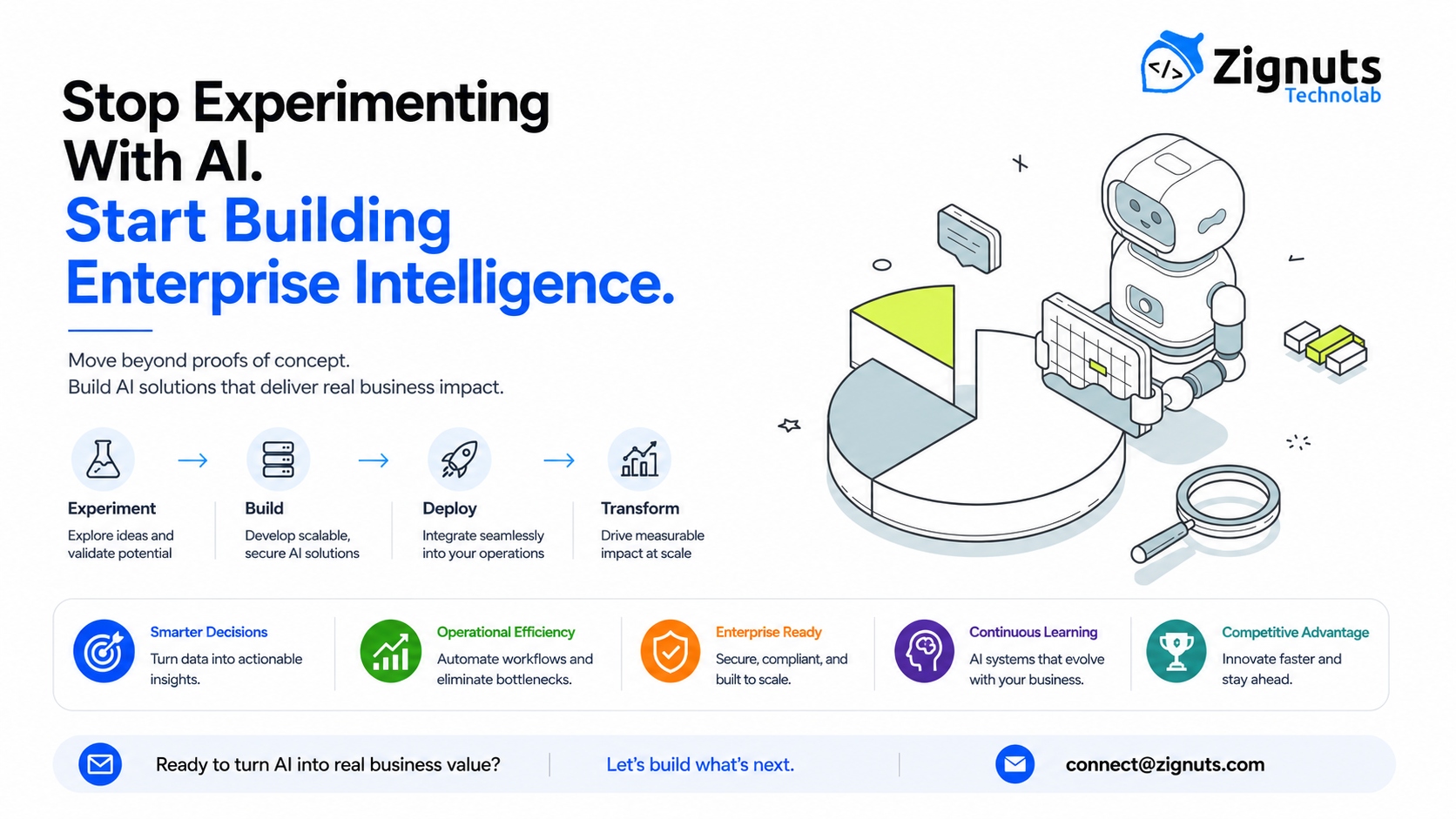
An AI pilot can impress a leadership team in a week and still create almost no lasting business value. The harder question is what happens after the demonstration: Can the capability work with existing systems, use trusted business data, support employees, follow governance rules, and produce measurable outcomes? Intelligent Automation Solutions become strategically important at this point because they connect AI capabilities with the operational processes where enterprises actually create value.
For leaders planning the next stage of digital investment, 2027 is likely to bring greater attention to how AI performs inside real business environments rather than how impressive an isolated prototype appears. The following insights are forward-looking expectations, not guaranteed predictions. The practical priority is to build an enterprise foundation that can turn successful AI experiments into repeatable, governed, measurable capabilities.
2027 Insight | Business Impact | What Leaders Should Do |
|---|---|---|
AI moves deeper into core workflows | Intelligence can influence everyday operations | Prioritize processes with measurable business value |
AI and automation increasingly converge | Businesses can combine reasoning with repeatable execution | Identify workflows where AI can complement existing automation |
Governance becomes part of AI infrastructure | Greater AI adoption increases operational and compliance requirements | Establish access, monitoring, approval, and accountability controls |
Enterprise AI investments face stronger ROI expectations | More projects will need clear financial and operational justification | Define baselines and measurable outcomes before scaling |
The Enterprise AI Problem Is No Longer Experimentation
Most organizations have already discovered that AI can generate content, summarize documents, answer questions, classify information, and assist employees.
That is no longer the difficult part.
The challenge is turning those capabilities into dependable business processes.
Consider a finance team that uses AI to analyze invoices. If employees still have to download documents, upload them into a separate tool, review the output, and manually update the accounting system, the organization has created an AI-assisted task, not an intelligent workflow.
The difference matters.
Enterprise intelligence begins when AI becomes part of the process rather than another destination employees have to visit.
From AI Experiments to Enterprise Intelligence
An experiment usually asks whether a technology can perform a particular task.
An enterprise system asks a different set of questions:
Does it solve a meaningful business problem?
Can it work with existing systems?
Is the required data available?
Can employees trust the output?
What happens when the system is uncertain?
Who remains accountable?
Can the capability scale?
How will the business measure its value?
These questions move the discussion from technical possibility to operational viability.
A successful AI strategy therefore requires more than model selection. It requires workflow design, integration, governance, data management, security, and organizational adoption.
What Enterprise Intelligence Actually Looks Like
The transition from experimentation to enterprise capability can be represented as a simple business flow:
Business Problem → Trusted Data → AI Intelligence → Workflow Action → Human Oversight → Measurable OutcomeThe important point is that AI sits inside a larger system.
The model is not the complete solution.
Data provides context. Integration connects applications. Workflow orchestration determines what happens next. Human oversight manages risk. Measurement establishes whether the investment produced meaningful results.
Why Intelligent Automation Is Different From Basic Automation
Traditional automation is excellent at predictable processes.
If an invoice arrives, the system can route it.
If a customer submits a form, the system can create a ticket.
If an approval is completed, the system can trigger the next step.
These rules remain useful.
But enterprise workflows frequently contain exceptions.
A customer request may not fit a predefined category. A supplier contract may contain unusual terms. A financial transaction may require investigation. A sales opportunity may depend on information spread across several systems.
AI can help interpret these situations.
That creates a powerful combination:
Traditional automation handles predictable execution.
AI supports interpretation, context, recommendations, and exception handling.
Humans remain involved where judgment or accountability matters.
Business Use Cases That Go Beyond AI Pilots
Customer Service
Customer service is often treated as a chatbot opportunity.
The bigger opportunity is the complete service workflow.
AI can help classify incoming cases, retrieve customer history, summarize conversations, search approved knowledge sources, recommend responses, and route complex issues.
When integrated with CRM and support systems, employees can receive relevant context without manually searching multiple applications.
The outcome is not simply faster responses. The objective is a smoother resolution process.
Finance and Accounting
Finance teams can use AI to support invoice processing, reconciliation, document analysis, exception detection, reporting, and information retrieval.
Suppose an invoice does not match a purchase order.
Instead of simply flagging the mismatch, an AI-enabled workflow could gather relevant records, identify the likely cause, summarize the discrepancy, and send the case to the appropriate finance employee.
The employee still makes the decision where required, but the investigation becomes more efficient.
Sales Operations
Sales teams spend significant time preparing information.
AI can assist with account research, customer summaries, meeting preparation, follow-up content, opportunity analysis, and CRM administration.
The value becomes stronger when these capabilities are connected directly to the sales workflow.
Instead of generating information in isolation, AI can help employees act on that information.
Operations and Supply Chain
Operational teams frequently deal with large volumes of information.
AI can help identify unusual conditions, summarize operational changes, prioritize exceptions, and support planning.
For example, an operations manager may not need to review every event in a system. They may need to know which issues could affect delivery, production, inventory, or customer commitments.
AI can help bring those issues to the surface.
Professional Services
Professional services firms can use AI to support research, document analysis, knowledge retrieval, proposal preparation, project administration, and internal knowledge management.
The advantage is particularly relevant when experienced employees spend significant time searching for information that already exists somewhere inside the organization.
Where the Business Value Comes From
Enterprise intelligence should ultimately connect to measurable business outcomes.
Productivity
Employees spend less time performing repetitive information-processing tasks.
Cost Efficiency
Organizations can reduce unnecessary manual effort and improve how skilled employees allocate their time.
Faster Decisions
Relevant information can reach decision-makers sooner.
Better Customer Experience
Employees can respond with greater context and consistency.
Scalability
Businesses can potentially process higher volumes without increasing manual effort at the same rate.
Risk Reduction
AI can assist with monitoring, anomaly identification, document review, and policy-driven workflows.
The important principle is measurement.
Leaders should not assume that AI automatically produces financial value. They should establish a baseline and determine whether the changed process actually improves performance.
Executive Decision Framework
Before moving from experimentation to enterprise deployment, leadership teams need a structured way to evaluate the opportunity.
Decision Area | Key Question | Business Consideration |
|---|---|---|
Business value | Which measurable problem are we solving? | Select a workflow with visible operational or financial impact |
Data | Does AI have reliable context? | Assess quality, ownership, accessibility, and permissions |
Integration | Which systems need to connect? | Review APIs, legacy dependencies, and data flows |
Governance | What can AI access or execute? | Match autonomy and permissions to business risk |
ROI | How will success be measured? | Establish baseline metrics, targets, and ownership |
The Hidden Importance of Data
AI initiatives often expose problems that already exist within enterprise data.
Customer information may be duplicated.
Product records may differ across systems.
Documents may have multiple versions.
Business definitions may vary between departments.
An AI system can process information quickly, but it cannot automatically make unreliable enterprise data trustworthy.
Before scaling an AI workflow, businesses should identify:
Sources of truth
Data owners
Access requirements
Data quality standards
Update frequency
Sensitive information
Retention requirements
The goal is not to make every piece of enterprise data available to AI.
It is to provide the right information for the right workflow under the right controls.
Integration Is the Bridge to Enterprise Adoption
An AI capability becomes much more useful when it can work with the applications employees already depend on.
That could include CRM platforms, ERP systems, support software, databases, document repositories, analytics tools, internal applications, and collaboration platforms.
Replacing everything is rarely necessary.
In many cases, the better strategy is to build controlled connections around existing technology.
This approach can reduce disruption while allowing organizations to introduce intelligence into familiar processes.
Security and Governance Cannot Come Later
The risks change when AI moves from a prototype to a production system.
A prototype may process limited test information.
An enterprise AI workflow could potentially access customer records, contracts, financial information, employee data, or operational systems.
Organizations therefore need appropriate controls for:
Authentication
Authorization
Least-privilege access
Data protection
API security
Audit logging
Monitoring
Human approval
Incident response
AI should never receive access simply because a connection is technically possible.
Access should correspond to the business task and its associated risk.
Human Oversight Is a Feature, Not a Failure
There is a tendency to measure AI maturity by how much human involvement has been removed.
That can be misleading.
For many enterprise processes, the right objective is not eliminating people. It is giving people better information and reducing unnecessary manual work.
A useful autonomy model is:
Retrieve information
Analyze information
Recommend an action
Prepare the action
Request approval
Execute within defined limits
A low-risk workflow may eventually support more autonomous execution.
A high-impact financial, legal, healthcare, or security decision may require stronger human involvement.
The appropriate level of autonomy should be determined by risk, not enthusiasm.
Build, Buy, or Combine?
Organizations do not have to build every AI capability themselves.
Packaged solutions may work well for standardized business processes.
Custom development can be appropriate where workflows are proprietary or integration requirements are complex.
A hybrid approach can combine established AI infrastructure with custom business logic and enterprise integration.
Executives should evaluate:
Total cost of ownership
Implementation speed
Security
Flexibility
Scalability
Integration requirements
Maintenance
Vendor dependency
Internal technical capability
The cheapest initial option is not always the lowest-cost long-term option.
A Practical Path From Experiment to Scale
Step 1: Choose a Business Problem
Start with measurable friction, not a preferred AI technology.
Step 2: Establish a Baseline
Measure current costs, processing time, employee effort, quality, or another relevant business metric.
Step 3: Map the Workflow
Identify people, systems, data, decisions, approvals, and manual handoffs.
Step 4: Define the AI Role
Determine whether AI should retrieve, classify, analyze, recommend, generate, or execute.
Step 5: Establish Boundaries
Define what information AI can access and which actions require human approval.
Step 6: Integrate the Required Systems
Connect only the applications and data sources necessary for the selected workflow.
Step 7: Test With Realistic Scenarios
Test normal cases, exceptions, incomplete information, conflicting data, and failure conditions.
Step 8: Measure Results
Compare performance against the original baseline.
Step 9: Scale What Works
Once value, reliability, security, and governance are demonstrated, apply proven patterns to additional workflows.
Common Reasons Enterprise AI Projects Stall
The Business Problem Was Never Clearly Defined
A project can continue indefinitely when success is described only as "using AI."
The Workflow Was Not Redesigned
Adding AI to an inefficient process may simply make an inefficient process faster.
Data Was Treated as an Afterthought
Unreliable information can undermine the quality of AI-supported decisions.
Integration Was Underestimated
Connecting enterprise applications can require significant architectural and security planning.
Employees Were Not Included
People need to understand how AI changes their responsibilities and where they remain accountable.
Success Was Measured Poorly
Usage metrics can show adoption, but they do not necessarily demonstrate business value.
The real question is whether the business performs better.
What Leaders Should Prepare for Next
The next stage of enterprise AI is likely to involve more connected workflows rather than simply more AI applications.
Organizations should consider building reusable capabilities around:
Secure data access
API integration
Workflow orchestration
Identity management
AI evaluation
Monitoring
Governance
Human approval
This creates an operating foundation that future AI initiatives can use.
Instead of treating every project as a separate experiment, the organization can gradually develop a repeatable approach to deploying intelligence.
Questions for the C-Suite
Before approving the next major AI initiative, leaders should ask:
What business problem are we solving?
Why is AI necessary for this problem?
What is the current baseline?
Which systems and data are required?
Who owns the process?
What can AI access?
What can AI change?
Where does human oversight remain?
What happens when AI is wrong?
How will ROI be measured?
What will ongoing maintenance cost?
Can the solution scale to other workflows?
These questions help separate strategic AI investment from technology experimentation.
Conclusion
Enterprise AI becomes valuable when it stops being a demonstration and starts becoming part of how the organization operates.
The difference is not simply a better model.
It is the combination of reliable data, connected systems, thoughtful workflow design, security, governance, human oversight, and measurable business objectives.
Intelligent Automation Solutions can help organizations make that transition by combining AI's ability to interpret information with automation's ability to execute repeatable processes.
For business leaders, the smartest next step is not to launch another broad AI experiment.
Choose one workflow that matters.
Measure the current problem.
Identify where intelligence can improve it.
Integrate only what is necessary.
Define clear boundaries.
Measure the outcome.
Then scale the approach.
That is how enterprises move from experimenting with AI to building intelligence into the business itself.
FAQs
1. What does enterprise intelligence mean?
Enterprise intelligence refers to embedding AI capabilities into business processes, data environments, applications, and decision-making workflows so that intelligence contributes directly to operational outcomes.
2. How are Intelligent Automation Solutions different from traditional automation?
Traditional automation generally follows predefined rules. Intelligent automation can combine those rules with AI capabilities such as language understanding, document interpretation, classification, analysis, recommendations, and contextual decision support.
3. Which business processes are best suited for intelligent automation?
Processes involving repetitive information work, multiple systems, document-heavy tasks, customer interactions, frequent decisions, or operational exceptions can be strong candidates.
4. Does enterprise AI require replacing existing systems?
No. Many organizations can integrate AI with existing CRM, ERP, finance, support, analytics, and operational platforms. Replacement should be considered only when current technology creates a material limitation.
5. How should executives measure AI ROI?
Start with a baseline. Depending on the workflow, measure processing time, operating cost, employee effort, error rates, customer experience, capacity, revenue contribution, or risk-related metrics.
6. Should AI be allowed to make decisions independently?
It depends on the decision's risk. Low-risk processes may support greater autonomy, while high-impact decisions should have appropriate human validation, approval, and escalation mechanisms.
7. What is the biggest mistake companies make with enterprise AI?
Starting with the technology instead of the business problem. A strong AI strategy begins by identifying measurable operational friction and then determining whether AI is actually the appropriate solution.
Comments
Log in or sign up to join the conversation.