


Summary Of the Markets Today:
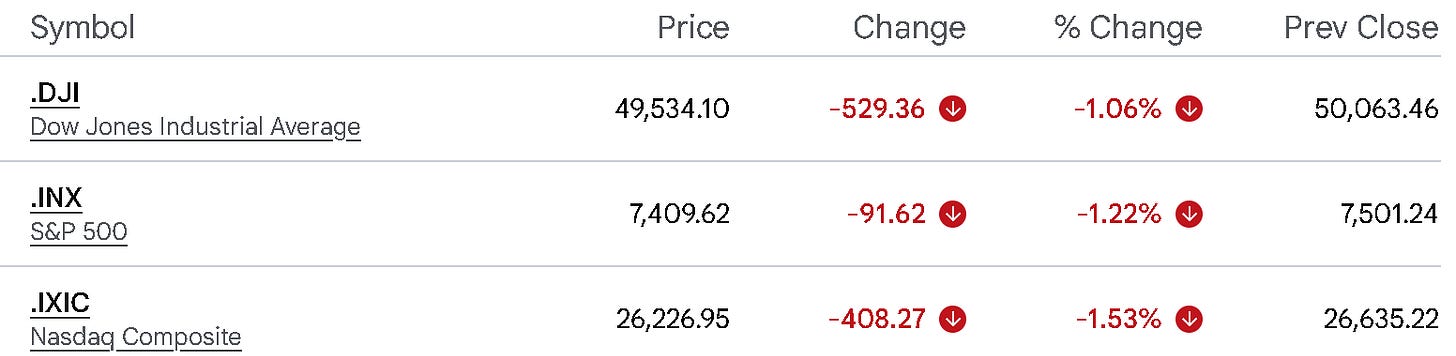
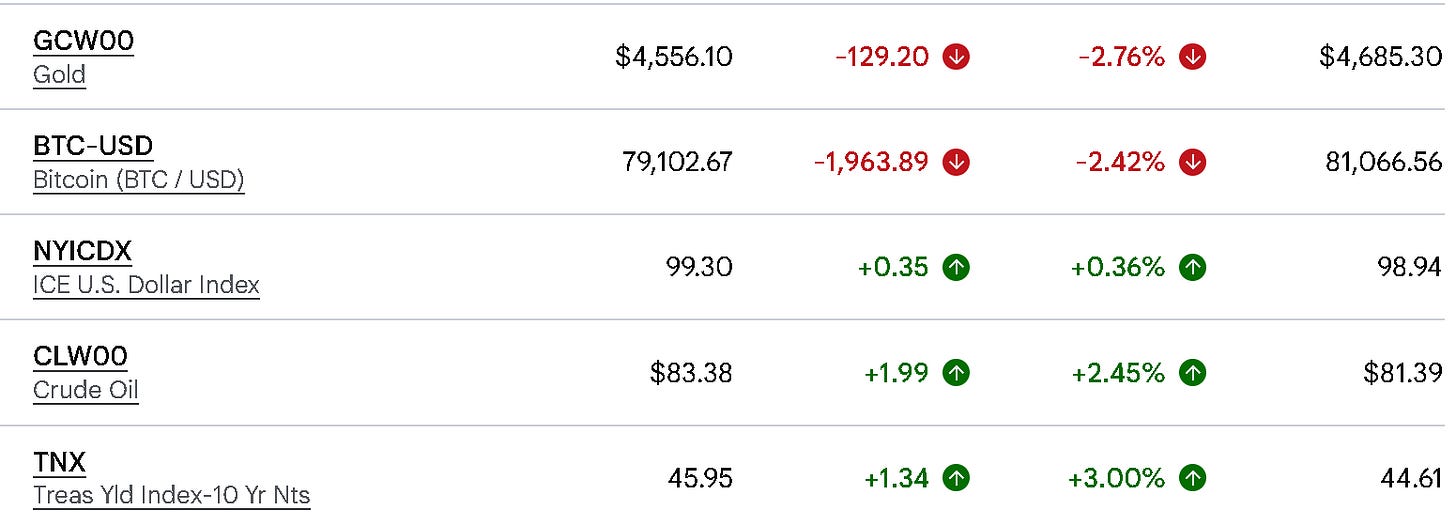
Image Source: Google Finance
*Stock data, cryptocurrency, and commodity prices at the market closing
Today’s Highlights – Market Summary
Today’s indexes closed notably lower after an early decline, then spent the remainder of the session moving sideways in a controlled, range-bound pattern. That action suggests the market successfully absorbed the selling pressure and settled into a more balanced, wait-and-see posture into the close.
All three major indexes opened with a sharp gap lower, extending the recent pattern of alternating gains and pullbacks. Rather than signaling instability, this type of back-and-forth action often reflects a dynamic market environment where both buyers and sellers remain actively engaged, helping establish clearer price discovery. The Dow and S&P 500 declined more than 1%, with the Dow initially opening only modestly lower before accelerating to the downside on elevated volume, reinforcing the conviction behind the early move. The Nasdaq led the early weakness, opening more than 1.5% below the prior close. While the anticipated dip-buying phase was brief, the subsequent price action remained relatively controlled. The S&P 500 paused before easing lower, while the Dow trended in an orderly fashion. Meanwhile, the Nasdaq developed a defined 150-point trading range, with the 26,400 level acting as a clear resistance marker and offering traders a well-defined structure to monitor.
By mid-afternoon, the market transitioned into a broad sideways consolidation phase characterized by constructive horizontal movement. Periodic bursts of selling were met with steady buying interest. Thus showing underlying demand remained present. Notably, both the Nasdaq and S&P 500 began forming higher lows during this period. This signaled a subtle improvement in intraday support despite remaining below this session's resistance. Into the final hour, the indexes softened and drifted toward session lows, interrupting the earlier pattern of rising lows.
The session’s movement can be viewed as a constructive recalibration, driven by a mix of macro and sector-specific influences. This included profit-taking after recent strength, interest-rate sensitivity, and positioning ahead of upcoming economic data. Early pressure appeared concentrated in growth and technology, where the higher-beta names responded to rate concerns. This showed relative stability, helping to moderate broader downside momentum. Financials also displayed mixed performance as yields fluctuated, while energy stocks provided intermittent support tied to commodity price resilience. Volume patterns reinforced the idea of active but orderly participation, with strong early turnover reflecting institutional repositioning rather than panic selling. This was followed by more measured activity that allowed price levels to stabilize.
Individual Movers
The stocks showing the most notable price action today were concentrated in Nvidia (NVDA), Advanced Micro Devices (AMD), and Applied Materials (AMAT). Those were the biggest swings tied around interest rates, inflation, and policy headlines that can rapidly reprice growth-oriented names. Apple (AAPL) and Microsoft (MSFT) also saw notable intraday pressure. These large-cap technology stocks remained sensitive to valuation changes when yields or risk appetite shifted. Notably, Intel (INTC) and Broadcom (AVGO) helped reinforce the broader semiconductor-sector response.
Technical Signals
Today’s most important technical influence was a constructive range-building session: the major indexes gapped lower, then spent much of the day stabilizing, with the Nasdaq and S&P 500 carving out higher lows before the final hour softened the tone. That kind of action signals the market is working through overhead supply in an orderly way rather than breaking down, which creates a constructive setup for a potential rebound. Volume is supporting this interpretation, with heavy participation early and solid turnover through the afternoon. Thus showing an active two-way trading and steady dip-buying rather than capitulation. As for RSI, the available evidence points to momentum that was cooling but not broken. However, the S&P 500 is moving closer to levels that have historically aligned with short-term recovery opportunities. Candles, Bollinger Bands, and the VIX were less critical to today’s read, as the clearest signal came from price structure holding firm and volume confirming active engagement.
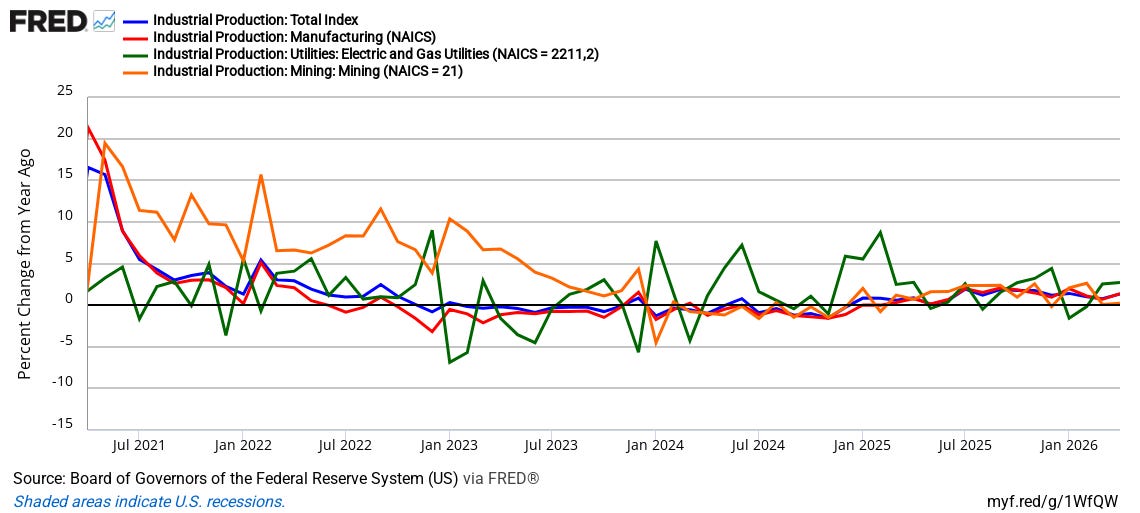
Industrial Production (IP) in April 2026 was up 1.4% year-over-year (YoY). Capacity utilization moved up to 76.1 percent, a rate that is 3.3 percentage points below its long-run (1972–2025) average. IP component manufacturing was up 1.4% YoY, component mining was up 0.2% YoY, and component utilities were up 2.7% YoY. There is little evidence in this data of an improvement in manufacturing.
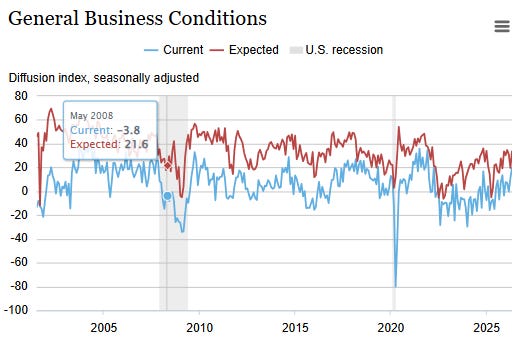
The New York Fed Manufacturing Survey strengthened sharply in May 2026, with the general business conditions index rising nine points to 19.6, its highest level since April 2022. New orders also improved, climbing three points to 22.7, their strongest reading in more than four years. Shipments were little changed at 18.9, indicating another solid increase, while unfilled orders rose for a fourth straight month. Delivery times lengthened significantly, with the index up eight points to 20.4, and the supply availability index stayed negative at -10.7, showing worsening supply conditions; inventories, meanwhile, increased modestly. Still, we have seen little evidence of improving manufacturing in the hard data.
Financial News:
Today’s coverage is dominated by the conclusion of the Trump-Xi summit in Beijing, the persistent U.S.-Iran stalemate over the Strait of Hormuz, and resulting energy market volatility. Trump wrapped up two days of talks with Xi, describing them as “very successful” and inviting Xi to the White House in September. Discussions covered trade deals, tariffs, Taiwan (where Xi issued warnings), AI/tech, and pressing China to help resolve the Iran conflict. No major breakthroughs were announced, but both sides emphasized stability.
WSJ reported on the U.S.-Iran “neither peace nor war” deadlock hanging over the summit, April inflation rising to 3.8% driven by gas prices, eBay (EBAY) rejecting GameStop's (GME) takeover bid, and an insider-trading scandal at M&A law firms. CNBC highlighted market reactions (Dow retaking 50,000 territory amid mixed sentiment), summit takeaways, Trump ousting the FDA commissioner, and stories like hantavirus boosting pharma stocks and Cisco's (CSCO) rally.
ZeroHedge leaned into geopolitical risks, shadow wars involving Iran proxies, market fragility concerns, and conspiracy-tinged angles. OilPrice focused on surging oil (Brent heading for weekly gains as buffers dwindle), tankers going dark in Hormuz, coal demand spike, China/India energy pain, Modi urging fuel conservation, and India raising fuel prices. The Economic Times covered Indian markets under pressure from oil shocks and rupee weakness, PM Modi’s austerity push (fuel saving, gold curbs), private capex growth, and domestic corporate/health stories.
Overall, outlets reflect cautious markets balancing diplomatic progress in China against unresolved energy disruptions and inflation risks, with India particularly exposed to the oil shock.


Comments
Log in or sign up to join the conversation.