

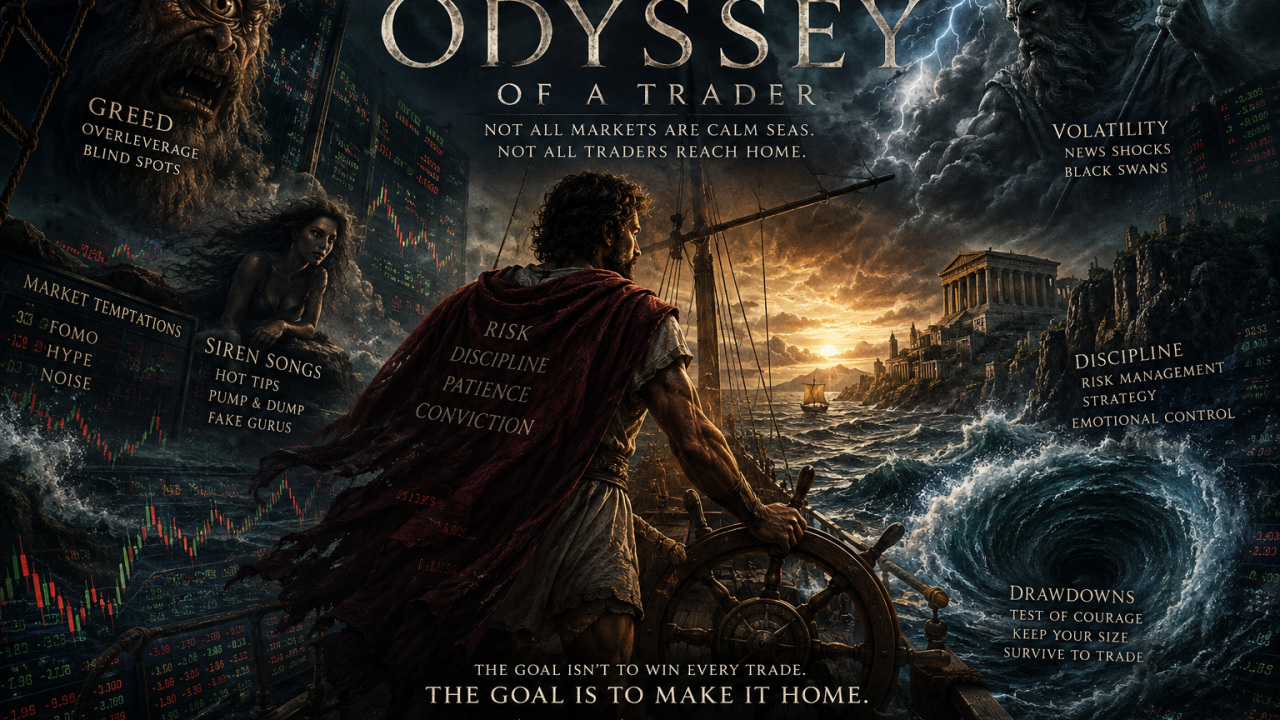
There's a reason the story of Odysseus has survived three thousand years, and it isn't nostalgia. It's structure. Strip away the gods, the monsters, and the twenty-year runtime, and you're left with the oldest trading journal ever written: a man tries to get from Point A to Point B, the market (the sea) refuses to cooperate, and every chapter is a lesson in risk he has to learn the hard way. As "The Odyssey" heads to theaters and reignites the conversation about this myth, I can't stop seeing my trading desk in every scene.
Let me walk you through it.
The Open Sea Is the Open Market
Odysseus starts his journey with a plan: sail home, in a straight line, as fast as possible. Any trader who has opened a position with total conviction knows that feeling. The chart looks clean. The setup looks obvious. You can already see the exit.
Then the wind changes.
The market, like the sea, does not care about your plan. It does not care that you did your due diligence, built your thesis, and sized your position "responsibly." The sea moves because of forces bigger than any one sailor, and the market moves because of forces bigger than any one trader — macro data, central bank decisions, geopolitical shocks, liquidity shifts, a single tweet. You are not sailing a straight line home. You are sailing into weather you cannot forecast, using tools that only ever give you probabilities, never certainties.
This is the first lesson the Odyssey teaches every trader: the map is not the territory, and the plan is not the outcome. Respect the sea. Respect the market. Neither one is impressed by your confidence.
The Sirens Are Every Signal Screaming "Buy Now"
The most famous scene in the whole epic is also the most relevant one for anyone who has ever opened a trading app during a meme-stock rally.
The Sirens don't lie, exactly. Their song is genuinely irresistible — it promises knowledge, pleasure, certainty, everything the listener wants to hear. Odysseus knows that hearing it will destroy him, but he also knows that avoiding it entirely means missing something extraordinary. So he doesn't plug his ears like his crew. He listens — but he ties himself to the mast first.
That's the entire psychology of speculative frenzy in one image.
Every trader has heard the modern Siren song: the forum thread insisting a stock is "going to the moon," the influencer calling the top of a rally "just the beginning," the chart pattern that looks exactly like the one that made someone else rich last year. It's not that the excitement is fake. It's that acting on it without restraint is what wrecks portfolios. The traders who survive aren't the ones who never feel the pull of FOMO. They're the ones who built their mast — their stop-losses, their position-sizing rules, their pre-committed exit plans — before they ever heard the song.
You don't outsmart the Sirens with willpower in the moment. You outsmart them with structure built in advance. Discipline isn't a feeling you summon at 2pm when the stock is up 40% intraday. It's a rope you tied to yourself that morning, before you ever opened the terminal.
Scylla and Charybdis: The Impossible Choice Every Portfolio Faces
Later in the voyage, Odysseus has to navigate a strait guarded by two monsters: Scylla, a six-headed creature that will pick off a few sailors if he sails too close to her side, and Charybdis, a whirlpool that will swallow the entire ship if he drifts too close to hers.
There is no version of this passage where nothing is lost. The only real decision is choosing the smaller, more survivable danger over the catastrophic one.
Every trader eventually finds themselves in this exact strait. On one side is Scylla: overleveraging, oversizing, chasing conviction trades with position sizes that turn a normal drawdown into a career-ending one. On the other side is Charybdis: sitting entirely in cash, refusing to take any risk at all, "protecting" capital so thoroughly that you're guaranteed to be worn down slowly by inflation and opportunity cost instead of quickly by a bad trade.
Neither extreme is safety. Real trading skill isn't found in avoiding risk altogether or in betting the whole ship on a single current. It's found in the narrow, disciplined channel between the two — accepting small, controlled losses (a few sailors) so you never risk the kind of catastrophic loss that takes the entire fleet down (the whole ship, gone).
If your risk management strategy doesn't acknowledge that some losses are the acceptable cost of staying in the game, you haven't built a strategy. You've built a fantasy that will eventually meet Charybdis.
Circe, Calypso, and the Trades That Keep You From Going Home
Odysseus doesn't lose all that time at sea purely to storms and monsters. He loses years of it on islands — with Circe, with Calypso — comfortable, seductive detours that feel, in the moment, like they might be permanent homes.
Every trader has a Circe's island. It's the position you should have closed weeks ago but haven't, because it's become comfortable, because closing it means admitting the thesis changed, because "it'll come back." It's the strategy that worked beautifully for six months and that you keep running on autopilot even after market conditions have shifted underneath it. It's the sector you fell in love with during one incredible year and now can't emotionally let go of, regardless of what the current data says.
These aren't the dramatic risks. Nobody blows up an account on a Circe's island. They just quietly stop moving forward. Capital sits. Opportunity cost accumulates. Years pass on a position that, in hindsight, was never going to take you home.
The hardest skill in trading isn't identifying a good position. It's recognizing when a position — or a whole strategy — has become an island you're staying on out of comfort rather than conviction, and having the discipline to get back in the boat.
The Cyclops: When Overconfidence Blinds the Trade
Before any of the famous trials, Odysseus makes his first real mistake in the cave of Polyphemus, the Cyclops. His crew wants to grab supplies and leave. Odysseus, curious and confident, insists on waiting to meet the giant, certain he can charm or outwit whatever he finds. The result is several of his men eaten before he manages to escape — and even then, sailing away, he can't resist shouting his real name back at the wounded Cyclops, purely to make sure credit for the victory is attached to him personally.
That last detail is the real lesson. The escape itself was smart — blinding the giant, hiding under the sheep, getting the crew out. The unnecessary risk came after, when ego demanded recognition. Polyphemus curses him by name, and that curse is what turns a rough voyage into a ten-year ordeal.
Traders do this constantly. A good trade gets closed at a good profit — and then, instead of moving on, the position gets reopened slightly larger "to prove the read was right," or the win gets broadcast so loudly that the next setup is forced to fit the narrative of being right again. The market doesn't care about your win streak or your reputation. Announcing your certainty to the world, or trading to protect an ego rather than a thesis, is exactly the kind of unnecessary risk that turns one bad Tuesday into a multi-year drawdown. Win the trade. Don't shout your name back at the Cyclops.
The Bag of Winds: Sabotage from Your Own Crew
One of the more overlooked moments in the story happens right as Odysseus is nearly home. Aeolus, god of the winds, gives him a bag containing every unfavorable wind, sealed shut, so that only the gentle breeze needed to sail home is left free. Ithaca is in sight. And then, while Odysseus finally sleeps after staying awake the entire voyage to guard the bag himself, his own crew opens it — convinced it's hidden treasure being kept from them — and the storm inside blows them straight back out to sea.
This is the risk that has nothing to do with the market at all: the risk of an unmanaged process, an unclear plan, or a team (even a "team" of one, made up of your own competing impulses) that doesn't understand why the discipline exists. Odysseus never explained the bag to his crew. He just guarded it. The moment he stopped watching, the lack of shared understanding destroyed months of progress in a single night.
Every trader has a version of this. A trading rule that exists in your head but isn't written down, so in a moment of exhaustion or distraction, "future you" breaks a rule "past you" would never have allowed. A well-defined strategy that gets ignored the one time you're tired, distracted, or letting someone else make the call. Being close to a goal is exactly when vigilance matters most — not because the sea is more dangerous near Ithaca, but because complacency is. Document the plan. Guard the bag. Don't assume proximity to the goal means the risk is over.
Ithaca Isn't a Single Trade — It's the Return
Here's the part of the story that gets flattened in most retellings, but it's the most important part for anyone thinking about markets: Ithaca isn't a prize Odysseus wins in one dramatic moment. It's not a single decisive battle that ends the journey. It's the sum of every storm survived, every temptation resisted, every strait navigated without losing the whole ship.
Trading success works exactly the same way, and almost nobody wants to hear it. There is no single trade that "makes" a career. There's no one setup so good it replaces years of disciplined execution. The traders who actually get home — who build real, compounding wealth — aren't the ones who caught one legendary trade and told the story for the rest of their lives. They're the ones who kept sailing, season after season, taking manageable losses, protecting the ship, refusing to be shipwrecked by a single Siren song or a single overleveraged bet.
Compounding is unglamorous. It doesn't make for a great toast at dinner. But it's the only version of "getting home" that actually exists in markets. Ithaca is not the destination of a lucky voyage. It's the destination of a well-sailed one.
Penelope's Patience Is Risk Management, Too
It's worth remembering that Odysseus isn't the only one navigating uncertainty in this story. Back home, Penelope spends years managing an impossible situation of her own — surrounded by pressure to act rashly, to assume the worst, to abandon her position and commit to something new simply because waiting feels unbearable.
She doesn't. She holds her ground, buys time, and refuses to be pressured into a decision she isn't ready to make just because the noise around her demands certainty right now.
If that isn't the most accurate description of holding a well-researched long-term position through a volatile, noisy market, I don't know what is. Sometimes risk management doesn't look like action. It looks like patience under pressure, holding your thesis while the crowd insists you're wrong to wait.
The Takeaway
"The Odyssey" endures because it isn't really about monsters and gods. It's about the gap between the plan and the outcome, and what it takes to survive that gap without losing yourself. That's the market, every single day.
You will hear Sirens. Tie yourself to a mast before you do.
You will face a Scylla and a Charybdis in every position you size. Choose the survivable danger.
You will find your own Circe's island — a comfortable trade you've outgrown. Get back in the boat.
And Ithaca, when it finally comes, won't feel like a single triumphant moment. It'll feel like one more voyage, safely completed, on the way to the next one.
Stay bound to your discipline. Let the Sirens sing to someone else's portfolio.
Comments
Log in or sign up to join the conversation.