

There's a reason to be bullish in the market but I think the risk from a Hong Kong standoff is underappreciated near term. Tanks quietly rolled into Hong Kong this morning. If China uses force it's fair to think a trade deal is pushed off indefinitely. That should negatively impact stocks, specifically tech stocks.
Hong Kong Stand-Off This Weekend
Many of the Hong Kong protests had been sanctioned. But this Saturday's planned protest was banned by the police. If protesters proceed I fear there can be a backlash in the way of force.
As China quietly rolls in troops, an unsanctioned protest bears global risk.
President Trump Warned About Use Of Force
This is what President Trump said recently about potential use of force by China:
"There’d be tremendous political sentiment not to do something. It does put pressure on the trade deal. If they do something negative, it puts pressure."
"Something negative" means using force and putting citizens' lives at risk. "Not to do something" means not to go ahead with this drag-out trade deal.
Tanks moving in this morning appear to be a clear statement from China that would pressure the president's concerns.
If force is used I don't see how trade talks can continue.
Near-Term Consequences
This is an investment forum, not a political or human rights forum, so I'm sticking to the topics that affect stocks and the stock market.
The stock market has been anticipating or hoping for a trade deal. The global economy has slowed due in part to a dragged-out trade war.
Tariffs raise prices and slow demand. Many companies have been moving out of China to avoid tariffs, which raises short-term costs and dislocations.
China's GDP growth has slowed along with global growth rates.
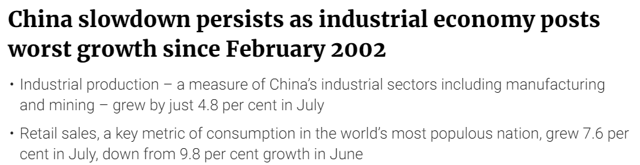
China is a key driver to global growth. So the weakness in China is having reverberations to the global economy.
One of the problems with the yield curve inverting is the fear of a global slowdown and the risk of a recession that's been well reported.
Ultimately a slowdown would hit earnings which can hit stocks.
While President Trump obviously wants a trade win to help his chances to get reelected in 2020, a Hong Kong standoff could tie his hands not to deal.
As seen in his quote above he knows he'd have political pressure not to deal if there were use of force by the military against Hong Kong citizens.
Stock Market Consequences
This situation, if it worsened I believe is not priced in to stocks. Recent stock market moves have been up and down based on the US and China imposing or threatening tariffs. The tit-for-tat back and forth has pulled markets up and down.
But almost none of the back and forth market moves have been about the US hands forced not to deal at all.
Hong Kong offers that new option that the US may be forced not to deal.
Many thought that in the end, President Trump will take any deal just to help his reelection hopes. If that move is off the table, that base of investors would need to adjust. That's a major change coming for markets if so.
Tech Stock Consequences
We focus on tech stocks. Tech stocks have huge exposure in China both on the revenue side and supply side.
Tech stock fundamentals appear to be improving.
But if China used force I would think President Trump would have a difficult time backing out of the current tariffs or moving forward with a deal. That would leave many tech companies with revenue risk in China.
China also has expressed their hope that the US stays out of China politics, but I don't expect it. If China feels that the US doesn't stay out of China's politics, China could further back out of any trade deal or hurt US companies currently positioned in China.
There are many potential outcomes, but a use of force is a near-term risk that I don't think is priced into markets.
Conclusion
Having the two largest economies in the world potentially forced not to deal would be something new and could hit markets. It sounds like there's a Hong Kong standoff coming this weekend. If so it has the risk to be a meaningful negative catalyst for markets.

Comments
Log in or sign up to join the conversation.