

While primary cycles do not change often, I like to start the week with a clear understanding of what type of market we are dealing with. For me, a quick glance at the color of the cycle board and the weekly/monthly S&P graphs below tells you everything you need to know about the "state" of the key market cycles.
Current Take
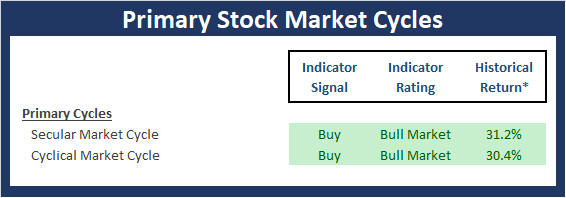
Once again, there are no obvious changes to report on the Primary Cycle board this week. However, in looking closely at the models, it is interesting to note that our Leading Indicators model, which had upticked last week, is starting to wobble again.
But with the board sporting a healthy shade of green at the present time, it is probably best to stay seated on the bull train. Yes, there are many reasons to be concerned about the current state of the market. Yet, the model readings suggest that investors are looking forward to better days. As such, this remains a bull market until proven otherwise.

* Source: Ned Davis Research (NDR) as of the date of publication.
* Source: Ned Davis Research (NDR) as of the date of publication.
The Secular Market Cycle
A secular bull market is defined as a period in which stock prices rise at an above-average rate for an extended period (think five years or longer), and suffer only relatively short intervening declines. A secular bear market is an extended period of flat or declining stock prices.
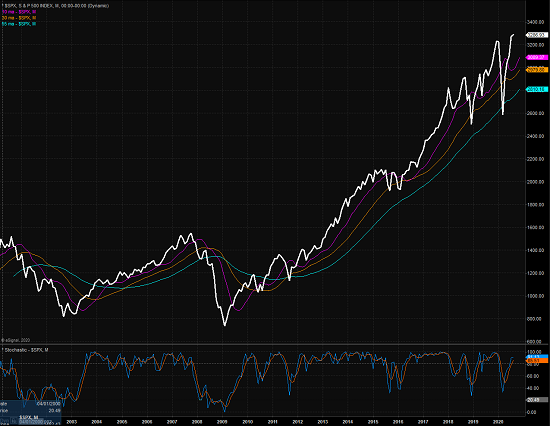
Secular bull or bear markets typically consist of multiple cyclical bull and bear markets. Below is a monthly chart of the S&P 500 Index illustrating the current cycle, which we estimate began on March 9, 2009.
S&P 500 - Monthly
The Cyclical Market Cycle
A cyclical bull market requires a 30% rise in the DJIA after 50 calendar days, or a 13% rise after 155 calendar days. Reversals of 30% in the Value Line Geometric Index since 1965 also qualify.
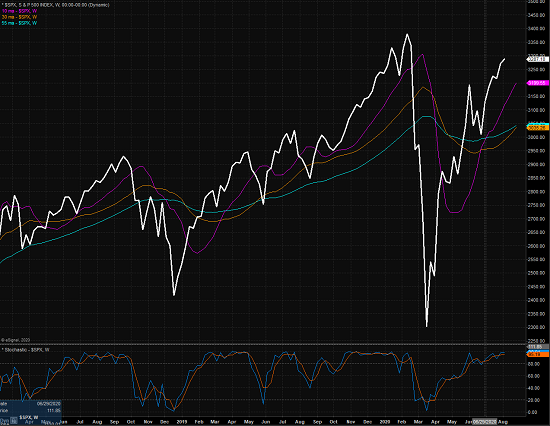
A cyclical bear market requires a 30% drop in the DJIA after 50 calendar days, or a 13% decline after 145 calendar days. Reversals of 30% in the Value Line Geometric Index also qualify. Below is a weekly chart of the S&P 500 illustrating the current cycle, which we estimate began on March 24, 2020.
S&P 500 - Weekly



Comments
Log in or sign up to join the conversation.