

Wow, do markets move fast in the day of smartphones, zero-fee commissions, and high-speed traders.
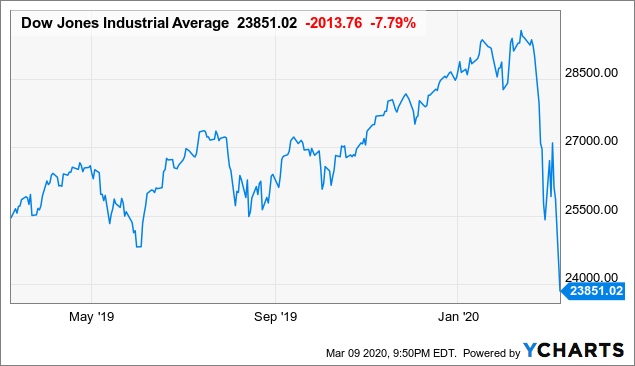
Who'd have thought back in the ancient times of February 12, 2020, when the Dow Jones Industrial Average had just made a record close of 29,551, that we'd now be experiencing day after day of increasingly steep drops and gains (but mostly drops) now culminating, perhaps, in 2020's "Black Monday" of a Dow down over 2,000 points?
Amid this historic volatility my message is - stay calm and maybe even buy a little.
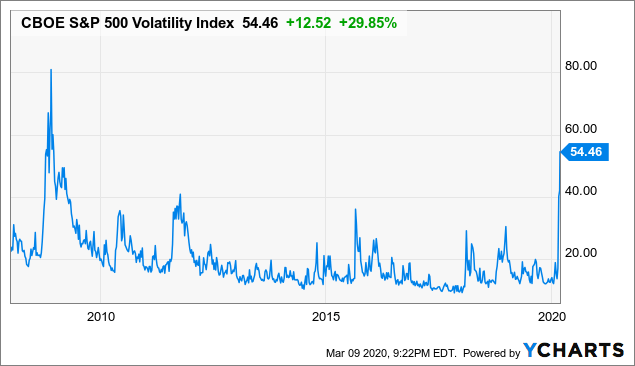
Data by YCharts
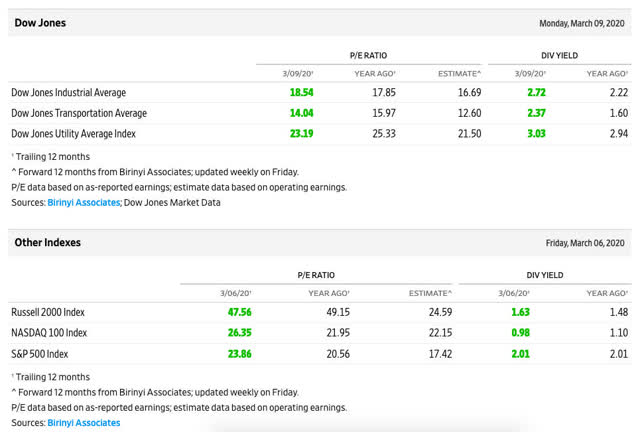
Coronavirus and oil are largely separate from one another but both impactful on their own and, when combined in a one-two, a devastating attempt at a knockout punch to this 11-year bull market. I think the market was due for a correction at the relatively rich and overly optimistic valuation levels it was at. However when looking at valuations now - things seem almost a bit cheap from a forward perspective.
(Source: The Wall Street Journal)
The fact is that economic growth both domestically and worldwide is not in recession territory, at least beyond a potential momentary blip from coronavirus quarantines, even if it is slowing. Revised U.S. 2020 economic growth projections are down to 1.4%, a significant slowdown from 2019's 2.3%. China, which seems to have largely recovered from the virus, is seeing growth expectations of around 5% and down from its consistent 6% levels. Other regions, such as India, an already-slowing Europe, and otherwise seem likely to experience similar. These primarily come from a combination of economic growth that already seemed strained even at the turn of this new year and now compounded greatly by the coronavirus and oil price shock.
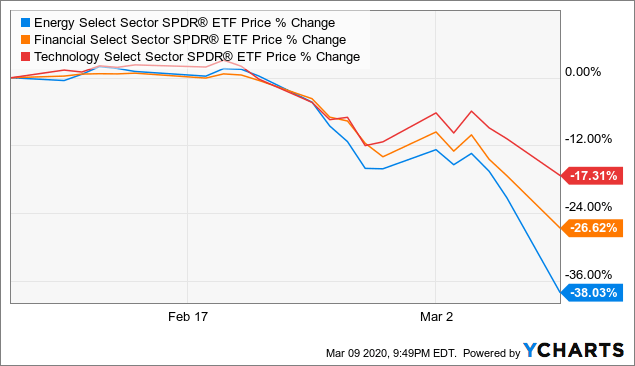
Yet I believe the systematic medium and long-term risk remains low even if it is quite possible volatility may continue for a few more weeks or even months. The risks in the short-term are if the coronavirus continues to spread, and thus disrupt economically through impacts on consumer and business activity, through more nations and particularly key economies such as Europe, India, Japan, and especially the United States. The oil price shock has the potential to cause some credit risks to companies exposed to revenue streams linked to oil, such as financial companies which experienced almost as harsh a Black Monday as energy stocks.
Data by YCharts
For oil, it is worth remembering that the world survived, and grew, from several oil price shocks even this past decade. The oil downturn from late 2014 to early 2016 did hold markets down for a time, in combination with other factors such as the Eurozone crisis and geopolitics, but the markets returned in full force and exploded even while oil only made a small and moderate rally. Furthermore this current oil price shock appears to be a temporary battle between OPEC nations rather than a long-term fundamental switch - it is very possible that by summer there will be greater stability and resolution to the current proposed supply gut and oil returned to a more moderate level.
By summer it is also very likely we will see the real impact of coronavirus and if it actually deserves the angst and fear it is causing currently in markets. Many companies have guided down but we've yet to see much in the form of concrete numbers. Much of the current downturn appears to be a revision in forward previously rosy estimates and perhaps some is deserved. However if coronavirus experiences, like it seemingly is in the direction of moving right now, a moderate resolution then its impact likely will be similarly short.
Based on the above I remain confident in the markets' long-term path. There are a lot of great buying opportunities right now for stocks, financial instruments, ETFs, sectors, and nations that previously just seemed (and as we now see correctly) too pricey. I believe within half a year things likely - but not for sure - will return to a general and slow, but still existing, growth path.
Data by YCharts
In the meantime hold on steady - this volatility looks only likely to continue in our fast-paced modern information and trading age.


Comments
Log in or sign up to join the conversation.