

Introduction
Srinivasa Perumal, also known as Lord Venkateswara or Balaji, is one of the most revered forms of Lord Vishnu in Hindu tradition. Enshrined atop the sacred Tirumala hills in Andhra Pradesh, this form of the divine preserver is worshipped by millions as the presiding deity of the Kali Yuga, believed to grant protection, prosperity and liberation to all who seek his blessings. The name "Srinivasa" itself means "the abode of Sri (Lakshmi)," reflecting his eternal association with the goddess of wealth and grace.
For devotees across India and around the world, Srinivasa Perumal represents unwavering faith, divine compassion and the promise of fulfillment for those who approach him with a sincere heart. This deep devotion extends beyond temple visits into everyday worship, and many households choose to bring home a finely crafted brass idol from IdolBronze to keep this sense of divine presence alive in their daily pooja rituals.
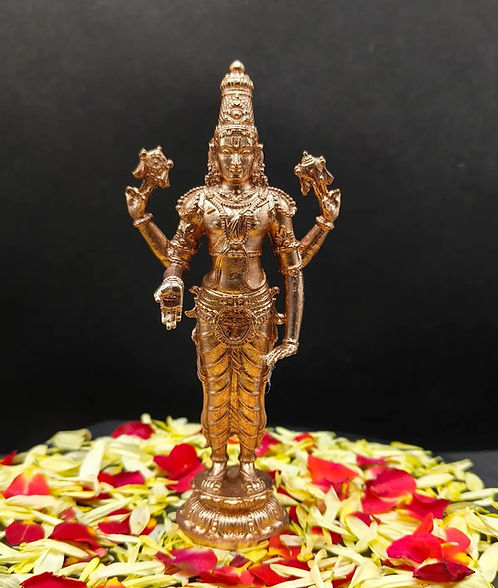
Who Is Srinivasa Perumal?
Srinivasa Perumal is a form of Lord Vishnu, worshipped principally at the Venkateswara Temple in Tirumala, Andhra Pradesh. According to tradition, when Goddess Lakshmi left Vaikuntha following a dispute, a grieving Vishnu descended to earth in search of her, taking the form of Srinivasa. Unable to find her, he settled into life on the Venkata hills, where he would eventually fall in love with and marry the princess Padmavati — believed to be an incarnation of Lakshmi herself. Once established at Tirumala, this form of Vishnu came to be called Venkateswara, "Lord of Venkata Hill," with Venkata popularly understood to mean the remover or "burner" of sin.
Srinivasa Perumal and His Consorts — Padmavati, Sridevi and Bhudevi
At Tirumala, Srinivasa Perumal is worshipped alongside two consorts, Sridevi and Bhudevi, representing the goddess Lakshmi in her celestial and earthly aspects. Padmavati, whom Srinivasa married in his earthly life, is honoured at a separate temple in nearby Tiruchanur, and tradition holds that pilgrims should seek her blessings before visiting Venkateswara at Tirumala. Some accounts also connect Padmavati to Vedavati, a devoted ascetic from the Ramayana whose unfulfilled wish to marry Vishnu is said to have been granted in this later birth.
Srinivasa Perumal Compared to Other Forms of Vishnu
Where Rama and Krishna are avatars tied to specific completed epics — the Ramayana and the Mahabharata — Srinivasa Perumal occupies a different category. He is understood as a living, ongoing presence rather than a story from the distant past: tradition holds that he remains physically enshrined at Tirumala to this day, watching over devotees through the present Kali Yuga. His iconography also sets him apart — Venkateswara is typically depicted with markedly dark, almost black skin, distinguishing him visually from the more commonly blue-tinted depictions of Krishna or Rama.
The Symbolism of Srinivasa Perumal's Iconography
Srinivasa Perumal is shown standing, holding the conch (shankhu) and discus (chakra) in his upper hands — the same core symbols carried by Vishnu across his forms, representing sound and cosmic order. His lower right hand is often shown in a gesture of blessing, while the left rests at his hip, a posture read by devotees as a standing invitation: everything a devotee needs, he is already offering. His mount is Garuda, the eagle who carries Vishnu across the heavens, and Sricharanam — his sacred feet — are themselves objects of deep devotion, often represented separately in temple worship and home shrines alike.
The Legend of Srinivasa Perumal
Vishnu's Search for Lakshmi and Life in the Anthill
The story begins in Vaikuntha, where a rift between Vishnu and Lakshmi led the goddess to leave for earth. Distraught, Vishnu followed her down, eventually settling on the Venkata hills, where — in one of the most striking images in his mythology — he is said to have taken shelter inside a termite mound, sustained only by a cow that came daily to offer milk.
The Meeting with Padmavati and Kubera's Loan
While living on the hill, Srinivasa encountered Padmavati, the daughter of King Akasha Raja, who — according to legend — had been found as an infant inside a lotus during a yajna. Recognising her as Lakshmi reborn, Srinivasa sought her hand in marriage. But a wedding befitting a god required wealth he did not have on earth, so he approached Kubera, the god of wealth, for a loan — a debt tradition says is still being repaid today through the offerings devotees leave at his temple.
The Celestial Wedding at Narayanavanam
With Kubera's loan secured and the blessings of the gods and sages obtained, Srinivasa and Padmavati were married in a grand ceremony, traditionally located at what is now the Kalyana Venkateswara Temple in Narayanavanam. The couple is said to have spent their first months of marriage there before Srinivasa returned to Tirumala, where he remains enshrined — his marriage to Padmavati still re-enacted annually at the temple as one of its most celebrated rituals.
Tirumala Venkateswara Temple — History and Sacred Features
The Venkateswara Temple at Tirumala is among the most visited religious sites in the world, drawing tens of thousands of pilgrims daily and crossing well over a hundred thousand during major festivals. While local tradition holds the temple to be five thousand years old, the earliest confirmed textual references appear in Tamil works dating to roughly the 5th or 6th century CE, with the first recorded donation to the temple made by the Pallava queen Samavai around 966 CE. Successive dynasties — the Cholas, the Pallavas, and especially the Vijayanagara Empire — expanded and embellished the temple over the centuries, including gilding its inner sanctum roof, the Ananda Nilayam ("Abode of Happiness"), first under a Pallava king and later under the Vijayanagara emperor Krishnadevaraya. The temple's biggest annual celebration, the nine-day Srivari Brahmotsavam, draws the largest crowds of the year and centres on a grand procession of the deity through the streets around the shrine.
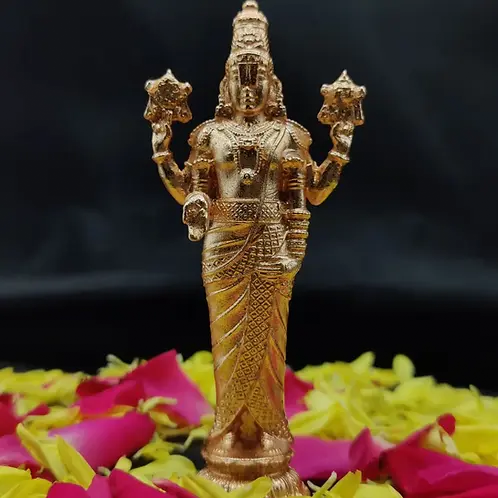
Spiritual Significance of Srinivasa Perumal
Fulfiller of wishes — Devotees visit Srinivasa Perumal specifically to have prayers answered, often making vows tied to major life events such as marriage, childbirth or new ventures.
The living deity of Kali Yuga — Unlike avatars associated with a completed era, Srinivasa Perumal is believed to remain physically present and accessible to devotees through the present age.
Devotion through giving — The tradition of Kubera's loan has shaped a culture of generous offerings at Tirumala, where devotees see their contributions as symbolically helping repay the deity's debt.
Union of Vishnu and Lakshmi — His marriage to Padmavati represents the restored union of divine masculine and feminine energies, associated with prosperity, balance and grace.
A pilgrimage of a lifetime — For many Hindu families, a visit to Tirumala is considered one of the most significant pilgrimages to undertake, often followed by keeping a Srinivasa Perumal idol at home as a lasting connection to that experience.
Why Is Srinivasa Perumal Different from Other Vishnu Forms
Vishnu's avatars are typically framed by dramatic, world-altering missions — Rama restoring dharma through exile and war, Krishna guiding the Pandavas through the Mahabharata. Srinivasa Perumal's story, by contrast, unfolds on a far more intimate scale: a heartbroken god, a humble anthill, a loan for a wedding. That very ordinariness is part of his appeal — his legend reads less like cosmic intervention and more like a devotee's own life, which is perhaps why so many approach him with personal requests rather than requests for cosmic justice. Combined with his distinct dark iconography and his standing as a deity still enshrined and active rather than a figure from a finished story, Srinivasa Perumal holds a category of devotion that is both deeply mythological and remarkably immediate.
Conclusion
Srinivasa Perumal's story is, at its heart, a love story — a god who came to earth in search of what he had lost, and found it again through marriage, humility and a debt willingly carried forward by generations of devotees. From his humble beginnings in an anthill to his place today as one of the most visited deities on earth, his legend continues to resonate because it mirrors the devotee's own journey: seeking, waiting and, eventually, receiving grace.
Comments
Log in or sign up to join the conversation.