

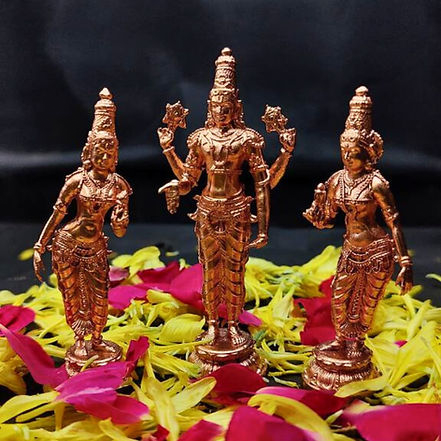
Srinivasa Perumal, flanked by his two consorts Sridevi and Bhudevi, is one of the most beloved forms of Lord Vishnu in South Indian devotion, and this bronze rendering is available at IdolBronze for those who wish to bring the presence of Tirumala's presiding deity into their own homes. Worshipped as the Lord of the Seven Hills, Srinivasa (also called Venkateswara or Balaji) stands as the protector and sustainer of his devotees in the current age, the Kali Yuga, offering refuge to anyone who seeks him.
With Sridevi seated on his right and Bhudevi on his left, the composition represents the completeness of the Lord, who is never without his consorts. This pairing has been cast in bronze and worshipped in temples and homes for centuries, and Idol Bronze continues that tradition of craftsmanship for devotees today.
Who Is Srinivasa Perumal?
Srinivasa Perumal is a form of Lord Vishnu, the preserver among the Trimurti, enshrined atop the Tirumala hills in Andhra Pradesh. The name "Srinivasa" translates to "the one in whom Sri, or Lakshmi, resides," a title that already points to his inseparable bond with his consort. He is also known as Venkateswara, "the Lord of Venkata Hill," and by devotees across Tamil Nadu, Karnataka, and Andhra Pradesh simply as Balaji or Perumal.
His Two Consorts
Sridevi, more widely known as Lakshmi, is the goddess of wealth, fortune, and auspiciousness. She is seated to the right of the Lord, a placement recorded in temple tradition as Paramapadam, the eternal abode of Vishnu in Vaikuntha. Bhudevi, the Earth goddess, sits to his left, representing the material world that Vishnu sustains and protects. Together, the three form a single devotional unit that is rarely worshipped apart, since the Lord's grace is understood to flow through both his heavenly and earthly consorts equally.
Classification Among Vishnu's Forms
Within the wider family of Vishnu images, Srinivasa Perumal belongs to the class of Utsava and Moola Murtis worshipped daily in Vaishnava temples of the south. Unlike the reclining Ranganatha or the seated Venugopala forms, Srinivasa is typically depicted standing, a posture called Sthanaka, which conveys his readiness to answer the calls of his devotees at any moment.
The Legend of Srinivasa and His Marriage
The story of Srinivasa Perumal begins with a curse and a search for refuge. According to the Sthala Purana of Tirumala, Vishnu once resolved a dispute between the sages regarding which of the Trimurti was foremost in patience, and in the course of the test the sage Bhrigu kicked Vishnu on the chest, the very place where Lakshmi resides. Insulted at this treatment of her seat, Lakshmi left Vaikuntha and descended to earth, leaving Vishnu without his eternal consort.
Grieving her absence, Vishnu too came down to earth and took the form of a poor young man named Srinivasa, wandering the Seven Hills of Tirumala. Weakened by hunger and searching for shelter, he was found and cared for by an anthill, and it is said he lived there disguised even from the other gods, surviving on milk offered daily by a cow belonging to a local cowherd.
The Meeting with Padmavati
While wandering the forest one day, Srinivasa came upon Padmavati, daughter of Akasaraja, the king of the region, and fell instantly in love with her. Recognising in her a form of Bhudevi, he sought her hand, but as a penniless ascetic he had nothing to offer as a bride price. In this hour of need, Srinivasa approached Kubera, the treasurer of the gods, and took a loan to fund his wedding, a debt that devotees still believe the Lord carries to this day, which is why offerings of wealth continue to pour into his hundi at Tirumala even now.
The Wedding and Settling at Tirumala
The marriage of Srinivasa and Padmavati was celebrated with great splendour, and the couple settled on the Venkata Hill, where the Lord chose to remain permanently, accompanied now by both Bhudevi, in her earthly form as Padmavati, and eventually reunited with Sridevi as well. This is why the image of Srinivasa Perumal is always shown flanked by both goddesses together, a testament to a story of separation, search, and eventual reunion.
Tirumala: The Abode of Srinivasa Perumal
The Tirumala Venkateswara Temple, perched on the seventh of the Seven Hills known as Venkatadri, is among the most visited pilgrimage sites in the world. The temple's principal shrine, the Ananda Nilayam, houses the black stone image of the Lord, believed to be a Swayambhu murti, one that manifested on its own rather than being carved by human hands.
Devotees who make the climb, whether on foot along the ancient stone steps or by road, do so in the belief that Srinivasa answers every sincere prayer, clearing debts both material and spiritual. The temple's daily rituals, from the Suprabhata Seva that wakes the Lord each morning to the Ekanta Seva that puts him to rest at night, follow a rhythm that has continued for centuries, tying every devotee who visits into an unbroken chain of worship.
Nearby, at Tiruchanur, stands a separate temple dedicated to Padmavati Devi, and pilgrimage tradition holds that a visit to Tirumala is considered incomplete without first paying respects to the goddess there, honouring the order in which the divine couple's story unfolded.
Spiritual Significance of Srinivasa Perumal
Refuge for the current age: Srinivasa is regarded as the most accessible form of Vishnu for the Kali Yuga, a deity devotees believe responds swiftly to sincere prayer.
Completeness through his consorts: The presence of both Sridevi and Bhudevi beside him reflects the belief that divine grace reaches devotees through both spiritual and material blessings together.
A story devotees carry with them: The tale of Srinivasa's debt to Kubera is often invoked by devotees seeking relief from financial hardship, who make vows and offerings at Tirumala in the Lord's name.
A living tradition: The rituals begun centuries ago at Tirumala continue in unbroken sequence today, connecting modern worshippers directly to the temple's founding devotion.
Why Is Srinivasa Perumal Different from Other Forms of Vishnu?
Where forms such as Ranganatha depict Vishnu at rest in cosmic sleep, Srinivasa stands upright and alert, ready to act on behalf of his devotees.
Unlike many Vishnu temples that centre on a single consort, the Tirumala tradition places equal emphasis on both Sridevi and Bhudevi, reflected in this bronze composition where both goddesses flank the Lord together.
His story is unusually personal among Vishnu's forms, built around a human-style courtship, marriage, and debt, rather than a cosmic battle or rescue, which is part of why devotees relate to him with such warmth.
Few other Vishnu shrines draw the sheer scale of daily pilgrimage that Tirumala does, making Srinivasa's worship as much a living, ongoing tradition as it is a historical one.
Conclusion
Srinivasa Perumal, seated eternally between Sridevi and Bhudevi, embodies a story of love, humility, and unwavering devotion that continues to draw millions of pilgrims to the Tirumala hills each year. Bringing home a bronze representation of this trinity is a way of holding onto that same devotion in daily worship, a reminder that the Lord who once wandered as a penniless seeker remains ever close to those who call on him.
Comments
Log in or sign up to join the conversation.