

Questionable Discount Strategy
Sprint (NYSE:S) may be adding customers at a significant rate, but its strategy of deep discounts to secure those new customers is hurting them. For the most recent quarter, Sprint reported lower revenue and greater losses than a year ago.

While Sprint added 22,000 net postpaid phone subscribers during the first three months of 2016, the company has been offering the service at a deep discount to its competitors, Verizon (NYSE:VZ) and AT&T (NYSE:T) - in some cases up to 50 percent less than their rivals. T-Mobile US (NASDAQ:TMUS) had the greatest gains in early 2016 by adding 877,000 customers during the period.
Sprint is not necessarily in a position of strength after adding only 22,000 customers. Sprint CEO Marcelo Claure defended the anemic performance by noting that it is an improvement over the previous years. (Sprint lost 201,000 postpaid customers for the first three months of 2015.)
Mr. Claure noted that the company is planning to open up to 2,500 new stores over the next two years in an effort to build its customer base further. At the end of March, Sprint had a total of 58.8 million customers, including wholesale and prepaid connections.
Fundamental Brand Challenges
One challenge that Sprint must overcome in its efforts is a pervasive perception that the company offers weaker service than that of its competitors. SoftBank Group from Japan acquired control of Sprint in 2013 for close to $22 billion, and its plans to lure customers from rivals has continued to face considerable barriers.
As Sprint has accumulated losses over the last few years, it worked out several deals with SoftBank to sell and lease-back network assets and phones to add an infusion of cash at lower interest rates that it could secure in the high-yield debt market. At the same time, Sprint has been looking for ways to cut up to $2.5 billion in expenses.
Heavy Debt Load
Sprint may also need to address its debt load to improve performance. Its current debt totals $31.5 billion versus a market capitalization of $13.5 billion for a net debt of 4.3 times its adjusted earnings before interest, taxes, depreciation and amortization. In September 2015, Moody's downgraded the company's corporate family rating (NYSE:CFR) from B1 to B3.
Moody's Powerful Downgrade
Moody's said the numerous operational initiatives, management changes, and funding plans "will be insufficient to stabilize Sprint's operations in the next few years," and that the "brutal competition now playing out" in the U.S. wireless industry will pressure the financial performance.
Moody's further stated the following: "We remain concerned about the ability of Sprint to refinance its large upcoming debt maturities absent a much stronger commitment from [majority shareholder] SoftBank to the long-term strategic importance of Sprint in SoftBank's overall plans," and that "the capital markets will be disinclined to provide funding to Sprint without enhanced collateral in light of its ongoing very large cash needs."
Less Than Expected Towards New Developments
Sprint also reported plans to spend $3 billion on network construction in the coming year; however, this represents about $2 billion less than Wall Street analysts had expected. The company expects future spending to continue slowing due to wait times for local zoning approvals for new cellular sites.
Although according to Sprint's latest 10-Q, its FY2015 operating income was a positive $310M, this was just the first time in nine years the company has reported positive in this regard.
Conclusion: Volatile Stock Performance, No Time To Buy
Shares in Sprint have been on a wild rollercoaster over the last several years. In January 2012, they reached a low of $2.17, but by December 2013, they had recovered to a high of $10.79. They then began a long decline and currently trade around $3.90.
(Click on image to enlarge)
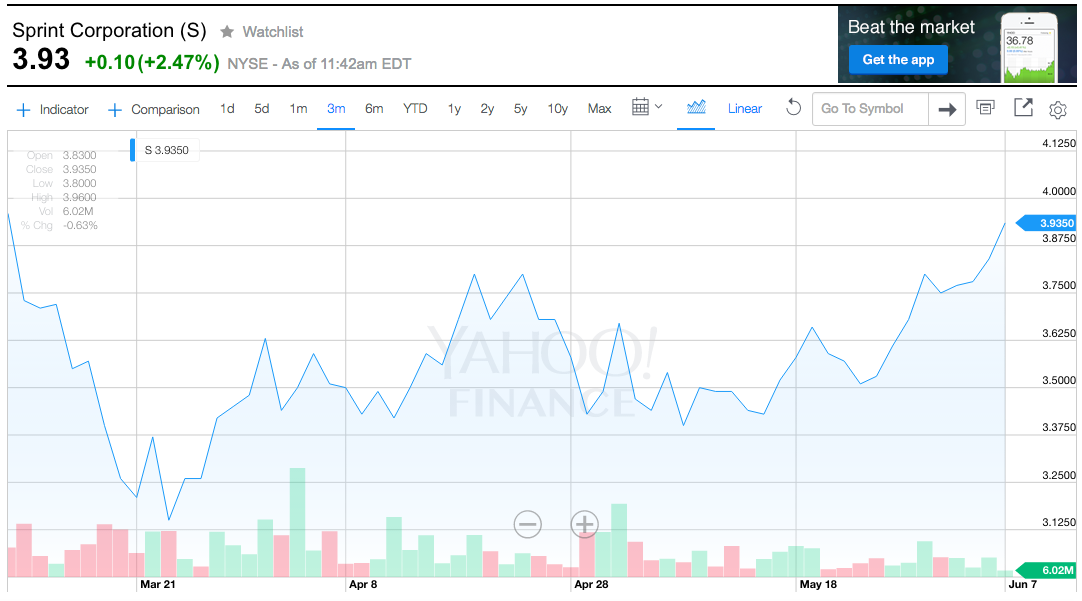
(Yahoo! Finance)


Comments
Log in or sign up to join the conversation.