

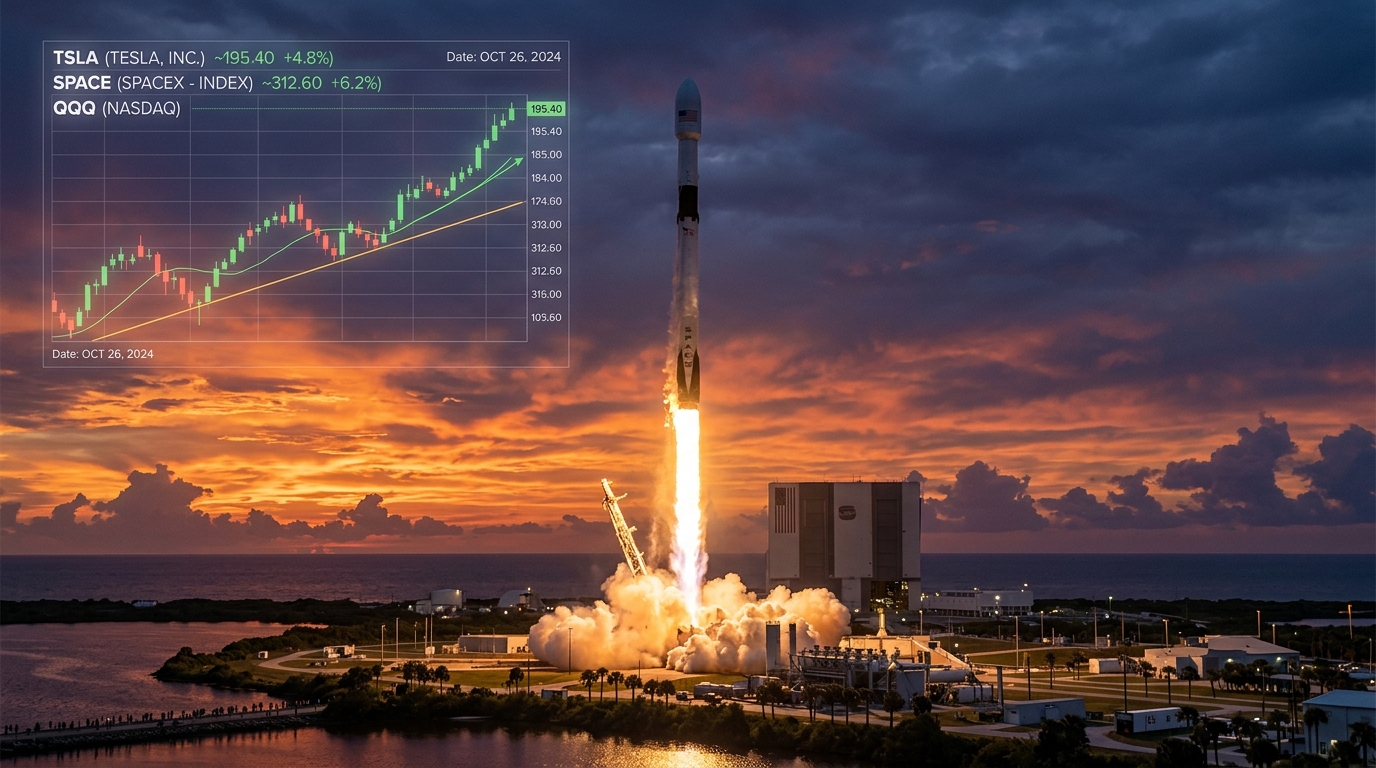
SpaceX (SPCX) went public on June 12 at $135 a share. It opened at $150, shot past $225 inside a week, and briefly made Elon Musk the wealthiest person on the planet by a wider margin than ever. Then reality set in.
By the close of trading on June 23, shares of Space Exploration Technologies Corp. had fallen below their opening-day price for the first time. The stock, which had briefly carried a market cap north of $2.9 trillion, shed nearly $1 trillion in value in less than two weeks. Analysts are calling it a textbook post-IPO hangover. Retail investors who piled in at the top are calling it something else entirely.
Here is what actually happened, why it matters, and what comes next.
By The Numbers
$135 — SpaceX IPO price on June 12, 2026
$225+ — All-time high hit within the first week of trading
~$146.88 — Share price on June 23, now below the $150 opening-day price
~$1 trillion — Market cap wiped out from peak to current
14% — Still above the original IPO price of $135, despite the sell-off
What Triggered the Sell-Off
It was not one thing. It never is.
On June 23, a sharp drop in South Korean semiconductor stocks triggered a broader technology rout across global markets. Nvidia (NVDA) fell 3-4%. AMD dropped 7%. Even Apple (AAPL) and Tesla (TSLA) took hits. SpaceX, trading at a valuation that required the company to essentially become a multi-generational infrastructure monopoly to justify, was not going to be immune to that.
Add to that the simple math of IPO mechanics. Most major institutional investors received their allocation at $135. Many flipped shares into the initial pop. Lock-up periods for employees and insiders do not expire for months. The stock was running on retail momentum, and retail momentum has a nasty tendency to reverse quickly once the narrative shifts from "limitless growth" to "wait, what is the actual earnings model here."
The Bull Case Has Not Changed. The Valuation Math Has.
SpaceX is the real deal. The Starlink satellite internet business generates real recurring revenue. Falcon 9 has become the workhorse of commercial spaceflight. The Starship program, if it works, changes how humans access orbit for the next century. None of that is in question.
What is in question is whether any of that justifies a valuation that, at the peak, exceeded the combined market caps of Boeing (BA), Lockheed Martin (LMT), Northrop Grumman (NOC), and Raytheon (RTX) combined, by a wide margin. That is not an investment thesis. That is faith.
"The business is exceptional. The price you pay for an exceptional business is still what determines whether you make money."
Investors who bought the IPO at $135 are still up 8-9% from cost. Investors who chased momentum above $200 are now sitting on real losses. The question is not whether SpaceX is a great company. It is whether the stock, even at $146, is priced for the best-case scenario with zero margin for error.
Three Things to Watch From Here
First: insider lock-up expirations. When early employees and company insiders become eligible to sell, the market will learn quickly how much of that paper wealth they want to hold versus monetize.
Second: Starlink revenue transparency. SpaceX does not file quarterly earnings the way traditional public companies do. Investors are pricing a business they cannot fully audit. The reaction to the first real earnings call will be decisive.
Third: broader tech sentiment. If the South Korean chip rout accelerates into a genuine sector rotation, high-multiple names with no near-term earnings support face continued pressure. SpaceX at any valuation above $1.5 trillion fits that profile.
You do not have to trust the skeptics. Trust the history of every major technology IPO that ran 60% in a week. They all eventually find a price that reflects reality rather than anticipation. The only question is whether that reality is $100 or $200.
P.S. The $150 level is now psychological support and a line in the sand. If SpaceX breaks and holds below it, watch for institutional buyers to step in near the original $135 IPO price. That would be the first real test of long-term conviction in this name.

Comments
Log in or sign up to join the conversation.