

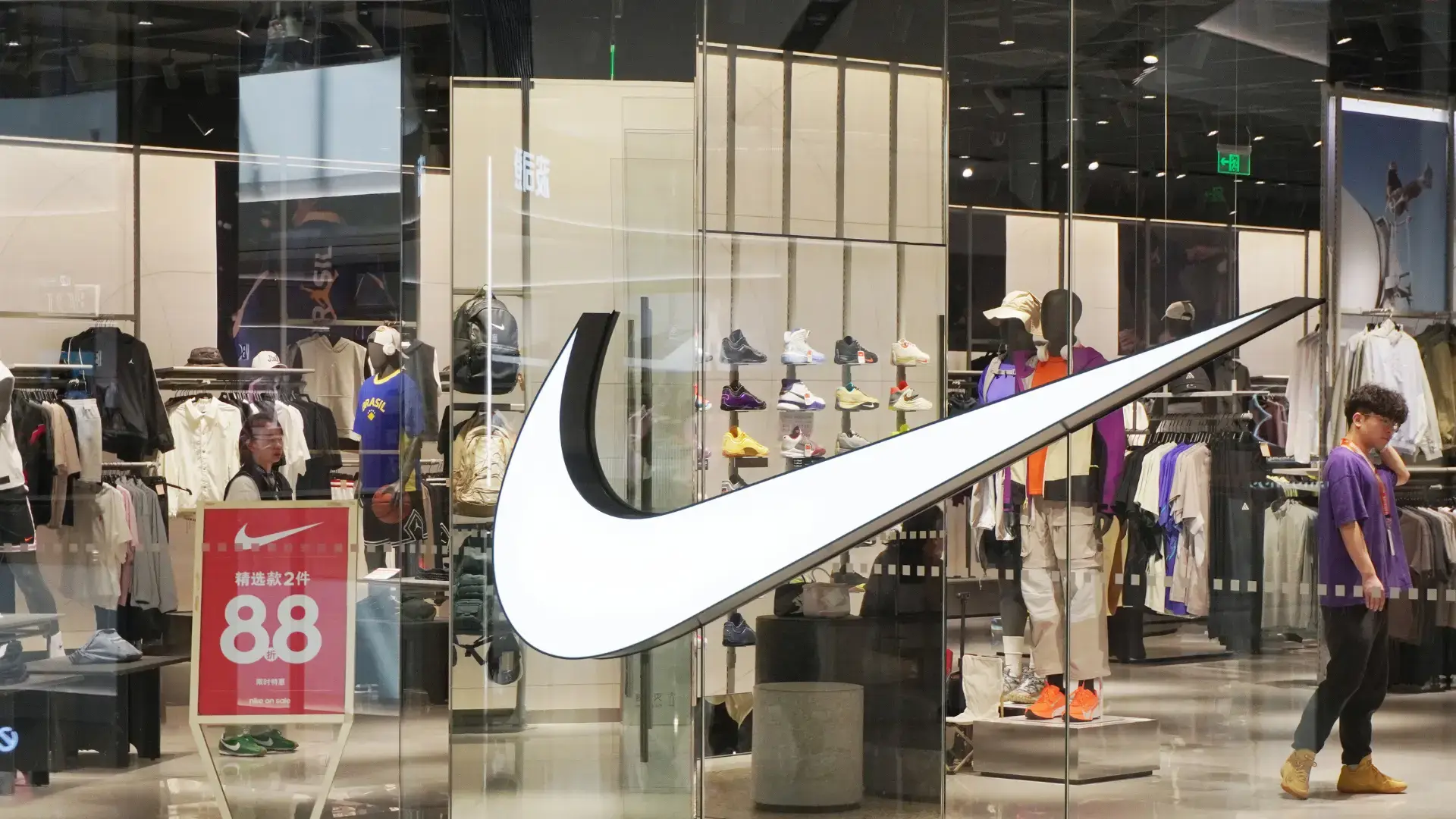
China weakness and tariffs are weighing on Nike’s margins, with a sharp decline in Greater China and rising costs driving profitability lower. Image Source: Sopa Images LightRocket/Getty Images
Key Points
Weak Q4 guidance and falling profits are driving the Nike sell-off, signaling the turnaround is taking longer than expected.
Wholesale is helping rebuild distribution, but its effort comes with lower margins and hasn’t fully offset weakness in direct channels.
China weakness and tariff pressure are weighing on margins, raising concerns about how quickly profitability can recover.
Nike is in the middle of a reset, but investors are starting to question how long it will take to work.
The brand still has global scale, strong partnerships, and a clear strategy. What’s missing right now is proof that those efforts are translating into real demand and sustainable profits.
Weak Q4 Outlook Shows Nike Isn’t “Winning Now" Yet
Nike has recently been trading at about 1.5 times sales, which seems historically cheap. However, the stock has been trading at a non-trivial 28 times forward earnings, which could, unfortunately, give the stock room to fall further if there are execution missteps.
On April 17, S&P Global revised its outlook on Nike to negative due to pressure on profitability during the turnaround. HSBC downgraded the stock from buy to hold and slashed its price target from $90 to $48, according to MarketBeat. Nike stock has been trading at around $46.03 per share, implying the firm no longer sees meaningful upside.
Other firms such as UBS, Stifel, and Truist also lowered their targets, though most kept more neutral or positive ratings.
Nike’s sell-off was primarily driven by weak guidance. After posting fiscal Q3 FY2026 results on March 31 for the period ended Feb. 28, the company said fiscal Q4 sales would fall 2% to 4% year-over-year. That overshadowed Q3 revenue of $11.3 billion, which was flat year-over-year, and made clear that distribution repair has not yet become a demand recovery.
Management reinforced the point, saying its “Win Now” actions, as The Chronicle Journal reported, will keep pressuring results through the rest of the calendar year. It’s clear that investors are now looking for evidence that Nike can return to growth without resetting its earnings model lower.
Q3 diluted EPS fell 35% to $0.35, and net income dropped 35% to about $0.5 billion. That tells investors Nike has little earnings cushion and that even modest operating pressure is hitting the bottom line hard. Some investors expect Nike will need to cut its dividend, given that the dividend payout ratio jumped to 117% in the most recent quarter.
Wholesale Rebound is Repairing Distribution
The clearest operational positive in Q3 was wholesale. Revenue there rose 5% to $6.5 billion, while NIKE Direct fell 4% to $4.5 billion. That shift shows CEO Elliott Hill is rebuilding third-party retail relationships after Nike’s earlier direct-to-consumer push weakened shelf presence and partner alignment.
Wholesale can restore reach faster than Nike’s owned channels can, especially while brand momentum is soft. Nike Brand revenue rose 1% to $11.0 billion, but digital sales fell 9% and NIKE-owned store sales dropped 5%. Wholesale is helping offset weakness in those channels and putting Nike back in front of consumers where they are already shopping.
If partners such as Foot Locker give Nike more shelf space, as Apparel Resources indicates, the company can regain visibility, improve launch support, and slow share losses to Adidas, On, and Deckers. Nike likely has to rebuild relevance through partners first and fix profitability later.
China and Tariffs Cloud Nike’s Margin Recovery
China remains the biggest issue. Q3 revenue was flat as reported but down 3% in constant currency, with Greater China declining roughly 20%, Footwear News confirmed. This is a meaningful hit to a region that typically drives some of Nike’s best margins.
That pressure is showing up directly in profitability. Gross margin fell to 40.2%, down 1.3% from a year earlier, as higher tariffs in North America, promotional activity, and mix all weighed on results. At the same time, selling and administrative expense rose 2% to $4.0 billion, and operating overhead increased 3% to $2.9 billion.
That is why tariffs have become a valuation issue, not just an operating one. Many firms cut price targets after the report, even though Nike ended the quarter with $8.1 billion in cash and short-term investments and inventory down 1% to $7.5 billion.
The balance sheet gives Nike time, but investors need confidence that future sales will convert into acceptable margins.
What Could Drive a Nike Turnaround
More shelf space at key wholesale partners helps stabilize North America revenue.
Faster product refresh cycles support stronger full-price sell-through.
Inventory normalization reduces markdown pressure and supports margins.
A rebound in Greater China improves mix and overall earnings quality.
Strong cash position gives Nike flexibility to invest through the reset.
What Could Keep Pressure on Shares
Weak demand extends into fiscal 2027, delaying a revenue recovery.
Nike could slash dividends to fuel growth initiatives.
Ongoing softness in Greater China weighs on a key profit driver.
Heavier wholesale mix stabilizes sales but limits profitability.
Weak NIKE Direct traffic and conversion reduce a high-margin growth lever.
Nike Investors Should Be Patient With the Company’s Recovery
Nike’s turnaround is in motion, but it’s not showing up in the numbers yet.
Weak guidance, margin pressure, and softness in key regions are outweighing early progress in distribution, leaving investors focused on whether the company can restore growth without sacrificing profitability.
If Nike can show revenue reaccelerating without another leg down in margins, the stock can rerate. Until then, the recovery case could take longer than bulls initially expected.



Comments
Log in or sign up to join the conversation.