

Over the last few years, mega-cap companies have played an increasingly important role in driving U.S. equity market returns. Indeed, the five largest names in the S&P 500® accounted for 16.8% of the index at the end of last year, the highest year-end weight since 1982 and higher than the 16.6% reached at the end of 1999 during the Tech Bubble.
(Click on image to enlarge)

The sizeable representation of mega-cap companies in the U.S. equity market means that indices seeking to measure the performance of the market – such as the S&P Composite 1500 and the Russell 3000 – often have similar weights in these companies. Perhaps unsurprisingly, the two indices exhibited similar risk/return characteristics, historically.
(Click on image to enlarge)

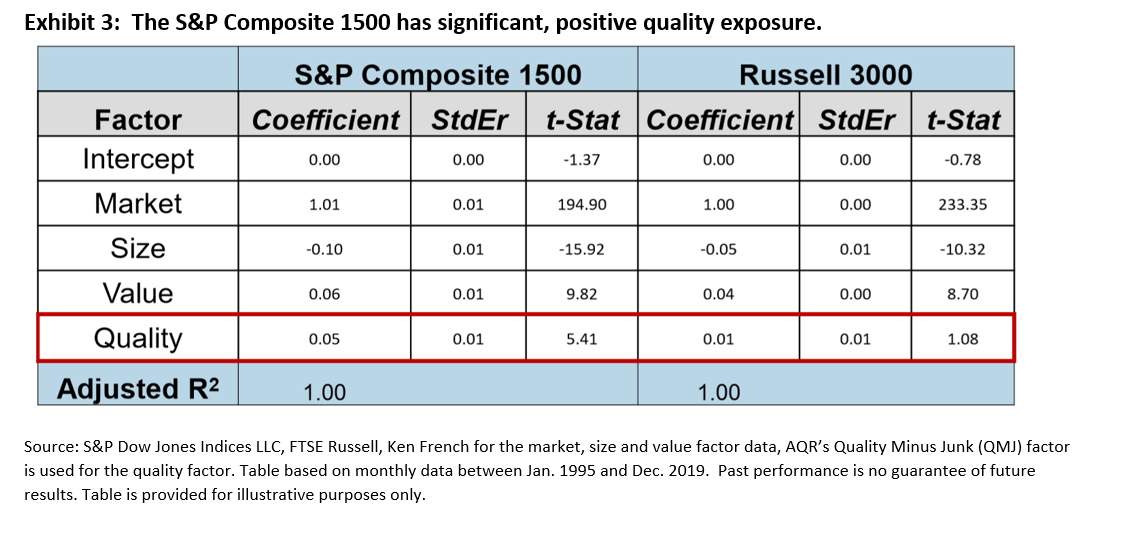
However, it is important to remember that not all indices are created in the same way.For example, unlike the Russell 3000, the S&P Composite 1500 focuses on profitable U.S. companies by incorporating earnings criteria. Exhibit 3 shows that this focus meant the S&P 1500 has significant, positive quality exposure, which was also observed for each of the S&P 500, S&P MidCap 400® and the S&P SmallCap 600®.
(Click on image to enlarge)
Differences in index construction, especially the S&P 1500’s earnings screen, may also be relevant given the proportion of IPOs with negative earnings:2019 saw 74% of IPOs with negative 12-month trailing earnings per share, following 2018’s record-equaling figure (81%).To the extent that these companies are expected to out- or underperform, differences in index methodologies may help to explain any divergence in index performance.
(Click on image to enlarge)

As a result, the sizeable representation of large-cap stocks means indices designed to track the U.S. equity market often have similar weights in these companies, resulting in similar risk/return profiles.However, understanding the different factor exposures of the S&P Composite 1500 and its competitors may be useful for assessing the impact of various market drivers on index returns.



Comments
Log in or sign up to join the conversation.