

The S&P 500 see-sawed during the trading week ending on Friday, 27 February 2026. The index ended the week at 6,878.88, down 0.44% from where it closed the preceding week as geopolitical tensions built during the week.
If not for Friday, the rises and falls of stock prices would have cancelled out, leaving the index essentially flat for the week. But Friday was a down day for the S&P 500. Oil prices surged along with an increased potential for military action between the U.S. and the Islamic regime that has controlled Iran since 1979, as negotiations to avoid conflict showed little progress.
Even with that development, the change in stock prices was muted. latest update of the alternative futures chart shows the S&P 500 is close to the middle of the redzone forecast range we recently added to account for the echoes of volatility from last year's DeepSeek AI shock and "Liberation Day" global tariff shock on its projections.
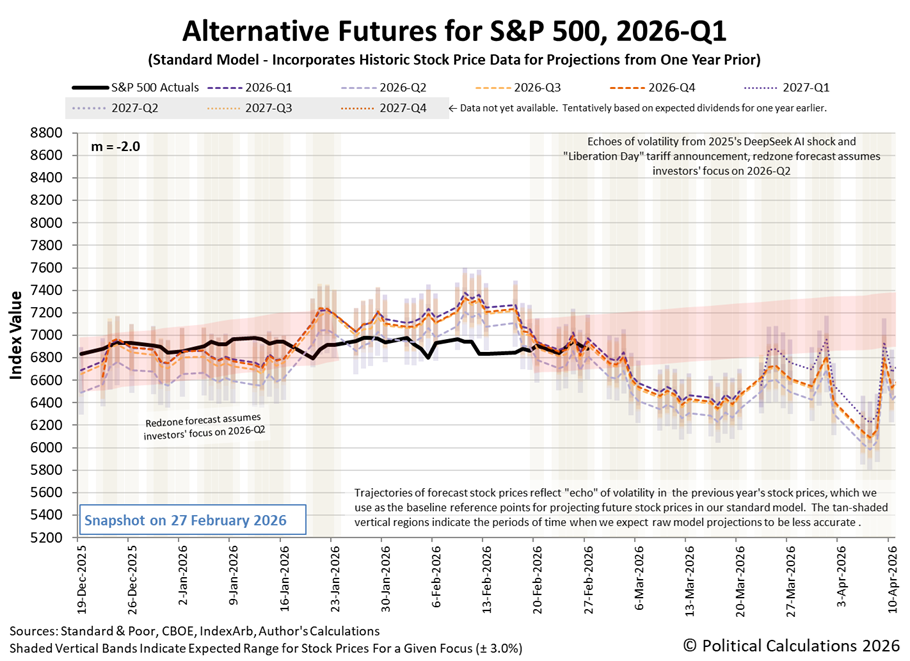
This compensation is necessary because the dividend futures-based model behind the projections shown on the alternative futures chart uses historical stock prices as the base reference points from which its forecasts of the potential futures for the S&P 500's trajectory are made. The redzone forecast range assumes investors will primarily focus on the upcoming quarter of 2026-Q2 as they set current day stock prices over the period it runs.
Here are the week's market-moving headlines, which adds geopolitics to the ongoing concerns over tariffs and AI for shaping investor expectations.
Monday, 23 February 2026
Signs and portents for the U.S. economy:
Fed minions keep trying to sell their pause in cutting interest rates:
BOJ minions likely to fight falling yen with rate hikes:
Chief ECB minions trying really hard to sell idea Eurozone monetary policy is in a good place, also may have an ethical scandal:
Wall Street dragged down by AI-disruption fears, tariff uncertainty
Tuesday, 24 February 2026
Signs and portents for the U.S. economy:
Fed minions starting to think AI might cause job losses, claim they can' t do anything about it:
Bigger trouble developing in China:
BOJ minions standing by to leap into action to stop Japanese yen from collapsing:
Bigger trouble developing in the Eurozone:
Wall Street ends higher as software stocks rebound from Monday selloff
Wednesday, 25 February 2026
Signs and portents for the U.S. economy:
Fed minions still worrying about inflation even though it's running under the level they've really been targeting:
Bigger trouble developing in China:
BOJ minions see steady inflation, standing by to prop up yen as looser policy:
ECB minions find out who their Number Two is:
Thursday, 26 February 2026
Signs and portents for the U.S. economy:
Fed minions thinking about more rate cuts, but not until later in the year:
Bigger trouble developing in China:
BOJ gets new minions, gets stronger yen after rate hike threat:
Bigger trouble developing in the Eurozone, chief ECB minion claims again she won't quit early and also sees no wave of AI job layoffs yet:
Wall Street ended lower as investors digested Nvidia results
Friday, 27 February 2026
Signs and portents for the U.S. economy:
Bigger stimulus developing in China:
BOJ minions see inflation that doesn't justify rate hikes:
Lower inflation developing in Eurozone:
Wall Street ended lower after wholesale inflation arrived hotter than expected
The CME Group's FedWatch Tool is giving a 66% probability the Fed will cut the Federal Funds Rate by a quarter point on 17 June (2026-Q2) which is higher than the preceding week. Beyond that date however, the outlook for rate cuts has changed with additional quarter point rate cuts on 16 September (2026-Q3), and 27 January (2027-Q1) now expected with better than even odds.
The Atlanta Fed's GDPNow tool forecasts real GDP growth will be +3.0% in the current quarter of 2026-Q1, a tick lower than the +3.1% growth projected a week earlier.
Comments
Log in or sign up to join the conversation.