

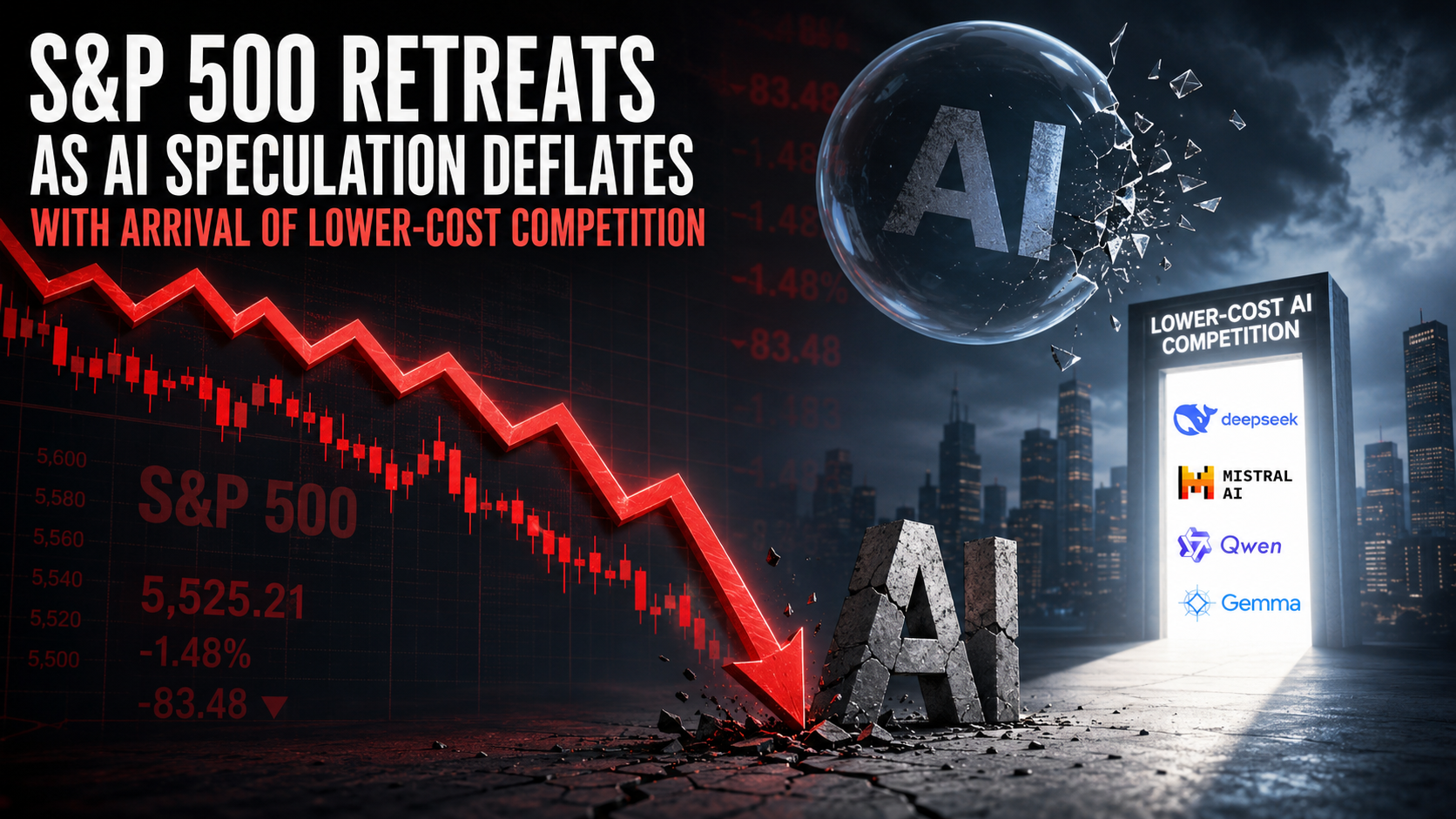
The S&P 500 (Index: SPX) retreated 1.5% from its previous week's close to end the week at 7,457.69.
Much of the market's downward movement came in response to a growing awareness among investors of the high cost of utilizing the most advanced AI systems over the last several weeks. The shift in sentiment has largely capped the upward movement of these stocks despite many having just reported strong earnings.
But it hasn't deflated the S&P 500 the way the index crashed during 2025's "DeepSeek" scare, which one analyst provocatively described as "hiding" a crashing market brought about by investors rotating their investments from AI tech stocks into other sectors of the market.
That's a phenomenon we've described as the conveyance effect. This is a special case of market rotation, in which the gains of what might be described as a speculative bubble within either a single stock or sector of the stock market becomes diffused into the larger market.
Provided investors maintain their demand to own stocks, it can be a healthy development that reduces the concentration of the biggest companies within the market cap-weighted index. In that situation, the index itself goes through a brief decline before resuming an upward trajectory.
If that demand falls however, the index can decline because money is in effect leaving the market instead of being conveyed into the ownership of other stocks within it. That's the recipe for a crash that takes both the sector with the speculative gain and the rest of the market down with it. Much like what happened during the DeepSeek scare.
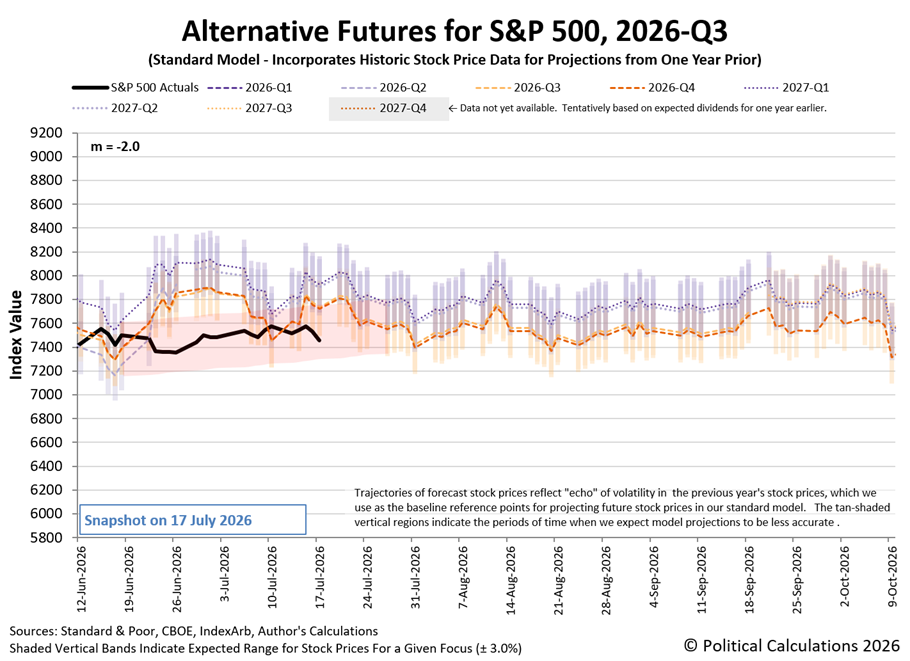
In the latest update of the alternative futures chart, we find the S&P 500's trajectory dipped, but remains well within the redzone forecast range. This outcome indicates the deflation of speculative gains in the AI sector hasn't become a drag on the whole stock market.
There is, of course, more going on to shape investors' outlook for the businesses whose stocks make up S&P 500 index. Here are the market moving headlines of the week that was:
Monday, 13 July 2026
Signs and portents for the U.S. economy:
Fed minion makes rate hike nearly a 50-50 possibility for July 2026:
Bigger trouble, stimulus developing in China:
BOJ minions think higher growth on the way for Japan's economy as stimulus expected:
ECB minions thinking about adding Eurocrypto as Eurozone currency:
U.S. stocks end lower as chip stocks fall, U.S.-Iran tensions rise
Tuesday, 14 July 2026
Signs and portents for the U.S. economy:
New chief Fed minion lays out U.S. monetary policy changes to Congress:
Growth in China's exports paced by AI demand outside China, weak demand for loans within China:
S&P 500 and Nasdaq end higher on cool inflation data, solid bank earnings
Wednesday, 15 July 2026
Signs and portents for the U.S. economy:
Fed minion reveals they're not really paying attention to U.S. inflation data:
Another minion sees the writing on the wall:
Fed minions thinking about revamping their own inflation measure:
Bigger trouble developing in China:
BOJ minions / Bigger trouble developing in Japan:
ECB minions standing by for action:
Wall Street closes higher as the tech trade strengthens, wholesale inflation comes cooler
Thursday, 16 July 2026
Signs and portents for the U.S. economy:
Fed minions called out for policy flip-flops:
Fed minions say they'll hike rates if inflation doesn't fall, don't seem to be aware of consumer, producer price indices:
Bigger trouble, stimulus developing in China:
Bigger trouble developing in Japan, BOJ minions getting excited to hike Japan's interest rates again, bail out Japan's currency again:
ECB minions standing by to hike Eurozone interest rates later:
Friday, 17 July 2026
Signs and portents for the U.S. economy:
Bigger trouble developing in and out of China:
Bigger trouble developing in Japan, BOJ minions standing by for action:
S&P 500 logs weekly decline as tech selloff weighs on markets
The CME Group's FedWatch Tool now only sees one rate hike in its forecast range as having a greater than 50% probability of happening: a quarter point rate hike coming when the Fed meets on 16 September (2026-Q3). The FedWatch tool however still sees the potential for additional rate hikes in 2027.
The Atlanta Fed's GDPNow tool's estimate of real GDP growth for the U.S. economy in the current quarter of 2026-Q2 rebounded to +1.7% from the previous week's real growth estimate of +1.2%.

Comments
Log in or sign up to join the conversation.