

The S&P 500 (Index: SPX) recovered during the Good Friday holiday-shortened trading week. The index closed at 6,582.69 on Thursday, 2 April 2026, up nearly 3.4% from its previous trading week's close.
Given that the week featured news of higher oil and fuel prices, which has been a catalyst for falling stock prices in recent weeks, that outcome seems paradoxical. When you add a surprisingly strong jobs report into the mix, it would seem certain the Federal Reserve would be more likely to hike interest rates in upcoming months. After all, the fear of the Fed raising interest rates to fight inflation from the Iran war surge of oil prices has been front and center in financial news headlines in shaping investor expectations of the future.
But the week saw something different with the actual expectations for how the Fed would be setting interest rates through the end of 2026. The CME Group's FedWatch Tool foresees no interest rate changes through the end of 2026, with a much lower probability of any rate hike taking place. The FedWatch tool even sees a growing chance for a quarter point rate cut in 2027, with the most likely timing of that change coming near the end of 2027-Q3.
What's going on is that the oil price surge is now raising the potential of a recessionary contraction in the U.S. economy, which increased after President Trump's mid-week speech boosted the prospect the Iran war would intensify in the near term rather than come to a resolution as had previously been expected. The heightened risk of contraction would forestall the Fed from hiking rates in 2026 and would support the S&P 500 holding onto its gains during the week in the absence of additional information for how that would affect the various parts of the U.S. economy. The latest update of the alternative futures chart shows the rebound:
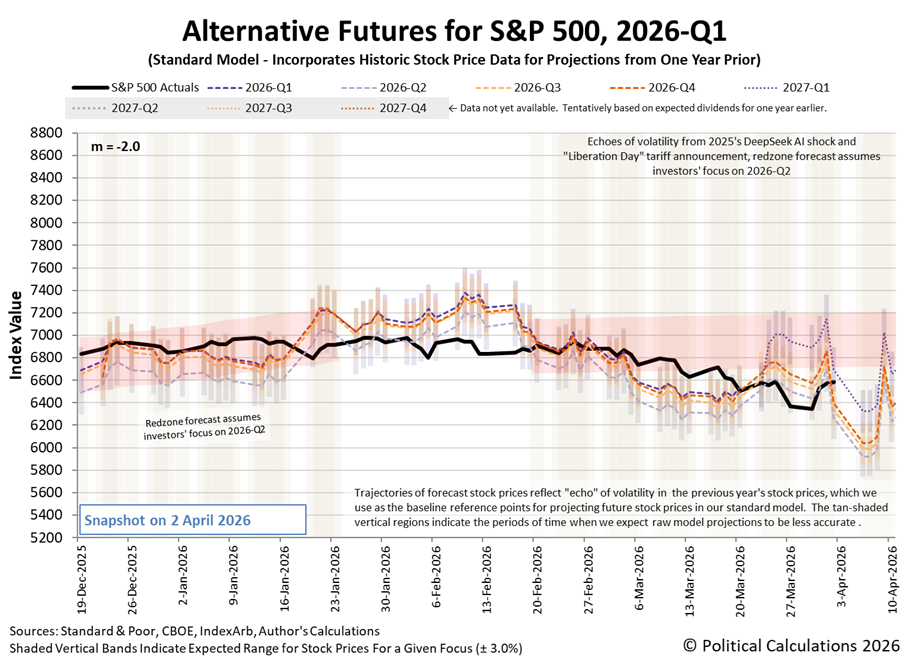
As the geopolitical event progresses, we're likely to continue seeing an elaborate dance between investors expectations for inflationary pressures related to the disruption of oil markets, interest rates, and the outlook for businesses as the economy copes with all of it. The market moving headlines of the week that was gives a taste of those dynamics:
Monday, 30 March 2026
Signs and portents for the U.S. economy:
Chief Fed minion says Fed will stand still on interest rates, Number Two minion says Fed's policy can handle 'unusual' circumstances:
Growth signs developing in China:
BOJ minions worried about effect of oil and their own monetary policies on Japan's inflation:
Bigger trouble developing in the Eurozone:
ECB minions starting to think they may not have the perfect monetary policy they thought:
Wall Street's major averages ended mostly lower to kick off the holiday-shortened week
Tuesday, 31 March 2026
Signs and portents for the U.S. economy:
Fed minion warns against letting down guard against inflation:
Bigger trouble, stimulus developing in China:
Bigger inflation developing in Eurozone, ECB minions excited to test their new models of inflation expectations:
Nasdaq surged nearly 4% as Wall Street closed higher on potential Iran war resolution news
Wednesday, 1 April 2026
Signs and portents for the U.S. economy:
Fed minions thinking oil price spike is short term event:
Bigger trouble, growth signs developing in China:
New BOJ minion worried about potential for stagflation in Japan's economy:
Bigger trouble developing in Eurozone, ECB minions continuing to stand by for action:
U.S. equities ended higher as hopes of Iran conflict de-escalation lifted sentiment
Thursday, 2 April 2026
Signs and portents for the U.S. economy:
Fed minions disappointed U.S. oil production not ramping up faster:
Bigger trouble developing in China:
Former BOJ minion thinks supply disruptions may force BOJ to put aside rate hike plans, but they don't want to give them up:
ECB minions starting to worry a bit about Eurozone economy:
Wall Street ended mixed as investors digested U.S.-Iran war developments
The Atlanta Fed's GDPNow tool forecast of real GDP growth in 2026-Q1 slowed to +2.0%, declining from the +2.0% growth anticipated a week earlier.
Comments
Log in or sign up to join the conversation.