

Investors reacted positively to the after the market close news of a ceasefire between the Iran war combatants on 7 April 2026. The S&P 500 () (Index: SPX) bounced up 2.5% on the news the following day before proceeding to increase its gains in the remainder of the trading week. By the time the market closed on Friday, 10 April 2026, the index stood at 6,816.89, up a little under 3.6% from its previous week's level.
The news of the ceasefire had an immediate effect on oil prices. Crude oil futures (CL1:COM) had peaked at $117.62 per barrel earlier on 7 April 2026, but plunged at low as $94.62 after the announcement. Crude oil futures went on to spend most the rest of week in the mid-to-upper $90 per barrel range.
The drop in oil prices helped shape expectations for how the Federal Reserve will set interest rates in the U.S. While the CME Group's FedWatch Tool continues to foresee no interest rate changes through the end of 2026, it does see a growing chance for a quarter point rate cut in 2027, with the most likely timing being near the end of 2027-Q2, three months earlier than projected in the preceding week.
In this latest update of the alternative futures chart, the S&P 500 is about four percent below the central trend line of the redzone forecast range we added to the chart after Friday, 20 February 2026.
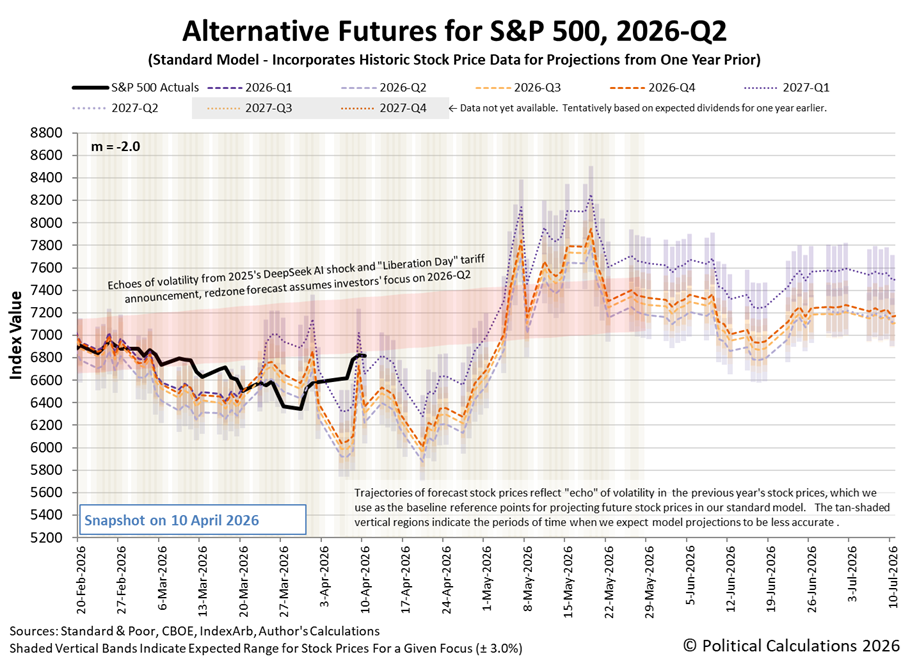
We had added the redzone forecast range to the chart, fully shown in this version, to compensate for the year-old echoes of two major volatility events, which arise from the dividend futures-based model's use of historical stock prices as the base reference points for its projections of the future. In this case, that was the echoes from February 2025's DeepSeek AI shock and President Trump's April 2025's "Liberation Day" tariff announcements. That redzone forecast range turned out to be ideally suited to use as a counterfactual to measure the impact of the Iran war geopolitical event on U.S. stock prices by indicating where they would reasonably have been in the absence of that event.
The rest is just keeping up with how the flow of news related to the Iran war's developments. Here are the week's market moving headlines:
Monday, 6 April 2026
Signs and portents for the U.S. economy:
Fed minions not keeping up with oil producer plans, worry about inflation:
Bigger trouble, stimulus developing in China:
IMF wants BOJ minions to keep turning the screws:
ECB minions say oil inflation may force them to drop perfect monetary policies:
Wall Street ends higher as traders price in de-escalation, while Iran rejects ceasefire proposal
Tuesday, 7 April 2026
Signs and portents for the U.S. economy:
Fed minions not so sure what they'll do next with monetary policies, claim they're not bothered by not yet having a new chief minion:
Bigger trouble, stimulus developing in China:
BOJ minions hellbound to hike Japan's interest rates:
Bigger trouble developing in the Eurozone as ECB minions start to think they will need to ditch their perfect monetary policy:
S&P 500, Nasdaq crawl out of red territory as Iran is reportedly reviewing two-week ceasefire deal
Wednesday, 8 April 2026
Signs and portents for the U.S. economy:
Fed minions shocked to find rate cuts back on the table after Iran war ceasefire:
Bigger trouble, smaller stimulus developing in China:
Bigger trouble developing in Eurozone:
Wall Street jumped over 2% and closed higher as U.S. and Iran agree to conditional ceasefire
Thursday, 9 April 2026
Signs and portents for the U.S. economy:
Bigger trouble, stimulus developing in China:
BOJ minions / Bigger trouble developing in Japan:
U.S. stocks gain for a second day while U.S.-Iran resolution is still uncertain
Friday, 10 April 2026
Signs and portents for the U.S. economy:
Fed minions point to tariffs contributing to inflation as it rises to hit their real target again, say it will take longer to lower it:
Sudden inflation arrives in China:
BOJ minions getting excited to hike Japan's interest rates again:
ECB minions excited for financial power grab in Eurozone:
Wall St ends mixed, notches weekly gains as investors parse Middle East negotiations
The Atlanta Fed's GDPNow tool forecast of real GDP growth in the recently ended quarter of 2026-Q1 slowed to +1.3%, declining from the +1.6% growth anticipated a week earlier.
Comments
Log in or sign up to join the conversation.