

While much attention remains rightfully focused on near term price changes after the significant decline in March, this week's Market Review adds a longer-term perspective to the upward sloping trendline from the February 2016 low. Then, a few charts support the view that WTI crude oil will likely continue somewhat higher.
S&P 500 Index (SPX) 3193.93 gained 149.62 points or +4.91% last week. Friday it opened with a gap up after the surprise nonfarm payroll report, closing 81.58 points higher. In the last three weeks, it added 11.12%. Now a modest pullback seems likely after the large one-day gain. The 200-day Moving Average at 3007.72 should provide support on any retreat.
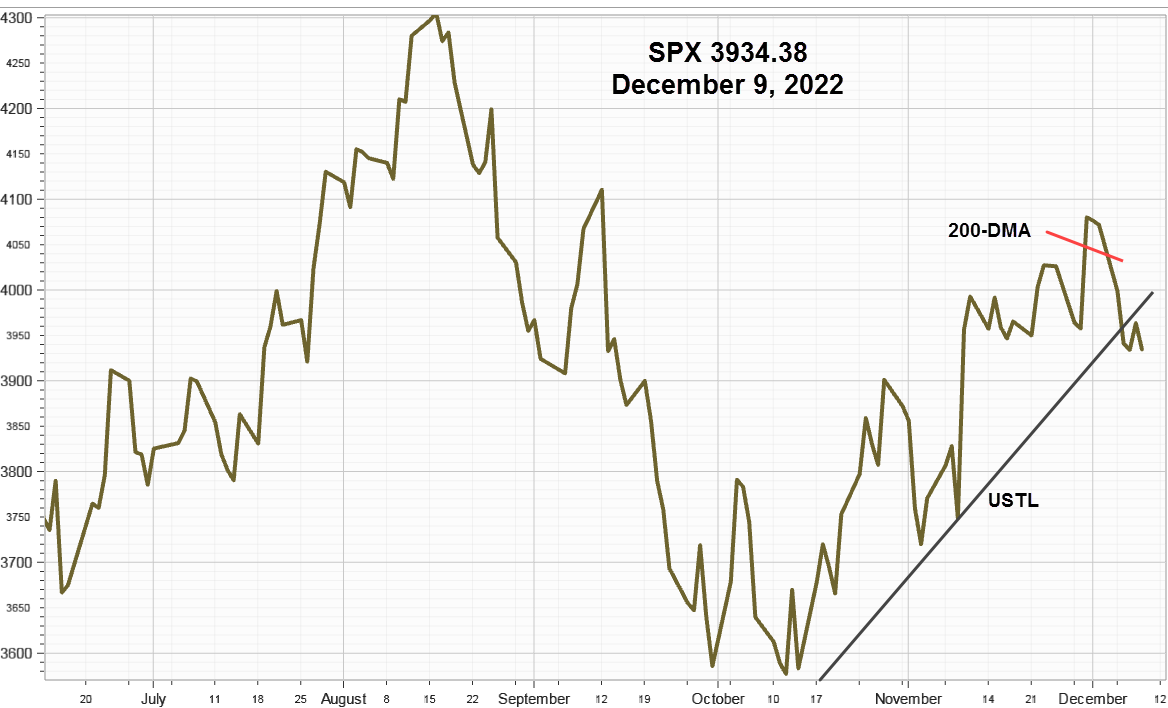
This chart adds perspective to the long-term uptrend.

The operative upward sloping trendline, USTL above, begins at the February 11, 2016 low of 1829.08. As the March decline crossed below the trendline, it changed the narrative to bear market, but now the rapid rebound challenges that early conclusion, especially as the retracement exceeds the 62% Fibonacci ratio with no sign of forming an Elliott 4 wave, assuming the impulse decline counted as wave 3. A semi-log chart would show SPX crossing below the USTL just a bit higher, around 2720 vs. 2620 shown above. Now it looks headed up to soon reach the previous high made on February 19, at 3393.52.
CBOE Volatility Index® (VIX) 24.52 declined 2.99 points or -10.87% last week. Our similar IVolatility Implied Volatility Index Mean, IVXM using four at-the-money options for each expiration period along with our proprietary technique that includes the delta and vega of each option, declined 3.02 points or -13.29%, ending at 19.70%.
The spike up to 77.15% on Monday, March 16, the day SPX declined 324.89 points, likely marks the top for this market decline. However, uncertainty may limit further declines until the SPX advances above the previous high.

VIX Futures Premium
This next chart shows as our calculation of Larry McMillan’s day-weighted average between the first and second-month futures contracts as of last Friday.

With seven trading days until June expiration, the day-weighted premium between June and July allocated 35% to June and 65% to July for a premium of 8.42% still in the yellow caution zone between zero and 10%, trending higher, vs. 6.73 % for week ending May 29.
The premium measures the amount that futures currently trade above or below the cash VIX, (contango or backwardation) until front month futures contract converges with the VIX at the next monthly futures expiration on Wednesday, June 17.
The relationship of the futures curve to the VIX, as measured by the premium, makes a good real-time sentiment indicator based upon actual commitments of large Asset Managers and Leveraged Funds.
For daily updates, follow our end-of-day volume weighted premium version located about halfway down the home page in the Options Data Analysis section on our website.
Crude Oil
Last week Digest Issue 22 "Beyond the 200 [Charts]" suggested WTI crude oil could be in the process of forming a Head & Shoulders bottom pattern implying it may continue up to fill the gap between 38 and 42 and then reach the measuring objective at 50.
Consider these three fundamental developments.
OPEC+ agreed to a one-month extension of output reductions while adopting a more stringent approach to ensure members keep their commitments. They all signed the revised deal to maintain a production cut of 9.7 million barrels a day to the end of July, instead of easing it to 7.7 million at the end of this month as originally planned.
Baker Hughes reported Friday that the number of active U.S. drilling rigs declined 17 to 284 last week after declining on a weekly basis since mid-March vs. 691 on June 7, 2019. Some now predict Permian shale supply will soon fall off a cliff.
EIA forecasts demand will exceed supply in the third quarter and then Germany approved stimulus measures to become a big spender thereby eventually increasing incremental demand in Europe.
This chart tells the story showing Friday's close moving into the gap.

From the CFTC's Disaggregated Commitments of Traders - Options and Futures Combined report as of last Tuesday, June 2, 2020, these charts show selected recent position changes.
With substantial financial risk and a vast information network "Managed Money,” the group that best correlates with crude oil price changes and arguably the most important, speculate on future prices. Shown a percentage of total open interest:

Next, Producer/Merchant/Processor/User (PMP)
A “producer/merchant/processor/user” represents entities engaged in the production, processing, packing or handling of a physical commodity that uses the futures markets to manage or hedge risks.

Having been net positive until the week of April 14, shorting then increased rapidly suggesting increased producer hedging activity and perhaps contango carry traders buying spot and selling futures.
One way to measure trend momentum is to watch open interest since it needs to keep expanding to sustain price trends both up and down.
This Z score chart standardizes changes in WTI Cash prices and futures Open Interest putting them on a comparable scale.

Until March 10, 2020, open interest had been trending lower since peaking on May 22, 2018. Then the quick advance corresponds with the rapid price decline that began on February 18, 2020, as shorting increased. Next, open interest peaked again on April 14, 2020, as shorts began covering, followed by a price low on April 21, 2020. These are cash or spot prices reported on the same day as the Commitment of Traders report.
It could be premature to declare the declining long-term open interest trend has changed since it will need increasing buying by "Managed Money" and "Others" to offset increases in shorting by producers who are likely hedging production again as prices rise. While there are other possible combinations at work including declining carry trades as inventories decline, keep an eye on the open interest trend that should increase along with the price. On the June 2 report, open interest was 2.78 million contracts, down from 3.38 on April 14.
Strategy
After Friday's 81.58 point gain by the S&P 500 Index, expect a pullback that could last long enough to close the gap created Friday. Last week rotation into cyclical like Energy and Industrials led the advance as the big cap NASDAQ stocks lagged.
Energy could also experience a pullback early in the week as the OPEC+ news was already in Friday's prices. Then assuming July futures find support at 38, the lower boundary of the gap range, consider SPDR S&P Oil & Gas Exploration & Production ETF (XOP) 63.72, out-of-the-money July 17 long call spreads
Summary
S&P 500 Index bullish momentum continued last week including a gap up open last Friday as it closed 81.58 points or +2.62% higher. A further advance up to the February high will challenge the bear market narrative that began with the sudden March decline.
Now overbought expect a brief pullback before it continues higher. WTI crude oil and the Energy sector will also likely continue advancing after a short-term corrective pullback.
Comments
Log in or sign up to join the conversation.