

Compared to the previous week, the S&P 500 (Index: SPX) didn't change much in the trading week ending on Friday, 30 October 2026. The index closed out the week at 7,580.07, down a little under 0.6% from where it closed the preceding week.
But that doesn't quite capture what happened. Stock prices rose the first three days of the week. And then, after the bell on Wednesday, 28 September 2026, tech giant Alphabet (Nasdaq: GOOG and GOOGL) reported not just that they were burning through cash to build up their Artificial Intelligence (AI) infrastructure, their advertising revenue from Internet searches was lower than expected, as their AI-based search feature underperformed expectations.
That was enough to deflate the company's stock by 12% on Thursday, 29 October 2026, which in turn, contributed to pulling the S&P 500 down by 0.3% for the day. But then after the market closed on Thursday, Amazon (Nasdaq: AMZN) and Intel (Nasdaq: INTC) delivered bad news of higher costs and falling revenues.
Of the two, Intel had the worst of it, with its stock plunging by over 28% by the time markets closed on Friday. More significantly, their combined bad news prompted investors to tank the stock prices of other chipmakers. Including the biggest company in the S&P 500, Nvidia (Nasdaq: NVDA), which lost over 4% of its value and became the second-biggest company in the index as a result by the end of the day.
By the end of the day, the S&P 500 lost over 1.8% of its total value. The latest update of the alternative futures chart shows the index' trajectory dropped to be near the bottom of the typical range the dividend futures-based model would place it assuming investors are focused on the current quarter of 2026-Q4 in setting stock prices.
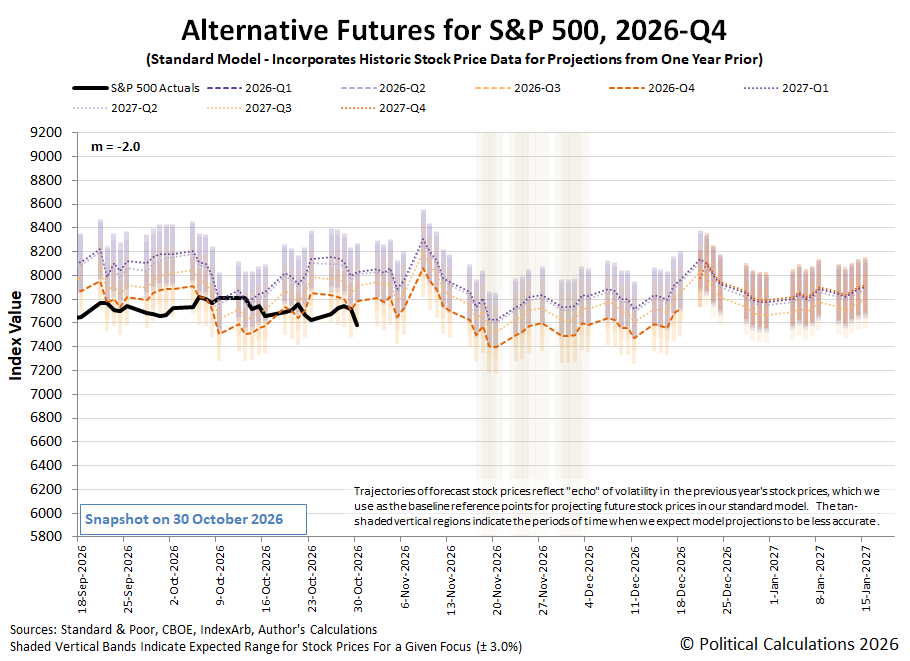
With bulls spooked by the sudden rapid deflation of some of the biggest companies in the AI tech sector after their earnings outlook shifted to be worst than expected, we can expect more outsize reactions as other companies report their earnings in the next few weeks. How stock prices will react will depend greatly on what new information investors will need to absorb from the newstreams. Much like they had to do with the market moving headlines from the final trading week of October 2026....
Monday, 26 October 2026
Signs and portents for the U.S. economy:
US retailers face record holiday delivery prices from surcharges tied to costlier diesel
Oil slides over 2% as traders weigh Saudi attack risks, demand destruction
US airlines favor higher fares over fuller planes as fuel costs squeeze profits
Microsoft to Trim Workforce with Buyout Offers for 60,000 Staff
Fed minions expected to leave interest rates unchanged this week:
Some growth signs developing in China:
Bigger trouble, wage-price inflation spiral developing in Japan:
Bigger trouble developing in Eurozone:
Wall Street ends higher as AI capex fears pause, Fed decision looms
Tuesday, 27 October 2026
Signs and portents for the U.S. economy:
Fed minions hear speculation in media about their next moves:
Bigger trouble, mixed growth signs developing in China:
Former BOJ chief minion super excited for more interest rate hikes in Japan, JapanGov minion standing by to keep Japan's currency from collapsing:
Bigger trouble developing in Eurozone:
Wall Street ends higher ahead of FOMC rate decision, big tech earnings
Wednesday, 28 October 2026
Signs and portents for the U.S. economy:
As expected, Fed minions leave U.S. interest rates unchanged, threaten future hikes:
Bigger trouble, stimulus developing in China:
Wall Street advances for the third consecutive session after the Fed keeps rates unchanged
Thursday, 29 October 2026
Signs and portents for the U.S. economy:
Fed minions thinking about their balance sheet:
Bigger trouble developing in China:
Job hunting chief ECB minion to quit ECB early as ECB minions skip rate hike for now with plan to hike Eurozone interest rates later:
Nasdaq sheds 1.4% as Alphabet’s historic drop rattles the markets, U.S. stocks suffer
Friday, 30 October 2026
Signs and portents for the U.S. economy:
Fed minions say inflation bad enough to justify rate hikes, but not until December 2026:
BOJ minions claim success in hitting their inflation target, thinking about more rate hikes later in year to contain it:
Bigger trouble developing in Eurozone:
S&P 500 ends week lower as AI concerns fuel rotation into defensive sectors
The CME Group's FedWatch Tool projections were unchanged. It still anticipates the Fed will next act to hike the Federal Funds Rate by a quarter point on 9 December (2026-Q4). Looking further forward in time, the FedWatch tool projects the Fed will hike this interest rate by a quarter percent on 17 March (2027-Q1). After that, the FedWatch Tool anticipates one more rate hike in 2027, coming when the Fed meets on 15 September (2027-Q3).
The Bureau of Economic Analysis reported its initial estimate for annualized real GDP growth during 2026-Q3 is +3.4%, just a bit lower than the +3.5% growth projected by the Atlanta Fed's GDPNow tool a week before.
The GDPNow tool has shifted forward to projecting the current quarter of 2026-Q4's inflation-adjusted economic growth rate, with its first estimate for the quarter coming in at 3.2%.
Comments
Log in or sign up to join the conversation.