

Geopolitical events dominated the first trading week of March 2026. The start of U.S. and Israeli military operations against Iran prompted a sharp rise in oil prices as Iran's military launched ballistic missile attacks against Persian Gulf nations and threatened shipping traffic through the strategic chokepoint of the Strait of Hormuz.
That escalation prompted marine insurers to cancel war risk coverage for oil container ships, which in turn, sharply reduced shipments of oil out of the Persian Gulf as shippers were unwilling to risk transiting the strait. The resulting new constraint on the 20% of global oil supply that is transported from the oil-rich nations of the Persian Gulf caused the global price of oil to jump over ten percent.
The increase in oil prices put central banks on notice to combat inflation. In the U.S., the prospects for additional interest rate cuts by the Federal Reserve during 2026 dimmed in response to the development. The CME Group's FedWatch Tool projects the Fed will delay an expected quarter point reduction in the Federal Funds Rate steady until 29 July (2026-Q3), six weeks later than what was anticipated a week earlier. The tool also projects another quarter point rate cut on 9 December (2026-Q4).
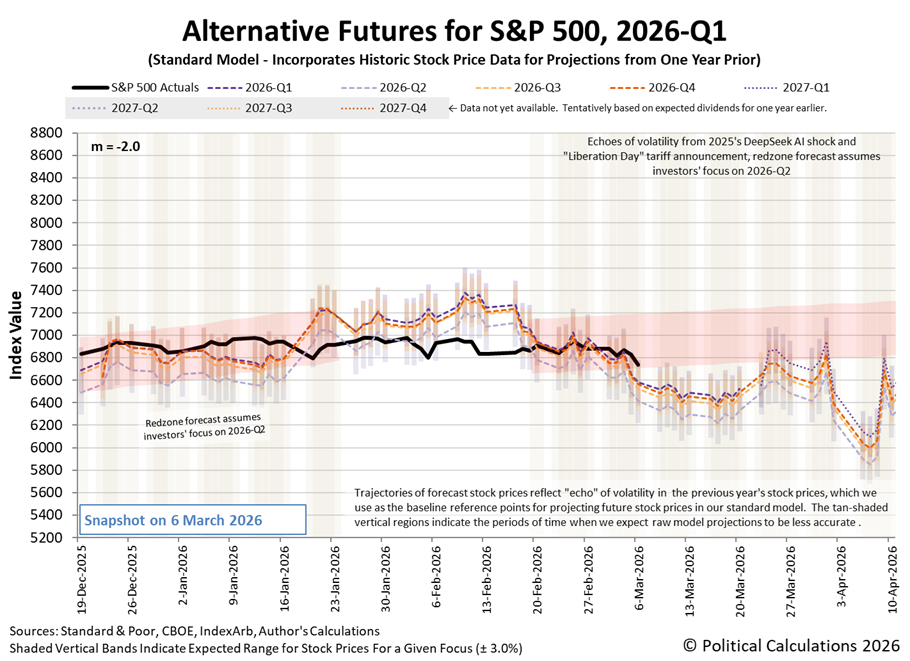
The effect on stock prices however was more muted. The S&P 500 (Index: SPX) declined 2.0% from its previous week's close to end the trading week at 6,740.02.
The latest update of the alternative futures chart shows the trajectory of the index is still within the redzone forecast range we introduced in the previous edition of the S&P 500 chaos series, but instead of being in the middle, it moved near the lower end of the range.
Although geopolitics delivered the week's biggest news, other news influenced investor expectations of the future as well. Here are the week's market-moving headlines:
Monday, 2 March 2026
Signs and portents for the U.S. economy:
Fed minions trying to grasp what AI technologies mean for monetary policies:
Bigger trouble, stimulus developing in China:
BOJ minions still excited to hike Japan's interest rates:
Nasdaq ends higher as U.S. stocks recover amid U.S.-Israel-Iran conflict escalation
Tuesday, 3 March 2026
Signs and portents for the U.S. economy:
Fed minions say they might not cut rates when expected if oil prices rise too much:
Bigger trouble, stimulus developing in China:
BOJ minions suddenly not so sure they'll hike Japan's interest rates so soon, thinking about getting into blockchain:
ECB minions still thinking they leave Eurozone interest rates alone, suddenly worried about inflation:
U.S. stocks ended lower amid Middle East conflict and South Korea chip selling
Wednesday, 4 March 2026
Signs and portents for the U.S. economy:
Fed minions divided over more rate cuts:
Mixed economic signals, stimulus developing in China:
BOJ minions locking in on rate hikes no matter what:
ECB minions having flashbacks of last time they blew inflation forecast after shock event:
Thursday, 5 March 2026
Signs and portents for the U.S. economy:
Fed minions say higher inflation and good jobs data could derail rate cuts, claim they see no big job losses from AI:
Bigger trouble, stimulus developing in China:
ECB minions not sure of next actions, suddenly worried about inflation and potential need to bailout banks in Eurozone:
Wall Street sinks as oil prices top $80/bbl after renewed Iran war escalations
Friday, 6 March 2026
Signs and portents for the U.S. economy:
Fed minions still divided on which way to go with monetary policies:
Bigger stimulus, deals developing in China:
BOJ minions suddenly thinking about not hiking Japan's interest rates again, standing by to keep currency from collapsing:
ECB minions worried world events may disrupt their perfect monetary policy:
S&P 500, Dow end week lower as nonfarm payrolls contract, oil prices accelerate
The Atlanta Fed's GDPNow tool forecast of real GDP growth in 2026-Q1 dropped to +2.1%, down from the +3.0% growth anticipated a week earlier.
Comments
Log in or sign up to join the conversation.