

The S&P 500 (Index: SPX) lost money every day of the trading week ending on Friday, 26 June 2026. By week's end, the index dropped 1.95% from the previous week's close, ending up at 7,354.02. That's about 3.4% below its 2 June 2026 record high.
It wasn't a big change as stock market volatility goes, but there is something interesting going on within it. The biggest stocks within the S&P 500, many of them making big bets on Artificial Intelligence (AI) technologies or having become big because they produce the infrastructure those bets on AI require, were down.
Since the S&P 500 weights its holdings of its component stocks by their market capitalization, having these biggest stocks of the index decline would be expected to take a bite out of the index as a whole. Which is indeed what happened.
What wouldn't necessarily be expected in that scenario is for the other, smaller stocks of the index to power higher, which also happened.
In the latest update of the alternative futures chart, we've added a new redzone forecast range to compensate for the echo of 2025's AI-powered recovery from the 'Liberation Day' global tariff event, during which we anticipate the S&P 500 will undershoot the dividend futures-based model's raw projections.
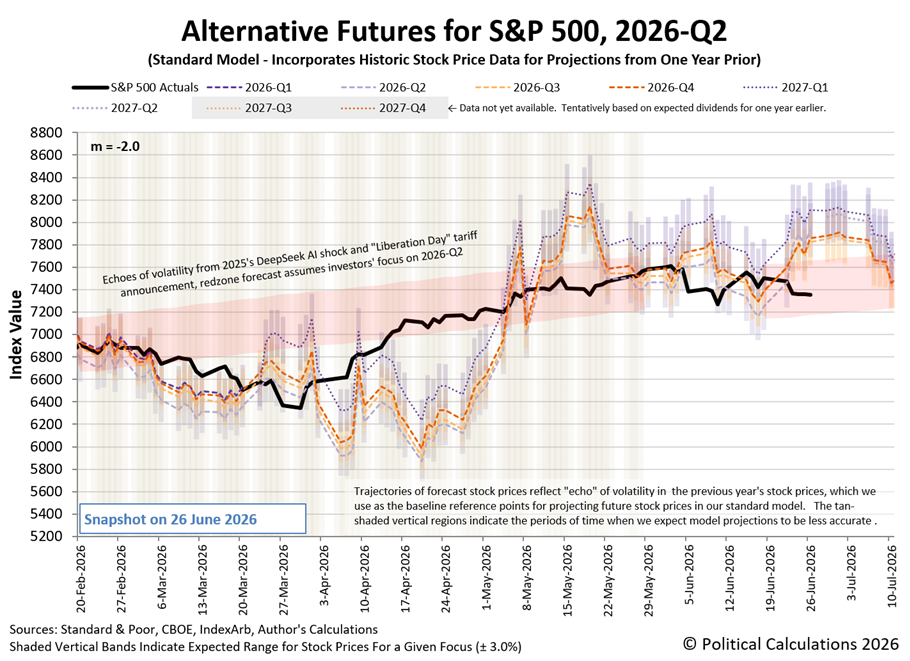
The echo effect arises because the model incorporates historic stock price data as the base reference points of its projections of the index' likely future trajectories. We add the redzone forecast ranges when we know the echoes of the past volatility of stock prices will affect the model's projections, in which we bridge across the period that will be affected. For this newest redzone forecast range, we've assumed investors will focus on the now current quarter of 2026-Q3 in setting current day stock prices, anchoring it on that trajectory on 18 June 2026 and setting the other end on the model's projections of where the S&P 500 will be on 27 July 2026, provided they hold their forward looking focus on 2026-Q3.
We expect investors will mostly hold their focus on this quarter because of the likely timing for when the Federal Reserve will hike short term U.S. interest rates. On that count, the CME Group's FedWatch Tool continued to project the Fed will hike the Federal Funds rate by a quarter point to a target range of 3.75-4.00% after the Fed meets on 16 September (2026-Q3).
Meanwhile, here are the market moving headlines that investors had to absorb during the trading week that was:
Monday, 22 June 2026
Signs and portents for the U.S. economy:
New chief minion's style affecting how investors read Federal Reserve's intentions:
Mixed economic signs developing in China:
Bigger stimulus slowly developing in Japan:
ECB minions say their 'neutral rate' analysis is useless for policymaking:
S&P 500, Nasdaq end in the red as tech suffers, traders weigh in Middle East peace talks
Tuesday, 23 June 2026
Signs and portents for the U.S. economy:
Fed minions slow to respond to changing conditions for inflation; say Iran war oil price shock wasn't big deal:
Bigger trouble, stimulus developing in China:
ECB minions say they'll wait for data, but signal more interest rate hikes are coming even as bigger trouble develops in Eurozone:
Wednesday, 24 June 2026
Signs and portents for the U.S. economy:
Fed minions give passing stress test results to U.S. banks:
Growth signs developing in China:
BOJ minions thinking about next move to hike Japan's interest rates:
U.S. stocks pull back as tech selloff persists, oil prices drop
Thursday, 25 June 2026
Signs and portents for the U.S. economy:
Fed minions expected to take summer off from more rate hikes, say their policy is 'well positioned' to lower inflation:
Bigger stimulus, trouble developing in China:
China central bank to add tool to better manage short-term liquidity
China's 'future industries' push triggers flood of venture capital, bubble concerns
China's carmakers rush to Canada as a ‘practice run’ for US sales
China's top auditor says major state banks have committed tax evasion or lending violations
Bigger stimulus, rate hikes developing in Japan:
ECB minions say persistent inflation in Eurozone will make them keep hiking interest rates:
Wall St ends mixed as tech megacap declines outweigh upbeat chip outlook
Friday, 26 June 2026
Signs and portents for the U.S. economy:
Bigger stimulus developing in China:
BOJ minions find inflation to fight in Japan:
Bigger trouble developing in Eurozone:
The Atlanta Fed's GDPNow tool's estimate of real GDP growth for the U.S. economy in the current quarter of 2026-Q2 dropped to +2.5% from the previous week's real growth estimate of +3.0%.
Comments
Log in or sign up to join the conversation.