

Red sauce is the key ingredient for many culinary recipes. Food processing businesses rely on constant supply of concentrated tomato products. It can be tricky to find rich quality ingredients as the cost of products will stay affordable without compromising on the taste. high quality tomato paste makes it easy for food manufacturers to please consumers with wonderful meals that make them come back.
When dealing with international suppliers or foreign manufacturers, it is important to know the basics of trade terminology. The meaning of the expression ‘tomato paste‘ in Chinese will allow you to communicate with the manufacturers, analyze product specifications and get better terms for your purchases.
What Is Tomato Paste in Chinese?
In communication with the suppliers of Chinese food, improper dialogue can lead to unwanted shipping incidents.
In the world of trade, Tomato paste refers to ketchup or artificial sauce. If you require raw ingredients for food production or canned food, you should order Tomato paste. The expression allows you to get high quality tomato paste instead of sweet sauce.
China is one of the biggest tomato-producing countries. The regions in China such as Xinjiang provide a long period of sunshine, arid weather, and significant variance in temperature between day and night. All these conditions give juicy, tasty tomatoes with a lot of solid content which are harvested by processing factories.
What Defines High Quality Tomato Paste?
Not all paste performs the same in large commercial kitchens or food packaging plants. Buyers must evaluate key technical traits before placing large import orders.
1. Brix Levels (Thickness and Density)
Brix indicates the degree of natural sugar solids concentration in food product. Higher Brix means thicker pastes with significantly less water.
• 28-30% Brix means the ideal density of canned products, small sachets, and retail cooking products.
• 36-38% Brix indicates dense bulk concentrate packed in large steel drums. Food manufacturing companies will later dilute this raw material to make ketchup, pizza sauce, juices, and soups.
2. Coloration (A/B Value)
The color denotes the freshness of the ingredients as well as the degree of heat employed while cooking. Pasta of an excellent quality has red color with no sign of browning which indicates that the product has not gone through high-temperature processes.
3. Viscosity and Flow (Bostwick Scale)
Viscosity determines how quickly a product flows on the surface of a specific test plate. Good quality tomato paste in Chinese has good viscosity and ensures proper emulsification with oils, broths, and spices while cooking.
4. Pure Ingredients and Safety
The clean products consist of good quality, ripe tomatoes along with simple salt if necessary. The top suppliers perform strict quality control tests to prevent any presence of dirt, bacteria, or any other foreign particles from coming into play.
Varied Packaging Needs for Varied Markets
• Different distribution channels have different needs when it comes to packaging types. The company Tianjin Shinhoo Food co.,ltd uses high-tech, automated lines to ensure that the needs of customers all over the world are taken into account.
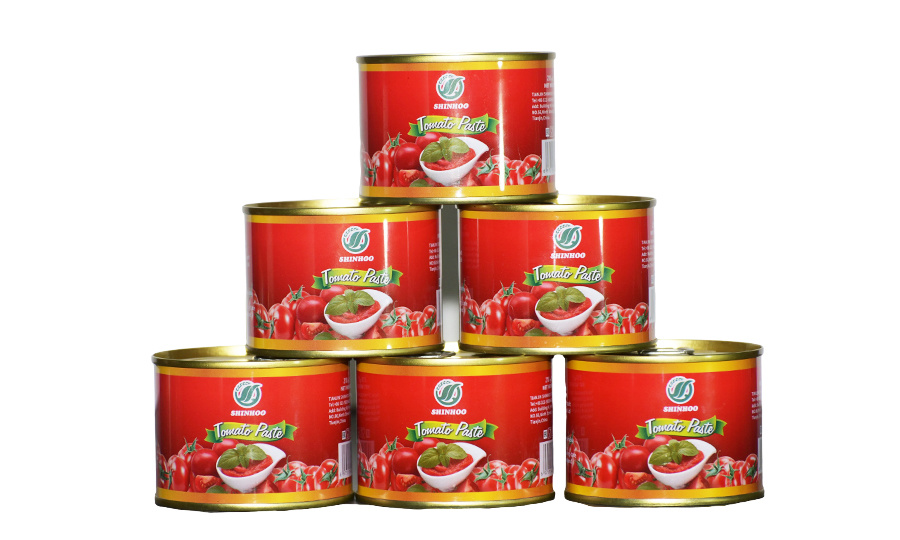
• Canned paste: Available in steel cans with an easy-to-open or a tough-open option, in sizes 70g, 210g, 400g, 800g, and 2.2kg. The cans keep the product away from light and air and thus extend its shelf life for up to two years.
• Sachets: Produced in small foil packets in sizes from 50g to 70g. The sachets enable individual portions to be distributed at a low price to street food vendors and for cheap meals and products.
• Bulk drums: made of aseptic bags in big steel containers of 220 liters. The companies also buy drum stocks to produce sauces, marinades, hot pot bases.
Smart Supply Chain Access via Tianjin
The logistics of shipping significantly influence the pricing of the final product. Tianjin Shinhoo Food co.,ltd, a prominent company located in the Tianjin Binhai New Area, is settled near Tianjin Xingang port. This place is one of the major ports of north China, and its location minimizes costs incurred in transportation with the use of trucks and speeds up the loading of containers into ships.
The new equipment includes the use of automatic feeding lines, vacuum degassing, and tubular thermal sterilizing. The automated process guarantees elimination of harmful microorganisms and preservation of the productive tomatoes’ color and vitamins. With the yearly production rate equal to 60,000 tons of goods, the factory employees manage to deliver all orders within the deadline.
Key Takeaways for Food Buyers
Sourcing the best ingredients is essential for running a successful and trusted food manufacturing enterprise. It's important to follow the following steps:
Indicate the Brix requirements according to how the ingredients are being aimed to be used.
Make sure to get color and Bostwick test reports prior to shipping.
Choose partners that can be found close to the main transportation hubs to save on shipping costs and not to experience port delays.
Comments
Log in or sign up to join the conversation.