

Solar Battery Cost in NSW: What Homeowners Actually Pay in 2026
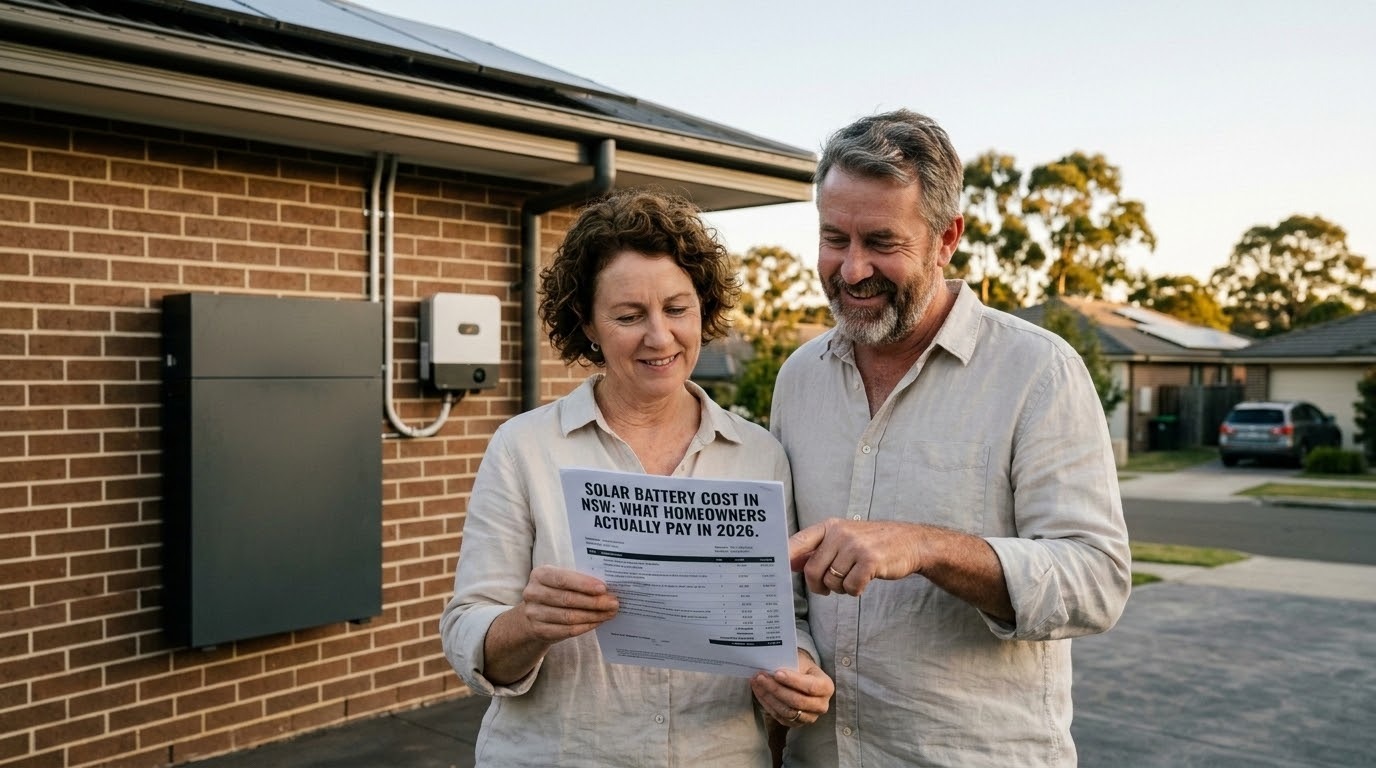
Solar battery storage in NSW costs $7,000 to $22,000 installed in 2026, depending on capacity, brand, and installation complexity. A mid-range 10 kWh system from a reputable brand runs $10,000 to $15,000 before rebates. NSW Government incentives through the Home Energy Saver Program can reduce that figure by $1,600 to $4,000 for eligible households.
Key Takeaways
Installed solar battery cost in NSW ranges from $7,000 (5 kWh) to $22,000+ (15 kWh+) before rebates in 2026
A 10 kWh mid-range system - the most common residential size - costs $10,000 to $15,000 all-in installed
The NSW Home Energy Saver Program (launched June 2026) reduces upfront cost for eligible households by up to $4,000
Lithium iron phosphate (LFP) batteries cost more upfront but degrade 30 to 40 percent more slowly than older lithium-ion
Payback period in NSW is 6 to 9 years at current electricity rates of 30 to 35 cents per kWh
What Drives Solar Battery Cost Up or Down
Three variables account for most of the price difference between quotes: storage capacity, battery chemistry, and installation complexity. Capacity is measured in kilowatt-hours (kWh) - the higher the kWh, the more evening and overnight load the battery covers, and the higher the price.
Cost breakdown by variable:
Capacity: 5-7 kWh costs $7,000 to $10,000 installed. 10-13.5 kWh costs $10,000 to $15,000. 15 kWh+ costs $15,000 to $22,000
Chemistry: Lithium iron phosphate (LFP) commands a 10 to 20 percent premium over older NMC lithium-ion but lasts 25 to 30 percent longer
Installation: Single-phase homes with a new solar system cost less to install than three-phase properties or battery-only retrofits requiring switchboard upgrades
Brand: Tier-1 brands (Sungrow, Tesla, Anker SOLIX, FranklinWH) carry 10-year warranties; budget brands often provide only 5-year coverage
Average Price Ranges by System Size in NSW - 2026
Here is what homeowners in NSW are paying for installed solar battery systems in 2026:
5-7 kWh system: $7,000 to $10,000 installed. Suits a 1-2 person household with daily consumption under 15 kWh
10-13.5 kWh system: $10,000 to $15,000 installed. Suits a 3-4 person household using 20 to 25 kWh per day
15+ kWh system: $15,000 to $22,000 installed. Suits larger households, those with EVs, or homes running ducted air conditioning
These figures include the battery unit, hybrid inverter (if required), installation labour, metering changes, and GST. They do not include design fees or any additional switchboard upgrades, which add $500 to $2,000 if required.
NSW Rebates That Reduce What You Pay
NSW residents in 2026 can access two main sources of financial support for battery storage. The NSW Government's $557 million Home Energy Saver Program, launched in June 2026, provides rebates and low-interest loans to eligible low-to-middle income households for battery installation. Separately, the federal Small-scale Technology Certificates (STCs) scheme reduces the installed cost of eligible solar-plus-battery systems.
Understanding exactly which rebates apply to your property and how to access them before signing a contract is essential. A detailed breakdown of current solar battery cost NSW rebate eligibility and how to stack available incentives is available from accredited local installers.
Is It Worth Pairing a Battery With Your Existing Solar System?
Retrofitting a battery to an existing solar system costs 15 to 25 percent more than installing battery and solar together, because the inverter often needs upgrading to a hybrid model. Despite the higher retrofit cost, the payback period is still typically under 9 years at current NSW electricity rates.
Battery retrofit makes financial sense when:
Your current feed-in tariff is below 6 cents per kWh and you are exporting more than 50 percent of your solar generation
Your household uses more than 15 kWh per day, most of it in the evening
Your existing inverter is a compatible hybrid model that supports battery integration without full replacement
If you are starting from scratch, designing a home solar panel system Central Coast NSW that includes battery storage from the outset saves $1,500 to $3,000 in inverter and labour costs compared to a two-stage installation.
Conclusion
Solar battery storage in NSW is a well-proven investment in 2026, with clear payback periods, strong government support, and a competitive installer market. Getting multiple written quotes from Solar Accreditation Australia accredited installers - each showing full system specifications and rebate calculations - is the most reliable way to understand what you will actually pay. To get a detailed quote for your property, contact Resinc Solar for a no-obligation assessment by an accredited installer covering the Central Coast and surrounding regions.
FAQs
Q-1: How much does a 10 kWh solar battery cost in NSW in 2026?
A 10 kWh solar battery system costs $10,000 to $15,000 fully installed in NSW in 2026, including the battery unit, hybrid inverter, installation labour, and GST. This is the most common residential battery size installed across NSW and suits households using 20 to 25 kWh per day. NSW Government rebates under the Home Energy Saver Program can reduce this figure by $1,600 to $4,000 for eligible households. Always confirm whether switchboard upgrade costs are included in the quote, as these add $500 to $2,000 if your existing board is not battery-ready.
Q-2: What is the cheapest solar battery available in NSW?
Entry-level 5 kWh solar battery systems start at approximately $7,000 installed in NSW in 2026. At this price point, most systems use budget-brand batteries with 5-year warranties and basic monitoring. Tier-1 LFP batteries in the 5-7 kWh range start at around $8,500 installed and carry 10-year warranties with cycle life guarantees. Choosing the cheapest option carries real risk - a battery that degrades to 60 percent capacity in year 7 costs far more in lost savings than the $1,500 saved upfront.
Q-3: Do NSW solar battery rebates stack with federal STCs?
Yes. NSW Government rebates under the Home Energy Saver Program and federal Small-scale Technology Certificates (STCs) can be applied to the same installation, provided the system and installer meet the eligibility criteria for each scheme. STCs are typically discounted at the point of sale by the installer rather than claimed separately by the homeowner. NSW rebates require a separate application with proof of income eligibility. Your Solar Accreditation Australia accredited installer should handle both applications as part of the installation process.
Q-4: How long does a solar battery last in NSW conditions?
Tier-1 lithium iron phosphate (LFP) solar batteries installed in NSW typically retain 70 to 80 percent of original capacity after 10 years of daily cycling. Older lithium-ion (NMC) batteries degrade faster, typically reaching 70 percent capacity in 7 to 8 years. NSW's climate is mild enough that temperature degradation - which accelerates in very hot or very cold environments - is not a major factor for most installations. Battery longevity is also affected by how deeply the battery cycles each day; shallow daily cycles (40 to 80 percent of capacity) extend lifespan significantly.
Q-5: Is a solar battery worth the cost in NSW right now?
At current NSW electricity prices of 30 to 35 cents per kWh and a 10 kWh battery discharging 8 usable kWh per evening, annual savings from the battery alone reach $875 to $1,015. Combined with solar panel savings of $1,500 to $2,500 per year, a combined solar and battery system delivers a payback period of 5 to 8 years and generates returns for 20 years or more. With electricity prices forecast to remain elevated through 2026 and beyond, the financial case for battery storage in NSW is stronger now than at any previous point.
Comments
Log in or sign up to join the conversation.