

Making Work Better
Since I started following Dropbox (DBX) a few years ago I have gone back and listened to several historical interviews with Co-founder and CEO, Drew Houston. From the beginning, Houston has had a consistent message and execution on a strategy of “making work better.” This strategy has hit its wheelhouse in the 2020 Covid work-from-home era but the market continues to yawn. This is an opportunity.
Dropbox is a software-as-a-service (SaaS) cloud company. Dropbox provides the technology infrastructure and computing platform in “the cloud” which means it has data centers around the world that store and secure customer data (infrastructure) and a cloud storage platform integrated with a “workspace” that resides on that infrastructure. The customer pays for the platform software that is accessed through an internet browser or synchronized desktop applications.
Right now, I am typing on the Dropbox Paper app and as I do the content gets automatically saved and backed up by Dropbox. I do not have to deal with hard drives, etc. I just need a computing device (desktop computer, laptop, tablet, of phone) and an internet connection. I started this Letter on a Mac desktop computer but I am now continuing it on a Macbook Pro laptop. If I get some bright idea in the middle of the night, I can reach for my phone and type right into this same Letter. The software runs and synchronizes on all my devices and it always does so flawlessly. My business workflows and investment writing continues to get more deeply integrated into the Dropbox platform.
Dropbox started as simply a cloud backup and storage provider. For a company with a vision to make work better, it was a good place to start and we should not forget that it was the leader in doing so giving it a fundamental legacy of success. Some investors still think that this is all the company does. I do not get mad, I get glad because it ultimately always pays to see a picture more clearly than others. I have yet to read an articulate bear case from someone who actually understands what the company does and what its edge is. The “professional” analyst community—you know the guys on the quarterly earnings calls trying to figure out if the operating margin will be 10% or 12% next quarter (or whatever)—seems to have finally figured it out and their increasing target prices reflect this. Kudos to them. They will look good on this one soon enough.
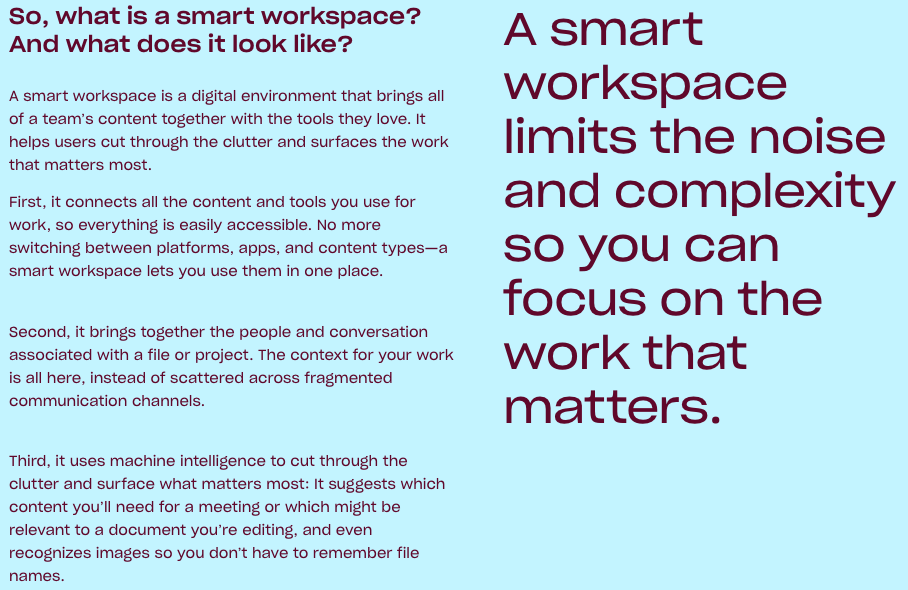
Dropbox has evolved from simply a file storage platform to a content collaboration platform where multiple users can collaborate (commenting together) on the same files and Paper canvasses (I’ll explain Paper in a moment) to a new further evolution to what the company aptly refers to as “Smart Workplace”. Here is a tidbit from the company website that gives you a flavor of it:
Source: Dropbox website
A key innovation for Dropbox last year was the launch of its Desktop app which is essentially the new Smart Workspace. Notably, the Desktop app gets users out of the clunkiness of working from a web browser (often with multiple tabs at a time) to a more central Smart Workspace. Smart Workspace is a perfect description because it makes the overall Dropbox platform a knowledge worker’s operating system within their operating system. Dropbox started off with the goal of making work better. The software is now front-in-center of millions of knowledge workers and with it the company is beginning to truly execute on that vision.
Building upon the file storage and sharing base, Dropbox has expanded to include the following:
-
Paper is an open and flexible content creation application—a sort of digital canvas—that is fully integrated with the main Dropbox file platform. It can be used for such things as creating collaborative meeting notes, presentation content (including images, videos, etc.), checklists, templates for repetitive content needs, and of course it is used for the True Vine Letter. I now store all of my Letters and associated images there and in Dropbox files so that I have everything should I need to change my website or simply reference materials.
-
Showcase is an elegant way to present from Dropbox. With the Zoom integration, users can present easily from Showcase which includes the ability to embed videos.
-
Transfer is the tool for transferring large files.
-
HelloSign is an eSignature and form creation (HelloWorks) platform that was acquired by Dropbox in early 2019 for $230 million. HelloSign is similar to Dropbox in that it has a clean, easy to use interface. Major competitors in the eSignature market include DocuSign (DOCU) and Adobe’s (ADBE) Adobe Sign. I have used DocuSign, HelloSign, and JotForm (private). For simply having documents signed or simple forms completed within an organization, HelloSign is the best option. DocuSign has a more developed product and works well for more complex document workflows requiring signatures. For building complex forms with multiple unique features, JotForm is superior. I used JotForm to build digital onboarding forms for prospective advisory clients and ultimately chose it over HelloSign for a specific security requirement that I needed. I would describe HelloSign as a quality product with a lot of potential. It is an excellent fit for Dropbox.
All of these functionalities and/or products integrate with the Smart Workspace.
Before moving on, it is interesting to note that from a relative valuation standpoint Dropbox’s annual free cash flow is roughly 5 times that of DocuSign but DocuSign’s market cap is more than 5 times larger than that of Dropbox. Free cash flow almost always, ultimately has the last word. This is a topic that I will be covering in the future on the Letter.
Critical Takeaways
At this juncture in the Dropbox evolution I think there are 2 critical attributes to understand about the Smart Workspace platform: open integration and stickiness:
Smart Workspace has an open ecosystem that integrates with essentially all other productivity applications, but especially deeper integrations with key players Microsoft Office, Zoom, Atlassian, Slack, BetterCloud, and Google Workspace. As I mentioned earlier, it is becoming a sort of operating system within an operating system for knowledge workers. This integrated open architecture continues to set it apart from competitor Box (BOX) which has taken a different route as an exclusively enterprise-grade content management, file storage and sharing, and collaboration platform. An individual using the Smart WorkSpace does not have to sacrifice the use of any other productivity application. They can “quarterback” their work from the Smart WorkSpace and, in many cases, seamlessly use other key applications without having to leave Dropbox. CEO Houston has noted that they really do not see anyone else doing specifically what they are doing.
The integrated Smart Workspace open ecosystem leads to the second critical attribute of stickiness. Users, like myself, begin to deeply embed their business processes around the Smart Workspace making it an essential application that I suspect they will also be willing to pay more for overtime. For a knowledge worker who uses the Smart Workspace daily to create, store, share, and collaborate on content, the price is really minuscule for the productivity value that comes from it. The next phase of product evolution will be interesting to watch from this standpoint. If future developments continue to build out and deepen these critical attributes, then investors may begin to anticipate increased average revenue per user (ARPU) leverage over time. On this last point, there are 2 things investors need to keep in mind.
First, because of Dropbox’s ample pricing tiers, users who do not need or are not willing to pay more for whatever reason do not need to be forced out. The ARPU expansion can be targeted toward aggressive users who will readily absorb higher pricing for what is increasingly becoming a must-have, especially as new organic product developments or acquisitions continue to enhance the overall value proposition. And this is nuanced. One user might not need or want to use HelloSign but some new feature or application acquisition may change the game entirely for them—increasing the criticality of the Smart Workspace for them personally (or their organization) by a considerable measure. A new plug-in acquisition or feature does not have to increase the prices of the product tiers to increase revenue. Just having some users upgrade to higher tiers because of these will increase ARPU.
Second, because Dropbox’s real competition actually continues to narrow considerably, they are less likely to face the standard SaaS pricing pressure that others face with several more direct competitors. I use Apple’s hardware products but I would not even try to replace what I’m doing on Smart Workspace with Apple’s alternatives because they are comparatively unattractive and Dropbox’s service is far better.
Moreover, Dropbox’s strong free cash flow generation will continue to enable acquisitions that may be able to enhance this proposition like HelloSign did. I see the potential for a diagramming application and/or a workflow management functionality to be a powerful next step in this evolution. There may be some applications out there that handle this that Dropbox is already integrated with, but there is scope for a homegrown application to fill this void like Paper did as a content creation tool. I see this as a sort of final brick in the Smart Workspace foundation for the time being. All this makes Dropbox an attractive acquisition target for a company like Zoom (ZM) with a bloated valuation. Just think about it. If Zoom bought Dropbox and fully integrated the two applications, it would make it easier to sell the Dropbox Smart Workspace to business customers.
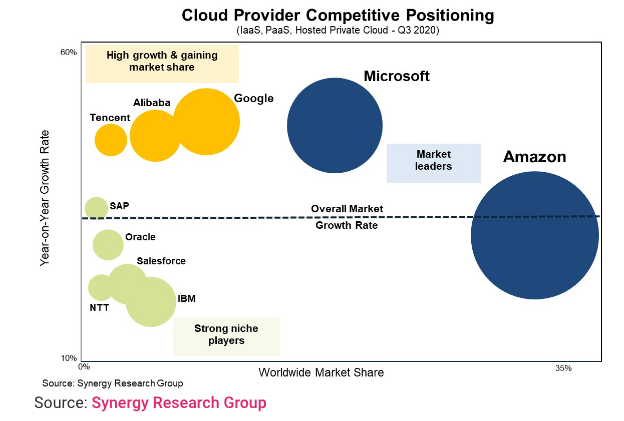
Dropbox bears frequently focus on strong competition and by this they mean Apple, Google, and Microsoft. Let me first address this by noting that in the early days of Dropbox Steve Jobs invited the co-founders to his office where he said they should sell to Apple. They respectfully declined, shrugged off the intimidation, and moved on. CEO Houston tells the story here. Jobs made the offer because Dropbox had built a better product. The “better product” advantage remains. The key advantage is that Dropbox’s open ecosystem means that the user does not have to stay tied down to strictly one vendor’s product lineup. I think we are now at the point where the size and resources of the big competitors really doesn’t matter. It comes down to (1) creativity, (2) design ingenuity, and (3) product execution. Dropbox is the leader here with intrinsic qualities that just can’t be bought or managed into existence.
In respect to product quality and competitive strength, a key going forward for Dropbox will be to focus on the customer and that is exactly what they are doing. They hold lengthy paid interviews with customers to (1) see how they use the product, (2) what work obstacles the face, and (3) what enhancement and feature suggestions they have. I have personally done one of these myself with a Dropbox employee. (Poor girl, I threw a lot at her.) I can’t imagine any of their big competitors reaching out to me like this. This focus on making working better continues to be a winning formula for the company.
The Financial Model
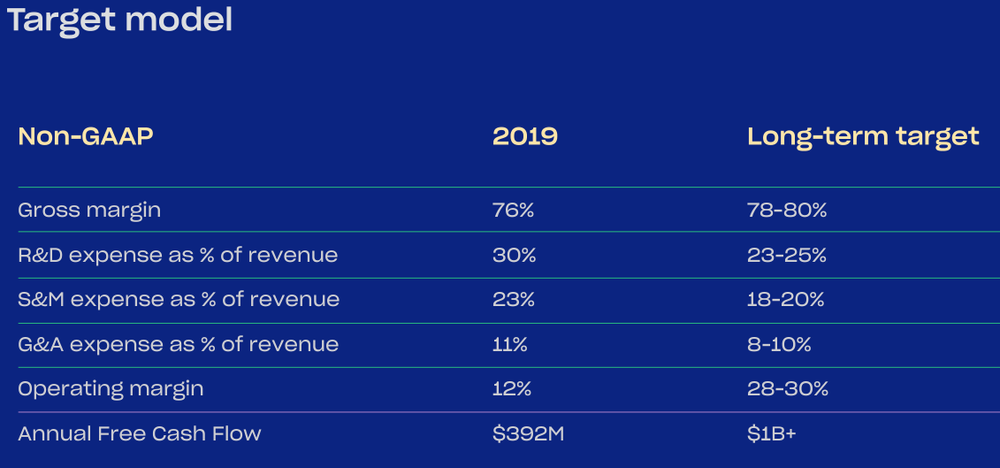
Company managements typically provide longer-term financial projections during investor days or similar events. These financial projections are critical for understanding (1) how management sees the business and (2) how investors should think about valuing the business. I am not talking about Total Addressable Market (TAM) fantasy land stories here, but real intermediate-term (e.g., 3 to 5 years) financial expectations coming from those closest to the trenches. Here are the highlights of the target model that Dropbox presented in 2019:
Source: Dropbox Investor Presentation
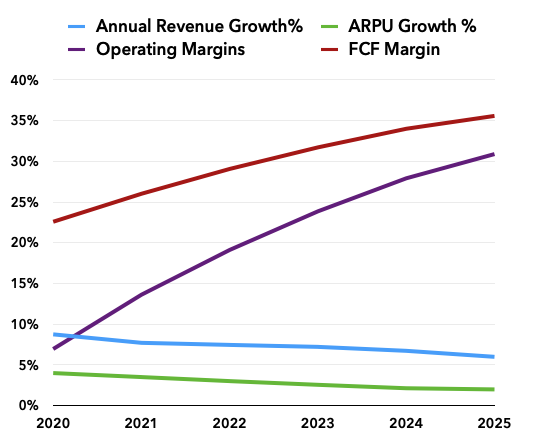
I incorporated these long-term targets into my own financial projections for the company. The following graphic reveals the annual revenue growth, annual ARPU growth, operating margins, and free cash margin trends that this Target Model implies:
Source: True Vine Investments
As revenues and ARPU continues to grow, howbeit at a gradually declining rate, operating leverage kicks in making Dropbox poised to reach the 30% operating margin threshold in the 2024-25 timeframe.
To gauge the long-term strength of the business, I think the key metric to pay attention to is ARPU growth. Over time, ARPU growth will tell us just how valuable customers are finding the Smart Workspace to be. Also, as the ecosystem is enhanced and becomes more entrenched in the workflows of customers, ARPU can grow as users upgrade to higher-tier plans. I think the ARPU growth I am modeling here is a bit on the conservative side and I would not be the least bit surprised to see significant surprises to the upside here.
Inflection Point Approaching
Given the financial glide path that this target model implies, I see Dropbox generating $1.36 in free cash flow per share in 2021. Given the long-term growth trajectory of the company, I value it at 22.5 times forward earnings so my 12-month target prices is $30.60 which represents 65% upside from the current price. If 2021 is not an inflection point for the share price of Dropbox, then 2022 will be as the stock is currently trading for less than 11 times my 2020 free cash flow per share estimate of $1.72.
Looking out further, to 2025, I see Dropbox at $3+ in free cash flow per share and $2+ in earnings per share. At a multiple of 18, we could be looking at a $54 per share in 4 to 6 years which is almost 200% upside. At the current price of $18.50 per share, and given the strengths of the business that I have described here, we could be looking at a Sprawling Vine longer-term from this starting point.
Tortoise Growth
Let’s face it. Dropbox has been shunned by software stock investors as they have preferred to throw money to the wind at about everything else. Here we have the classic tortoise and hare race at play. Because Dropbox is growing revenues at only 10% to 15% it has been forgotten. Nevertheless, this also provides one key advantage: it has left it to be ignored by its competitors.
What I see happening here is that by the time Dropbox’s Smart Workspace reaches its prime, it will be too late for competitors. Running the daily workstation for millions of knowledge workers will be fertile ground to expand new services and tools from.
The key thing I will remain focused on as I watch this company going forward is, are they truly making work better. From what I see, they are actually stronger now than they have ever been. The current focus on the value of removing distractions from knowledge workers exemplifies this. It is nice to see a company actually trying to do something about this. Dropbox is not really just a work-from-home play, it is a company that has truly been built for our modern work area, and ultimately, I think it will be a Sprawling Vine.
Company: Dropbox
Exchange: NASDAQ (USA)
Ticker: DBX
Sector: Technology
Industry: Application Software
Capitalization: Mid-Cap

Comments
Log in or sign up to join the conversation.