

Multiple financial publications have reported how historically on average September is the worst month for the overall stock market. Since 1950, the month of September has seen an average decline in the Dow Jones Industrial Average (DJI) of 1.1%, while the S&P 500 has averaged a 0.7% decline during September. Since the Nasdaq was first established in 1971, its composite index has fallen an average of 1% during September trading. This is, of course, only an average exhibited over many years, and September is certainly not the worst month of stock-market trading every year.
Investopedia reports there are several theories which attempt to explain this phenomenon. One particular theory points to the fact the summer months usually offer light trading volumes on the stock market, as a good deal of investors typically take vacation time and refrain from selling stocks from their portfolio. Once fall begins these investors typically return to work and exit positions they had been planning on selling. When this occurs, the market experiences increased selling pressure, and thus an overall decline.
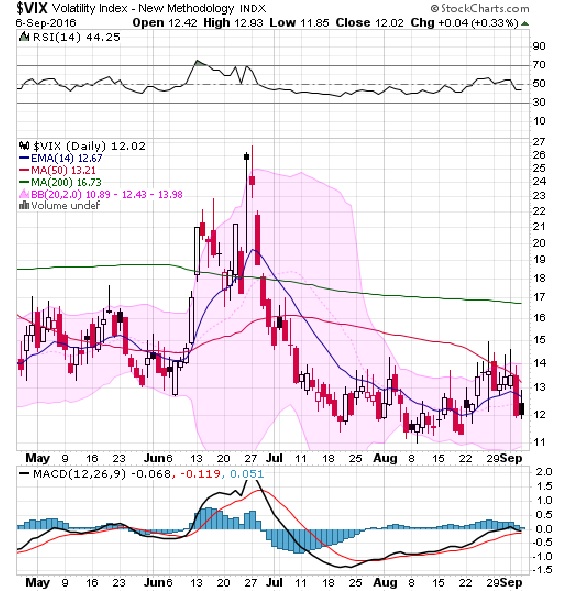
The CBOE Volatility Index (VIX) is known as the market’s “fear gauge” because it tracks the expected volatility priced into short-term S&P 500 Index options. When stocks stumble, the uptick in volatility and the demand for index put options tends to drive up the price of options premiums and sends the VIX higher. As evidenced in the chart below the VIX has been both low and in a very tight range. Currently, the VIX is about a point above its YTD low. The VIX has been almost entirely below 14 for 7 straight weeks now. In fact, the Volatility Index is down 53% over the past 10 weeks, the largest 10-week decline in history. If September market action follows the historical pattern, expect a continued low volatility environment. Unless there is unexpected financial news (e.g. Fed announcement) from a risk/reward perspective this is not an ideal time to expect directional trades to pay off. Credit spread trades to generate income usually works well during this time of year. You may not receive greater premium income compared to a higher volatility market, but if implied volatility remains subdued the proper credit spread trade is a limited risk opportunity.
Comments
Log in or sign up to join the conversation.