
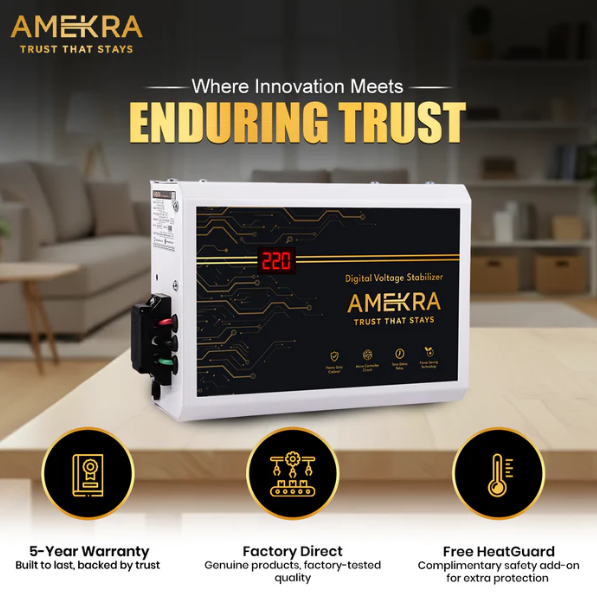
Power fluctuations are one of the biggest reasons behind air conditioner damage in Indian homes. A high-quality stabilizer for 1 ton ac helps protect your appliance from sudden voltage changes, improves performance, and increases the lifespan of your AC. At Amekra, the focus is on advanced voltage protection with the promise of “trust that stays.” Whether you use an inverter or non-inverter air conditioner, selecting the right stabilizer is essential for smooth and safe cooling.
A modern stabilizer for 1 ton ac is designed with intelligent voltage correction technology that automatically regulates input voltage before it reaches your air conditioner. This protection prevents compressor failure, overheating, and short circuits caused by unstable electricity. In areas with frequent voltage fluctuations, a stabilizer becomes a necessary investment rather than an optional accessory.
Understanding Stabilizer Technology
Modern stabilizers are equipped with microcontroller-based circuits that detect voltage variations instantly. These systems automatically boost low voltage and cut excess voltage to maintain a safe output range for the AC. Many advanced models also include:
Digital display for voltage monitoring
Time delay systems for compressor safety
Thermal overload protection
High and low voltage cut-off features
Surge protection against lightning or sudden spikes
An AC Stabilizer for 1 ton is specially designed to match the power requirements of smaller air conditioners. Using the correct capacity stabilizer ensures efficient cooling performance and reduced stress on the appliance.
Why Voltage Protection Matters
Air conditioners contain sensitive electronic components that can get damaged due to irregular power supply. Low voltage can force the compressor to work harder, while high voltage may burn internal circuits. A stabilizer helps maintain a balanced power flow, which improves energy efficiency and extends the life of the AC.
For larger cooling systems, an AC Stabilizer for 1.5 ton or a stabilizer for 2 ton ac is recommended because higher tonnage units consume more power and require stronger voltage handling capacity. Choosing the wrong stabilizer size can reduce protection and affect cooling performance.
Precautions While Using an AC Stabilizer
To get the best results from your stabilizer, users should follow a few important precautions:
Install in a Ventilated Area
Always place the stabilizer in an open and dry location. Proper airflow prevents overheating and maintains performance.
Check Voltage Range
Before buying, verify the voltage operating range. Areas with frequent low voltage should use wide-range stabilizers for better protection.
Avoid Overloading
Do not connect multiple appliances to the same stabilizer. It is designed specifically for the air conditioner’s load capacity.
Schedule Regular Maintenance
Dust accumulation and loose wiring can affect stabilizer efficiency. Periodic inspection helps maintain long-term reliability.
Buying Guide for the Right Stabilizer
When selecting a stabilizer, consider these important factors:
Capacity Compatibility
Choose a stabilizer according to your AC tonnage and power consumption.
Energy Efficiency
Modern stabilizers are designed to consume less electricity while delivering stable output.
Safety Features
Look for overload protection, digital monitoring, and automatic cut-off technology.
Brand Reliability
A trusted brand ensures better build quality, warranty support, and durable performance. Amekra offers dependable voltage protection solutions backed by advanced technology and the assurance of “trust that stays.”
Investing in the right stabilizer for 1 ton ac not only protects your cooling system but also ensures uninterrupted comfort during every season.
Comments
Log in or sign up to join the conversation.