

Few things have attracted more consensus that the belief that the US government has no choice but to "inflate away its massive $40 trillion debt" by devaluing the US dollar, a process that has a nasty habit of escaping the control of Central Planners and self-reinforcing into runaway / run-to-failure hyperinflation that destroys the economy.
As a hard-wired skeptic, when everyone is on board the same ship while the other side of the trade's ship has only a handful of contrarians and a few people wearing Silly Hats, I start wondering if Bob Farrell's famous Rule #9 will play out: "When all the experts and forecasts agree, something else is going to happen."
There are various game-theory and market dynamics supporting this truism: Self-Defeating Prophecy, group-think, etc., but there's another set of dynamics in play that few seem to think through.
Those empowered by their positions within the Central State have a keen interest in not letting the Central State devalue its currency--and thus its credibility and power--in a hyperinflationary death spiral. History offers few (if any) examples of hyperinflationary death spirals benefiting the citizenry, whose consent legitimizes the government.
While the consensus is confident that the US government "has no choice but to inflate away its debts" by debauching its currency, this discounts the survival instinct of those steering the ship. As already noted, only "madmen and economists" could believe that debauching the US dollar to "inflate away the debt" will generate a Hollywood ending to the drama--and it seems even madmen and economists don't believe it will lead to a Hollywood ending.
What's being discounted (other than Farrell's Rule #9) is the nation-state has other options other than destroying the value of its currency to inflate away the $40 trillion in Treasury debt. Doing nothing is popular because no one wants to make any additional sacrifices, but the irony here is painfully obvious: doing nothing feels like a victory until the currency and economy implode, laying waste to everyone's security.
There are various radical alternatives being proposed, for example, Ellen Brown's proposal to invoke the sovereign powers already granted to the nation-state: The Sovereign Reset: Escaping the Interest Trap with Greenbacks. These ideas are controversial, of course, because doing nothing remains the most popular and easiest choice, until something breaks and a crisis forces some action that proves undesirable to somebody.
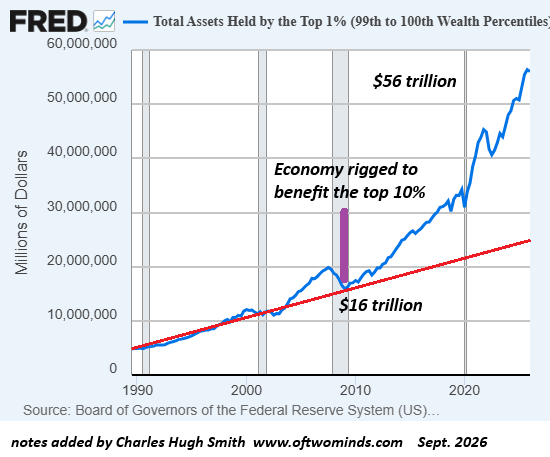
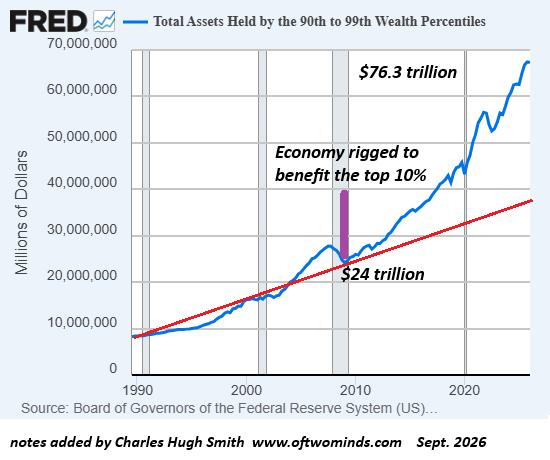
Post the rigging of the economy to favor the top 10% via monetary, fiscal and regulatory policy changes, the wealth of the top 10% tripled. The Federal Reserve breaks the top 10% into the top 0.1%, the top 1% and the top 90%-99%. The charts of the top 1% and the top 90%-99% are nearly identical: if the trend line of the previous decades had continued (i.e. unrigged), the assets held by the top 10% would be roughly half of their current levels.
This concentration of the nation's wealth is especially obvious in the top 0.1%, whose share of financial assets nearly doubled post-2010 from 7% to 13%:
The top 1%'s wealth more than tripled, from $16 trillion (poor things, only $16 trillion!) to $56 trillion:
The top 90%-99%'s wealth also tripled:
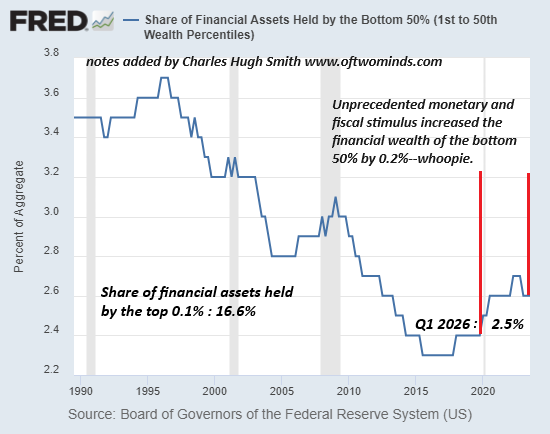
The bottom 50%'s share of financial assets--real wealth--plummeted: some are more equal that others in privatized totalitarianism. Note that the top 0.1%--340,000 people--own 16.6% of the nation's financial assets, 6.6X what the bottom 50%--170 million people--own, a 2.5% share of the nation's financial assets.
In terms of who got thrown under the bus and who's driving the bus, it's pretty obvious, isn't it? Here are the facts:
Top 10% share of total assets (everything with any monetary value: houses, vehicles, furniture, etc.): 64%
Bottom 50% share of total assets (everything with any monetary value: houses, vehicles, furniture, etc.): 5%
Top 10% share of total financial assets (assets that generate income and capital gains): 72%
Bottom 50% share of total financial assets (assets that generate income and capital gains): 2.5%
The rising tide of the monetary, fiscal and regulatory policy changes did not raise all boats: the share of financial assets owned by the wealthiest few doubled while the share of financial assets owned by the bottom 50% fell.
According to the Federal Reserve, the top 10% own $125 trillion in assets. If the economy hadn't been rigged to their exclusive benefit, their wealth--tracking the trendline of the previous decades--would have been about half this sum.
Doesn't common sense suggest that those owning 72% of the gains of our rigged economy should make 72% of the sacrifices needed to restore some measure of financial sense to the nation's accounts? In previous eras, this was called noblesse oblige, the obligation of the wealthy nobility to serve the shared interests of the entire society, not just their private interests.
It's almost amusing how those whose wealth tripled due to the economy being rigged to benefit the wealthiest 10% consider these gains "earned" and therefore sacrosanct, when the charts above indicate these gains were entirely the result of the casino being rigged.
It seems reasonably safe to assume the 200 million people thrown under the bus might not be amused when something breaks and a crisis demands resolution, and the 340,000 with political influence declare their wealth is sacrosanct. Few seem to think these dynamics through to their logical conclusion.
No wonder doing nothing is so popular with the wealthiest, most politically influential few.
If this doesn't sit well with the top 10%, they have another option: put their wealth to work electing adults instead of self-enriching toadies, sycophants, minions, lackeys and grifters who win re-election by passing out "free money" borrowed by the Treasury, money that accumulates interest paid by taxpayers.
The point here is there are options to destroying the currency and the economy, but they require something more than greed, which is all that's left in our rigged economy. When something finally breaks, greed won't provide a solution; it will only accelerate the dissolution and destruction.



Comments
Log in or sign up to join the conversation.