

The loudest silver story in July was a shooting war, but the more durable threat was a peaceful election in Peru, a country that digs up close to one silver ounce in six.
Silver trades near $59.43 an ounce as I write this, with the gold-silver ratio around 69. That ratio is simply the number of silver ounces it takes to buy one ounce of gold, and it sits near the high end of its historical range, a level long-term buyers read as silver being inexpensive against the larger metal. Silver is up more than 50% from where it stood a year ago, though it remains well below the record of $121.62 set on January 29.
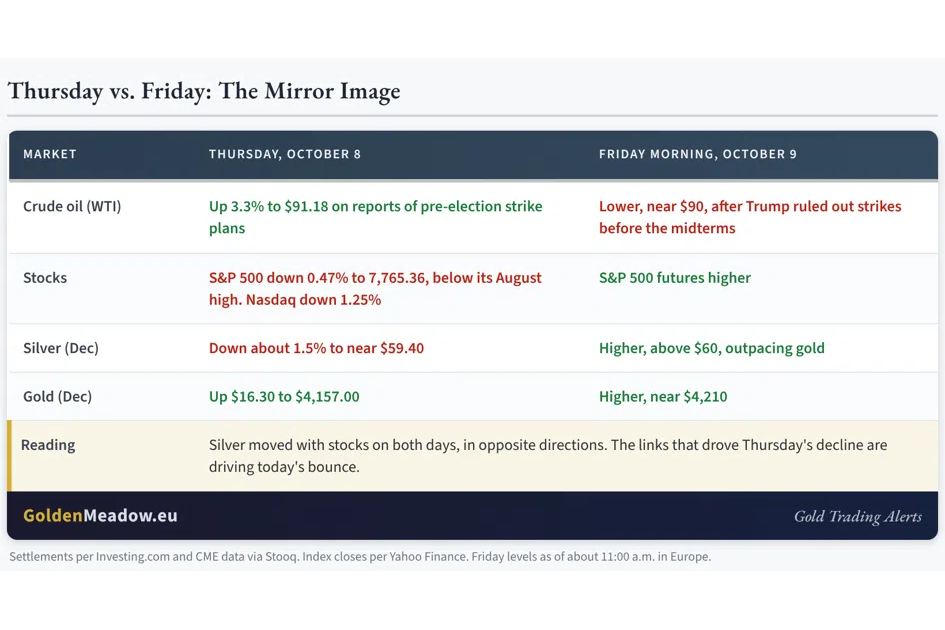
Most of the past fortnight's price action came from the Middle East, where renewed strikes on Iran drove oil higher and pulled silver down with it. That is the noisy, macro-driven side of the market, and it tends to dominate the headlines. Underneath it, though, a slower and more consequential story was developing on the supply side, in a country that rarely makes the front page of a metals report.
I write the Silver Catalyst newsletter for Golden Meadow, and one of the themes I keep returning to is that silver's supply is more concentrated, and more politically exposed, than its steady price history suggests. Peru is the clearest example. It is among the top handful of silver-producing countries, and in July its politics moved in a direction that could tighten an already narrow supply picture.
There are six Deep Dives in this issue of the premium Silver Catalyst newsletter, and in this article, I'll focus on one of them.
One Country, About a Sixth of Mine Supply
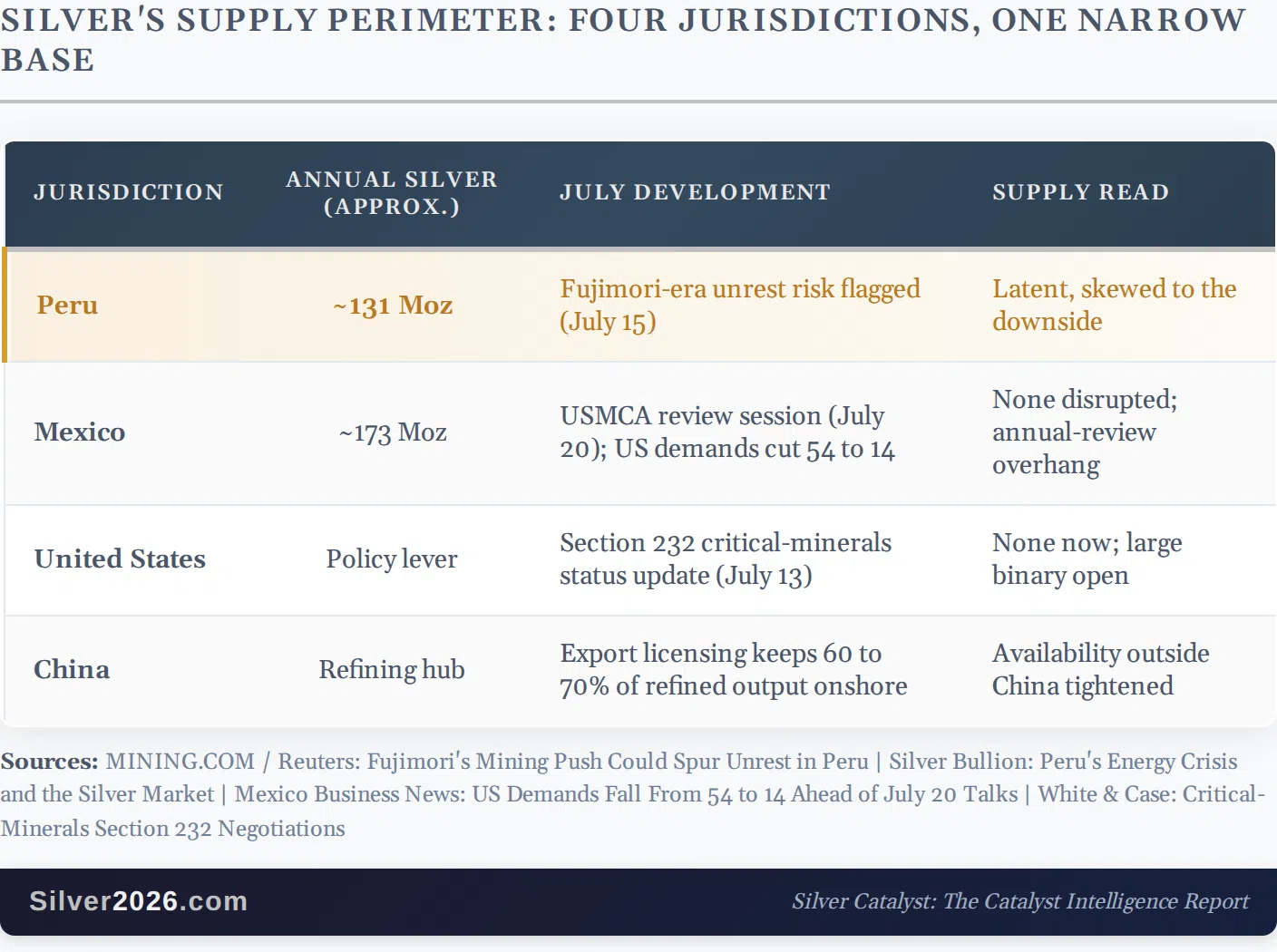
On July 15, Reuters reported that Peru's president-elect, Keiko Fujimori, could face renewed protests in the country's mining regions as her incoming government tries to push forward large copper and other mining projects that have been delayed for years. The report drew on a study by the Observatory of Mining Conflicts in Peru, which counts roughly $64 billion in planned mining investment, much of it in poor rural areas where communities say they see little local benefit and worry about the environmental cost.
This is not a war or a coup. It is the ordinary friction of a mining democracy, and that is exactly why it is easy to underrate. But the numbers behind it are not small. Peru produced about 131 million ounces of silver in 2025, according to Metals Focus and the Silver Institute, which is about 15% of the roughly 847 million ounces the world mined that year, close to one ounce in six.
Two features of Peruvian silver make that output especially fragile. The first is that most of it is a byproduct. Peru's mines are dug primarily for lead, zinc, and copper, and silver comes out alongside those metals rather than as the main event. This is not unique to Peru. It is how most of the world's silver is produced: mines built primarily for silver have fallen to just 26% of global supply, a record low, according to Metals Focus and the Silver Institute, which means roughly three-quarters of all silver now arrives as a byproduct of mining for other metals. What concentrates the risk in Peru is that so much of this byproduct supply sits in one country. It means silver supply from Peru rises and falls with decisions made for entirely different reasons, driven by the economics of lead, zinc, and copper, and it cannot easily be increased just because silver is expensive. The second is that many of Peru's silver projects are run by small and mid-sized companies with thin balance sheets, which makes them more vulnerable to the energy-cost spikes and road blockades that periodically disrupt the country's mining regions.
The backdrop was already unsettled before the election result. Peru issued an emergency decree in May to deal with an energy shortage, road blockades have periodically interrupted shipments of concentrate, and the program to formalize the country's large informal-mining sector has been extended into the end of 2026. A wave of protest over stalled projects would land on top of all of it.
There is a second-order effect that reaches well beyond Peru's borders. Peru is a major supplier of silver-bearing concentrate to China, the country that does most of the world's silver refining. A serious disruption in Peru would not just remove Peruvian ounces; it would tighten the raw material feeding Chinese refineries, at the same time that China's own export controls are keeping more of its refined silver at home. The squeeze would compound.
Sources: MINING.COM / Reuters: Fujimori's Mining Push Could Spur Unrest in Peru | Silver Bullion: Peru's Energy Crisis and the Silver Market | Mexico Business News: US Demands Fall From 54 to 14 Ahead of July 20 Talks | White & Case: Critical-Minerals Section 232 Negotiations
Why This Matters More Than One Country's Politics
The reason Peru carries weight is that the world's mined silver supply barely grows, so there is no cushion to absorb a loss.
In 2025, global mine production came in at 846.6 million ounces. For 2026, Metals Focus and the Silver Institute forecast it essentially flat, at 844.1 million ounces, a decline of about 2.5 million ounces. That flatness is the whole point. Silver has been in a supply deficit, meaning the world uses more than it mines and recycles, and it has closed the gap by drawing down above-ground stockpiles that are not unlimited. When mine supply cannot grow, every regional threat to it matters more, because there is nothing spare to make up the difference.
Peru sits right at the center of that math. The survey already expects Peruvian output to fall in 2026 on weaker lead and zinc production, and names Peru first among the declines that outweigh recovering output in Mexico and leave the global total slightly lower. In other words, Peru is already forecast to be a drag on world supply before any new political unrest is added. A wave of protest that stalled projects or blocked roads would push in the same direction, from an already flat base.
What This Means to Silver Investors
The practical lesson is that silver's supply risk is concentrated in a handful of countries, and it is the kind of risk that builds quietly rather than announcing itself.
An oil shock or a war moves the price this week, and it is easy to watch. A president-elect's mining agenda, a study on rural protest, an emergency energy decree: these move nothing today, and they never generate a dramatic one-day chart. But they accumulate. Peru, Mexico, and China between them dominate the world's mined and refined silver, and in a single fortnight all three showed up on the risk ledger at once, through Peru's unrest study, a US-Mexico trade review, and China's export controls. None of them removed an ounce from the market in July. What they did was raise the political premium sitting over the supply that has to fill a persistent shortfall.
That shortfall is the anchor. The market is forecast to run a sixth consecutive annual deficit of 46.3 million ounces in 2026, according to Metals Focus and the Silver Institute. A deficit means the world is consuming more silver than it produces and recycles, and covering the difference from existing stocks. Against that backdrop, a threat to roughly a sixth of global mine supply is not a footnote. It is a threat to the single side of the equation that has no slack left in it.
None of this is a forecast about next week's price, which will keep taking its cues from oil, the dollar, and the Federal Reserve. It is a point about the ground underneath the price. If you follow how silver has traded in 2026, you will see the sharp moves come and go with the macro headlines, while the longer-term case for silver rests on a supply base that is flat, concentrated, and increasingly political. The war grabbed the headlines in July. Peru is the one worth watching after they fade, and it is exactly the kind of slow, structural risk the framework in Silver Rising is built to track.
Comments
Log in or sign up to join the conversation.