

Warehousing and logistics operations are under increasing pressure to store more inventory, improve handling speed, and make better use of available floor space. A shuttle racking system addresses these challenges by combining high-density pallet storage with automated or semi-automated pallet movement.
Unlike conventional pallet racks that require forklifts to enter deep storage lanes, shuttle-based systems use a motorized shuttle to transport pallets within the rack structure. This approach can improve space utilization while reducing unnecessary forklift movement inside storage lanes.
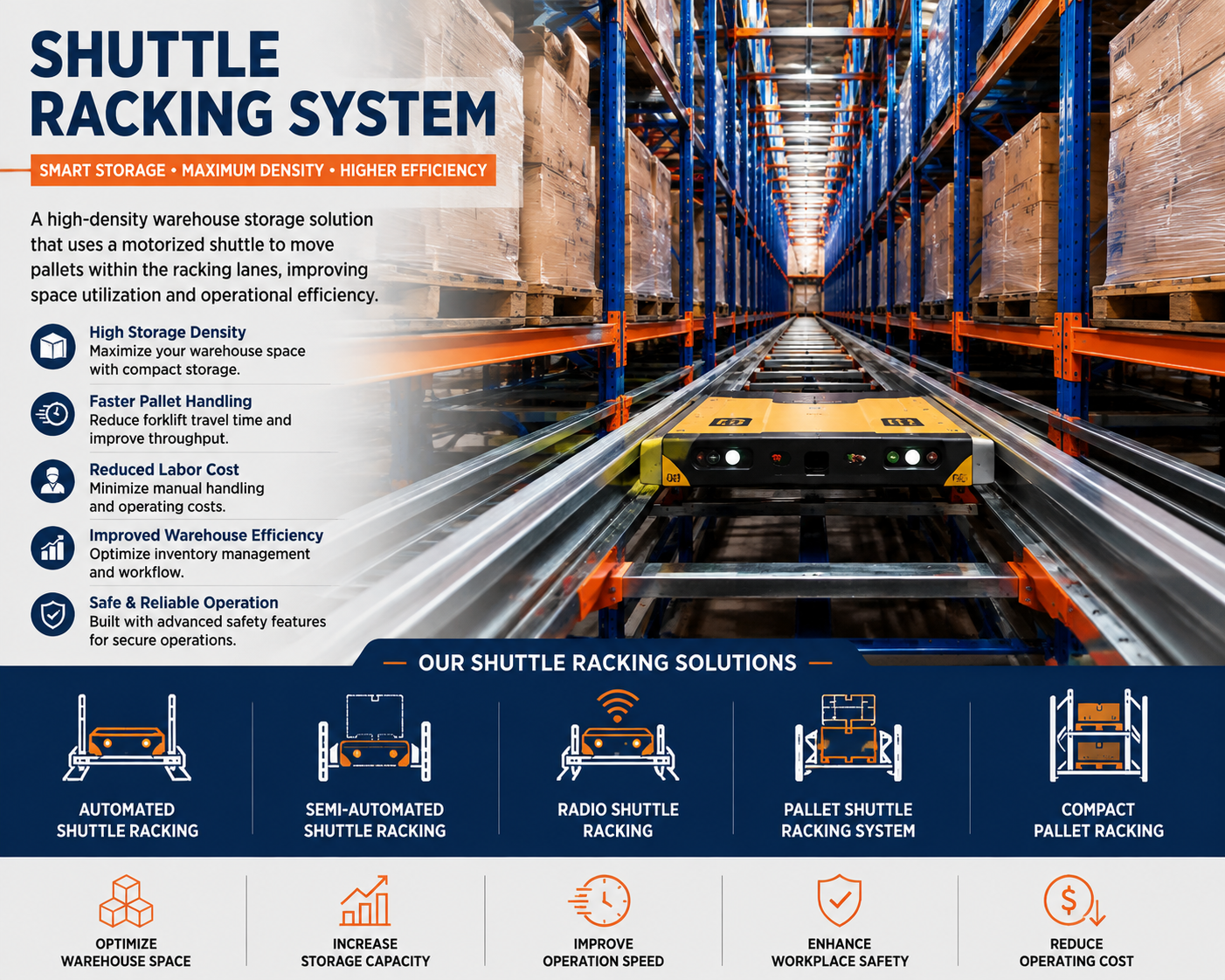
How a Shuttle Racking System Works
A typical pallet shuttle racking system consists of supporting rack structures, pallet rails, and a battery-powered shuttle. A forklift places the shuttle into the required storage lane, after which pallets are positioned at the front of the lane.The shuttle then transports each pallet to the designated storage location. This makes the system especially suitable for warehouses handling large quantities of similar products.
Depending on operational requirements, businesses may choose between semi-automated shuttle racking and more advanced automated shuttle racking configurations.
Why High-Density Storage Matters
Warehouse space is a significant operational investment. Expanding a facility can involve additional land, construction, utilities, equipment, and labor costs. For this reason, companies increasingly focus on maximizing the capacity of their existing buildings.
A professionally designed Industrial racking system can help companies organize inventory vertically and horizontally while improving overall warehouse space utilization.
Compact pallet racking and warehouse shuttle racking systems reduce the number of access aisles required compared with conventional selective pallet racks. The available area can therefore accommodate more pallet positions.
Operational Benefits of Shuttle Pallet Racking
One major advantage of shuttle pallet racking is reduced forklift travel inside the rack structure. Because the radio shuttle handles pallet movement within each lane, forklift operators mainly work at the rack face.
A radio shuttle racking solution can also support different stock rotation strategies, including FIFO and LIFO configurations, depending on warehouse layout and operational requirements.
Additional potential benefits include:
Higher pallet storage density
Better utilization of warehouse floor space
Reduced forklift travel distances
Faster pallet loading and retrieval
Lower risk of rack damage caused by forklifts
Improved inventory organization
Connecting Automation With Modern Warehousing
As distribution centers become more technology-driven, shuttle solutions can form part of a broader warehouse storage system strategy. Advanced facilities may combine shuttle technology with conveyors, warehouse management software, sensors, and an automated storage and retrieval system.
However, automation should always be selected according to throughput requirements, pallet characteristics, inventory rotation, building dimensions, and budget.
Importance of Proper Shuttle Racking Installation
Successful shuttle racking installation requires careful engineering. Pallet dimensions, rack loading capacity, aisle requirements, clear heights, floor conditions, and material-handling equipment must all be considered during system design.
When properly planned, a shuttle-based storage solution can provide an effective balance between automation, storage density, and operational efficiency.
Benefits of a Shuttle Racking System
A shuttle racking system provides a practical solution for warehouses that need high-density pallet storage and faster material handling. Key benefits include:
Better utilization of warehouse space
Increased pallet storage capacity
Reduced forklift movement inside storage lanes
Faster pallet loading and retrieval
Improved warehouse productivity
Lower risk of rack damage from forklifts
Suitable for high-volume pallet storage
Can support FIFO or LIFO inventory systems
Compatible with semi-automated and automated warehouse operations
Advantages of Shuttle Racking
1. Maximum Use of Warehouse Space
A shuttle racking system allows pallets to be stored deeper compared with traditional pallet racks. Since fewer aisles are required, more storage locations can be created within the same warehouse area. This makes it ideal for facilities where space expansion is expensive or limited.
2. Higher Storage Capacity
The system uses deep-lane storage, allowing multiple pallets to be stored behind each other. This significantly increases the number of pallets stored compared with conventional selective pallet racking.
3. Improved Warehouse Efficiency
The motorized shuttle automatically moves pallets inside the rack lanes, reducing manual handling time. Forklift operators only place or remove pallets at the rack entrance, improving overall workflow.
4. Reduced Forklift Movement and Damage
Because forklifts do not need to enter deep storage lanes, the risk of accidental impact with rack structures is reduced. This can help lower maintenance costs and improve workplace safety.
5. Faster Loading and Retrieval Operations
Automated shuttle movement allows pallets to be positioned quickly and accurately. This improves loading and unloading speed, especially in warehouses handling large volumes of similar products.
Disadvantages of a Shuttle Racking System (Explained)
1. Higher Initial Investment
The biggest disadvantage is the higher upfront cost compared with standard pallet racking. The system requires motorized shuttles, control systems, charging equipment, and specialized installation.
2. Requires Regular Maintenance
Shuttle units include electrical and mechanical components such as batteries, sensors, and motors. Regular inspection and maintenance are required to ensure reliable operation.
3. Limited Flexibility for Different Products
Shuttle racking works best when storing large quantities of the same or similar products. Warehouses with many different products and low quantities per item may find the system less suitable.
4. Dependence on Technology
Since pallet movement depends on the shuttle unit, any technical failure can temporarily affect access to stored pallets until the problem is repaired.
5. Requires Skilled Installation and Planning
A proper shuttle racking installation requires detailed planning of pallet sizes, load capacities, warehouse layout, and operational requirements. Poor design can reduce system efficiency.
Conclusion
The Shuttle racking system is becoming an important option for warehouses seeking greater storage capacity without continuously expanding their physical footprint. By combining high-density racking with automated pallet movement, it offers a practical transition between traditional forklift-operated storage and fully automated warehousing.
For manufacturers, distributors, cold stores, and logistics facilities handling high pallet volumes, shuttle technology can support more efficient and scalable warehouse operations.
#ShuttleRackingSystem#AutomatedShuttleRacking#PalletShuttleRacking
Comments
Log in or sign up to join the conversation.