

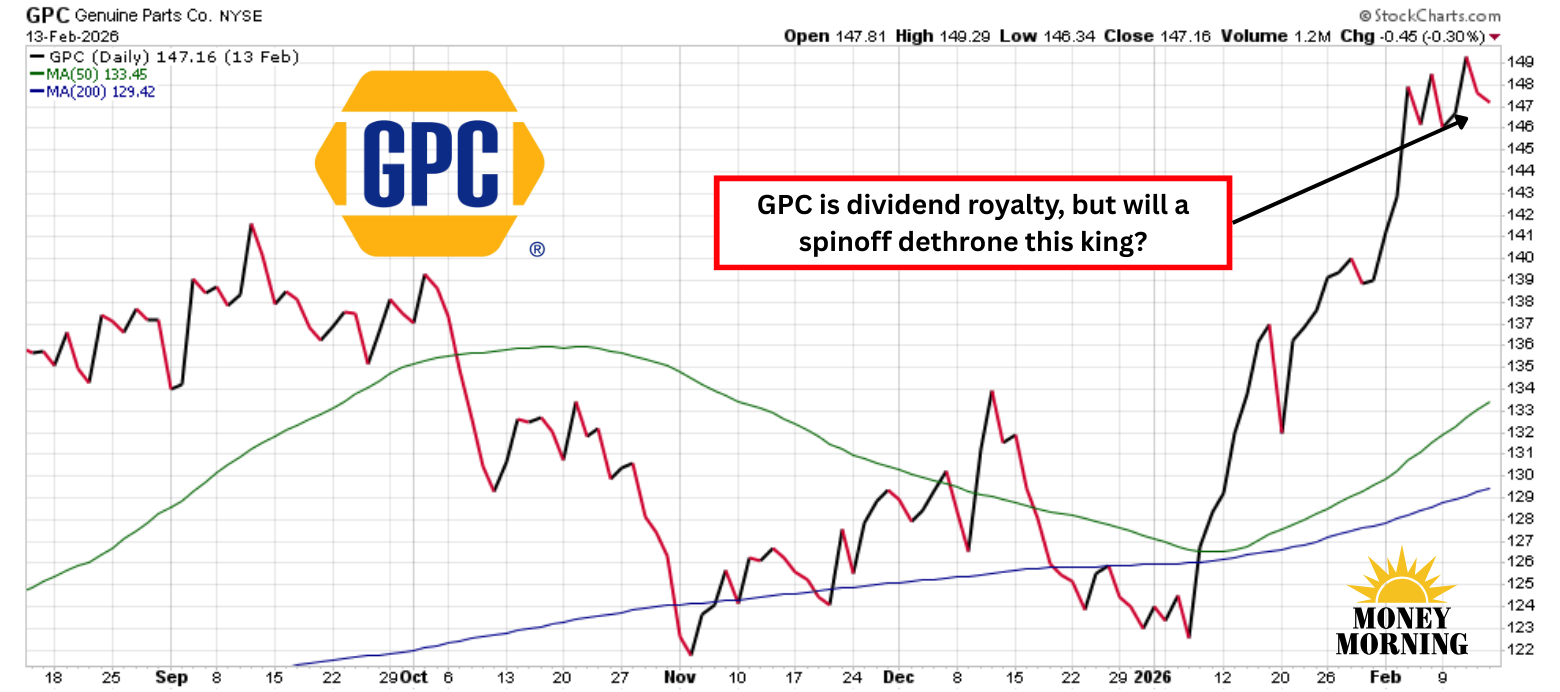
Genuine Parts (GPC) boasts one of the most impressive dividend histories in the market, with 70 consecutive years of annual increases, a streak surpassed only by American States Water (AWR)'s 71 years.
Yesterday, the aftermarket auto parts retailer and industrial parts supplier announced plans to separate into two independent public companies through a tax-free spin-off targeted for the first quarter of 2027. One will focus on the global automotive business – anchored by its NAPA Auto Parts chain – while the other will center on the global industrial segment through Motion Industries, specializing in replacement parts, bearings, and power transmission solutions.
The stated aim of the spinoff is to enhance strategic focus, operational clarity, and the often claimed purpose of "unlocking shareholder value" in distinct markets.
A Reliable Income Play with Modest Growth
GPC has long appealed to conservative investors seeking steady income rather than rapid growth. Over the past 20 years, its stock has delivered annualized returns of about 7%, trailing the S&P 500's 10%. As the company operates in mature sectors with limited organic growth, it has instead relied on acquisitions and efficiencies.
Despite post-pandemic challenges like supply chain issues and softer demand, GPC has sustained solid margins, free cash flow, and dividend reliability.
Its dividend growth, while respectable, has moderated. Over the past decade, the payout grew at a CAGR of about 5.3%, beating inflation. The latest increase – its 70th straight, also declared on Tuesday along with the company's fourth-quarter earnings results – was a modest 3.2%, raising the annual dividend to $4.25 from $4.12 per share. With a yield around 3% and a payout ratio near 60%, the dividend appears sustainable, supported by a strong balance sheet and diversified revenues.
Historical Spinoff Performance
Spinoffs have historically created value by allowing tailored strategies and attracting specialized investors, often leading to higher valuations. However, Forbes found recent trends show mixed results, with spun-off entities underperforming the S&P 500 by about 2.7 percentage points annually over the prior decade, due to passive investing dominance and activism-driven separations. Results, though, markedly improve when the parent company retains a sizeable stake in the spinoff, signaling confidence in the new business's outlook.
For GPC, details on post-spinoff ownership were not revealed in the announcement, so investors will need to await greater clarity, which may come at the company's investor day presentation expected later this year.
Bottom Line for Investors
Previous spinoffs by dividend royalty – like Abbott Labs (ABT) 2013 separation of AbbVie (ABBV) – preserved the legacy company's elite dividend status while the spinoff inherits the parent's payout track record, elevating it to Dividend Aristocrat or King status. GPC could follow suit, offering income investors reliability through the transition.
Income-focused investors should find Genuine Parts to be a good stock to still buy, while those who are growth-oriented may want to look elsewhere for faster expansion. With the spin-off approaching, patient holders might find GPC a solid hold – or an opportunistic buy – for its proven track record in a volatile market.



Comments
Log in or sign up to join the conversation.