

The US dollar dropped this week despite the Federal Reserve raising the interest rate. So, should you buy or sell the greenback?
Image Source: Pexels
A strange week in the currency markets just ended. It's a weird one because the US dollar did precisely the opposite of what it was supposed to do.
First, a war broke out in Europe three weeks ago. In times of uncertainty, the US dollar acts as a safe haven. This time, though, it only partially did so – it gained against the Japanese yen, but it lost ground against the euro, the British pound, the Australian dollar, and the New Zealand dollar.
Second, the Federal Reserve raised rates last Wednesday. Yet, despite the rising federal funds rate, the greenback gave back some of its gains since the Russia-Ukraine war started. So, should you buy or sell the US dollar?
EUR/USD Finds Buyers Below 1.10
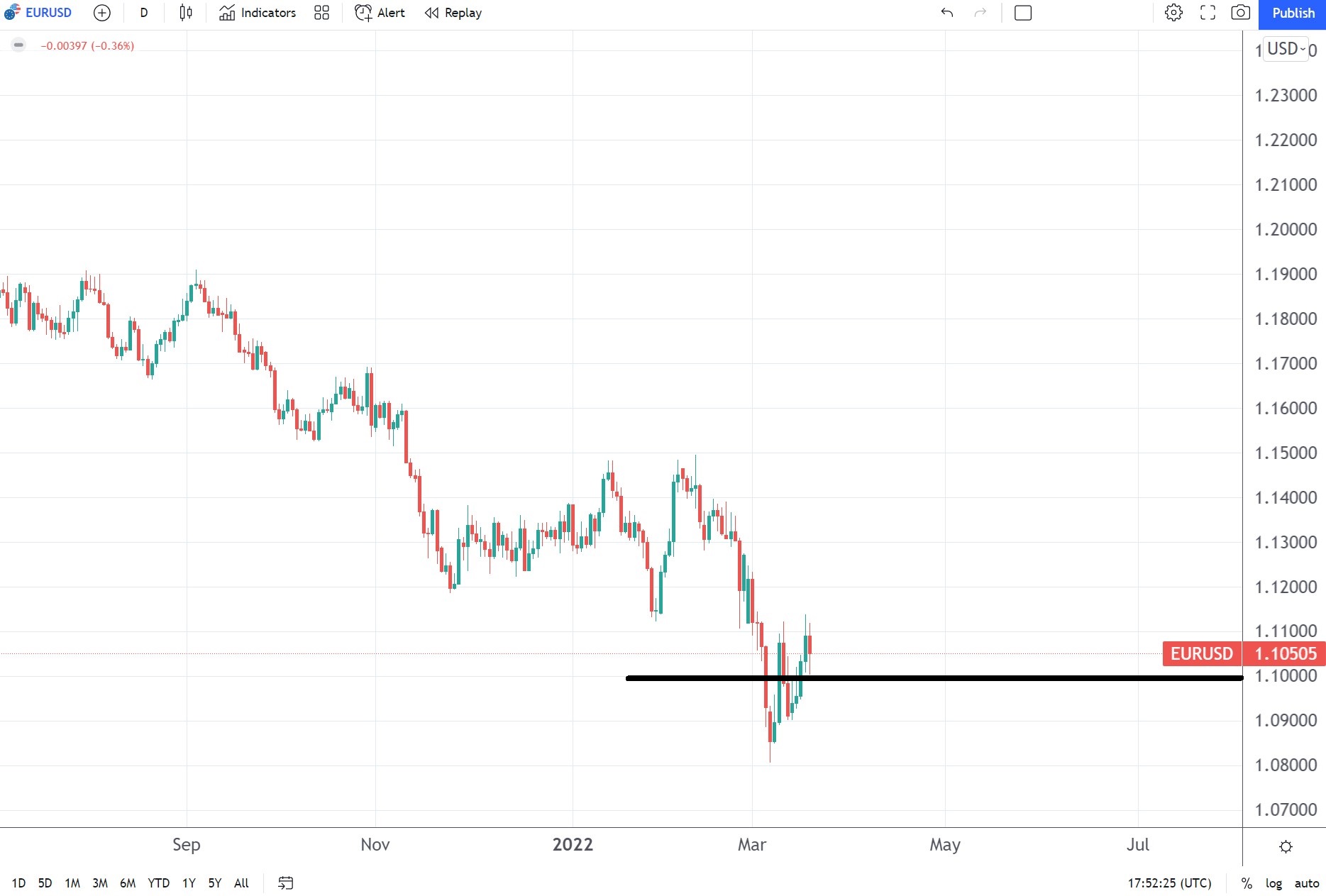
The EUR/USD daily chart is one to watch. The exchange rate dropped below 1.10, a pivotal level, and traded close to 1.08 before it bounced.
Somehow, the euro found bids below the 1.10 level despite the war in eastern Europe. Perhaps the markets paid attention to Europe's solidarity with Ukraine and the fact that it acted as a common block. However, we don't know that for certain. What we do know is that euro closed the week above the pivotal 1.10 level.
GBP/USD Finds Support at 1.30
The British pound dropped even more against the US dollar in 2022 than the euro did. The pound fell even though the Bank of England raised the rates again. So now, the current bank rate in the United Kingdom is 0.75%, struggling to keep pace with the 5.5% inflation rate.
But this may be the reason why the GBP/USD rallied this week. The federal funds rate is only 0.25% in the US, and inflation runs at 7.9% year-over-year. As such, this week's rate hike from the Fed did nothing to close the gap, so the pound outperformed the greenback.
AUD and NZD Outperformed
The two currencies down under are known to be closely correlated with the stock market. For example, the S&P 500 in the United States posted four consecutive straight days with gains over 1% – and so the two currencies outperformed the greenback, too.
Overall, the US dollar weakness should continue despite the war in Ukraine. If anything, markets tell us they are more rational than geopolitics may lead us to believe.



Comments
Log in or sign up to join the conversation.