


The Wyden-Grassley report has ruffled some feathers in the pharmaceutical industry. The 18 month investigation determined that Gilead GILD priced Sovaldi ($1,000 pill per day) to maximize revenue; R&D costs or the multi-billion acquisition of Pharmasset may not have factored into the price. The takeaway from the report is clear -- there could be justification for Gilead to make its HCV regimen more affordable. GILD fell about 4% last week, largely due to the investigation.
Pundits and the media immediately attempted to poke holes in the Wyden-Grassley findings. According to Forbes HCV drugs are cheaper in the U.S. than in Europe:
Amid all of the wailing and gnashing of teeth on drug prices, it was stunning to hear recent comments by Dr. Steve Miller, Chief Medical Officer of Express Scripts ESRX which governs the pharmacy benefits of 85 million Americans. Miller announced yesterday at the Forbes Healthcare Summit 2015 that the cost of hepatitis C drugs in the U.S. is now less than that in Europe. Furthermore, Miller boasted that Express Scripts pays far less for the new cholesterol lowering PCSK-9 drugs like Regeneron's Praluent, than the sticker price of $9,400/patient/year ... Are U.S. drug prices really going through the roof?
Gilead bulls immediately jumped on the story. On SA Author Brett Jensen's article, Gilead: Much Ado About Nothing, SA contributor DoctoRx had this to say:
DoctoRx: As it happens, a former PFE scientific executive has this piece out: "For Hepatitis C Drugs, U.S. Prices Are Cheaper Than In Europe" http://onforb.es/1YNCt2A.
Granted, pharmacy benefit managers like Express Scripts have played Gilead and Abbvie ABBV against each other in order to bring the price down for HCV drugs. The headline figure -- $84,000 for Sovaldi and $93,000 for Harvoni -- have been heavily discounted. That said, the angle that "HCV drugs are cheaper in the U.S. than in Europe" could provide cover against the Wyden-Grassley report.
HCV Drugs Cheaper In the U.S. Than In Europe. Really?
The question over whether HCV costs are cheaper in the U.S. vis-a-vis Europe, is key. I believe the jury is still out for the following reasons:
It Belies Common Sense
First of all, why didn't other noted healthcare experts mention it? SA contributors Bret Jensen, and DoctoRx have forgotten more about biotech than most of us will ever know. In fact, it was after reading Jensen's prognostications on GILD (when it was in the $70s) that I discovered the stock. Since they are both GILD bulls, I find it interesting that they did not raise this point earlier.
Secondly, the prevailing thesis has always been that Europe's single-payer health system, and its penchant for negotiating HCV prices as a collective unit enabled it to garner steeper discounts than its U.S. counterparts. Europe had garnered a 36% discount on Sovaldi prior to Abbvie even entering the market:
Charles Gore, chief executive of the UK-based Hepatitis C Trust, urged European governments and health providers to use the arrival of AbbVie's product as an opportunity to push for lower prices and wider access.He said: "Governments should say: 'give us a better price and we will guarantee higher volumes'. Here we have a life-threatening infectious disease which is suddenly curable in most cases. So let's find a way to give it to everyone."
The negotiating power of Europe's single-payer health systems has already secured discounts from Gilead of more than 36 per cent over the US price of Sovaldi and the entry of AbbVie could drive deeper cuts.
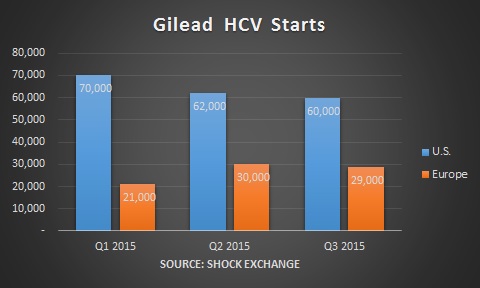
Gilead's Q3 HCV revenue from Europe was $870 million on 50,000 starts; this was down from $1.1 billion in revenue on 30,000 starts in Q2. On the earnings call management intimated that HCV revenue from Europe would be driven not by the number of patients being treated, but by government budget constraints:
Looking ahead in Europe, we anticipate that our HCV revenues will be constrained by country-specific budgets rather than the number of patients in need of treatment. We will continue to work hard to educate governments and other groups about the benefit of diagnosing and treating HCV-infected people as early as possible.
These comments are also indicative of the power of European governments to negotiate HCV prices.
Gilead's Financial Results Suggest Otherwise
Based on Gilead's financial results, its HCV product costs are cheaper in Europe than they are in the U.S. by a wide margin:
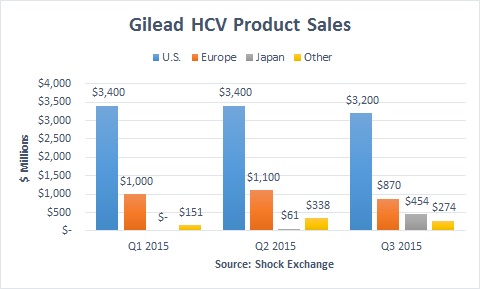
The above chart highlights Gilead's HCV product sales per region. Product sales declined by 6% in the U.S. from $3.4 billion in Q1 to $3.2 billion in Q3. Product sales in Europe fell 13% from $1 billion to $870 million over that same time frame.
Meanwhile, 70,000 U.S. patients started on the HCV regimen in Q1; starts fell 15% to 60,000 in Q3. There were 21,000 starts in Europe in Q1; starts increased over 35% to 29,000 in Q3.
The fall out from the data would be sales per start, which the following chart illustrates:
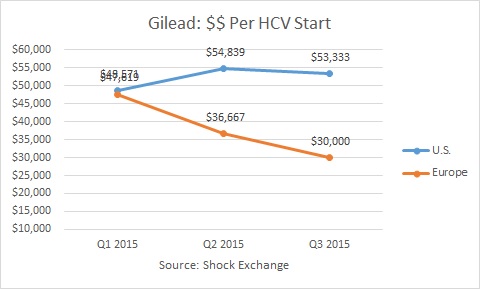
- Sales per start were practically equal in Q1 -- $49,000/start in the U.S. and $48,000/start in Europe. Q1 may contain some noise as starts ramped up in anticipation of the launch of Harvoni.
- In Q3 sales per start were over $53,000 in the U.S. and $30,000 in Europe. This makes sense as HCV sales in Europe declined, yet starts increased.
- In a perfect world one would use the average number of patients during the quarter. However, average patient data would still not make up for the wide disparity in the $53,333 cost in the U.S. vis-a-vis the $30,000 figure in Europe.
- Secondly, the data also buttresses management's earlier intimation that European HCV revenue is determined more by country-specific budgets than by the number of patients.
Conclusion
Based on Gilead's HCV product sales and patient starts, its HCV regimen is cheaper in Europe than in the U.S. The data could buttress the Wyden-Grassley report, and Senator Bernie Sanders' HCV rant that HCV drugs could be made more affordable. Look for lawmakers to use a similar analysis to push for cheaper HCV prices in the U.S. Avoid GILD.



Comments
Log in or sign up to join the conversation.