

Among all the sacred forms in Hindu worship, the Shiva Lingam holds a place unlike any other. Unlike the richly detailed, human-like idols of Ganesha, Murugan or Amman, the Lingam is deliberately simple in shape — a smooth, rounded pillar form that carries within it one of the oldest and most profound ideas in Hindu philosophy: that the divine cannot fully be captured in any single image.
This apparent simplicity is exactly what makes the Shiva Lingam so powerful. It is not a portrait of Shiva but a symbol of Shiva's true nature — infinite, formless and beyond the limits of ordinary depiction. Understanding its story and symbolism reveals why devotees across centuries, from grand Jyotirlinga shrines to modest home altars, have chosen this form above all others when seeking to connect with Lord Shiva — the same devotion behind the bronze Shiva Lingam idols crafted at Idol Bronze.
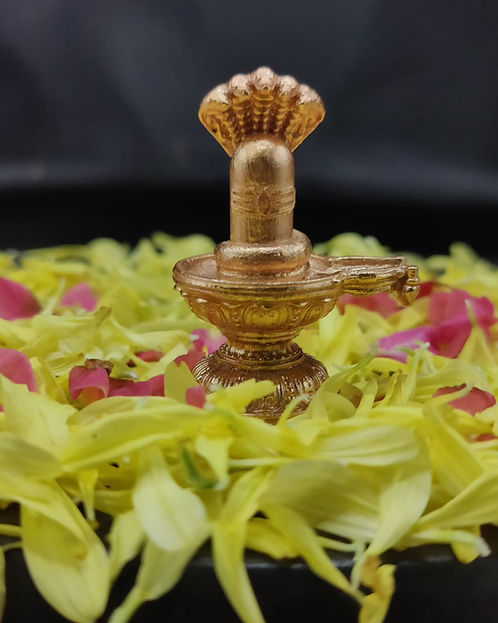
What Is the Shiva Lingam?
The word "lingam" translates roughly to "sign" or "mark" — an indicator pointing toward something greater than itself. In this case, that something is the Nirguna Brahman, the attribute-less, formless aspect of the divine that Shiva is said to embody. Where other Hindu deities are depicted with distinct faces, ornaments and postures, the Lingam intentionally avoids all of this, representing Shiva not as a being with a shape but as pure, boundless consciousness.
The Lingam-Yoni Union
Traditionally, the Lingam rests upon a rounded base known as the peedam or yoni, representing Shakti, the divine feminine energy embodied by Parvati. Together, the Lingam and its base form a single unit symbolizing the union of Purusha (consciousness) and Prakriti (creative energy) — the two forces whose interplay is said to give rise to the entire universe. This pairing echoes the same philosophy seen in forms like Ardhanarishwara, where Shiva and Parvati share one body, reinforcing that creation itself depends on this balance of masculine and feminine, static and dynamic.
The Philosophy Behind an Aniconic Form
Most traditions eventually settle on human-like images for their deities, since a familiar face makes devotion easier to hold onto. Shiva worship took a different path with the Lingam, choosing an aniconic — formless — symbol precisely to avoid limiting the infinite.
The Story of the Infinite Pillar of Light
The most celebrated legend behind the Shiva Lingam comes from the Linga Purana, and it begins with a dispute rather than a blessing.
Brahma and Vishnu's Contest
According to the story, Brahma and Vishnu once quarreled over which of them was the supreme being in creation. To settle the matter, an immense, blazing pillar of light suddenly appeared before them, stretching endlessly in both directions with no visible beginning or end. Startled, both gods agreed that whichever of them could find either end of the pillar first would be acknowledged as the greater. Vishnu took the form of Varaha, the boar, and dug deep into the cosmos searching for the base, while Brahma became a swan and flew upward for countless ages searching for the top.
Neither Could Find the End
Both returned exhausted and unsuccessful — the pillar had no end to find, for it was Shiva himself, manifesting as anantha, the infinite. Brahma, in his eagerness, falsely claimed to have found the top, a deceit for which he was cursed to never again be worshipped in temples the way Shiva and Vishnu are. This moment of humility before the boundless pillar is regarded as the origin of Lingam worship, and it is commemorated every year during Maha Shivaratri, when devotees stay awake through the night in reverence of this infinite form.
Temple Associations: The Panchabhoota Sthalams
While the Lingam is enshrined in countless temples across India, one group of five ancient shrines in Tamil Nadu holds special significance: the Panchabhoota Sthalams, each representing one of the five classical elements through its own form of Lingam.
At Kanchipuram, the Ekambareswarar Temple enshrines the Prithvi Lingam, representing earth, said to have been formed from sand by Parvati herself. At Thiruvanaikaval near Trichy, the Jambukeswarar Temple honors the Appu Lingam of water, uniquely positioned so that spring water constantly surrounds it. Thiruvannamalai's Arunachaleswarar Temple houses the Agni Lingam of fire — the very manifestation of the infinite pillar from the Linga Purana story — celebrated each year in the dramatic Karthigai Deepam festival, when a massive flame is lit atop the hill. At Srikalahasti, the Vayu Lingam represents air, and at Chidambaram, Shiva is worshipped as the Akasha Lingam of space — remarkably, with no physical idol at all, only empty space behind the temple curtain, the ultimate expression of formlessness.
Spiritual Significance of the Shiva Lingam
A focal point for meditation — its smooth, unbroken shape gives the mind a single, uncomplicated point of focus, free of the distractions that come with elaborate ornamentation.
A reminder of the formless truth behind all forms — even the most detailed idols are understood as expressions of the same infinite reality the Lingam represents directly.
A symbol of the cycle of creation, preservation and destruction — the same three forces Shiva governs in his role within the Trimurti.
A source of home energy and Vastu balance — many households keep a small Lingam idol as a steady, calming presence believed to bring spiritual harmony to a space.
A universal object of devotion — unlike forms tied to a specific mythological episode, the Lingam is worshipped identically whether in a vast Jyotirlinga temple or a small home altar.
Why Is the Shiva Lingam Different from Other Shiva Forms?
Shiva is depicted in many ways — as Nataraja, the cosmic dancer; as Dakshinamurthy, the silent teacher; as Ardhanarishwara, half-male and half-female. Each of these forms captures one particular quality or story associated with Shiva. The Lingam, by contrast, captures none of these narratives specifically — and that is precisely its distinction. It does not ask the devotee to picture a dance, a lesson or a union of two bodies. It asks them to sit with the idea of the divine as something beyond any single story, richer and larger than any one image could ever hold.
Conclusion
The Shiva Lingam stands apart from every other icon in Hindu worship precisely because it refuses to be limited by form. Born from a legend of an infinite pillar that neither Brahma nor Vishnu could measure, and enshrined today in temples representing the very elements of creation, it continues to remind devotees that the divine is something to be approached with humility rather than fully grasped. For a home altar, it offers a rare kind of devotion — simple, steady and endlessly deep.
Comments
Log in or sign up to join the conversation.