
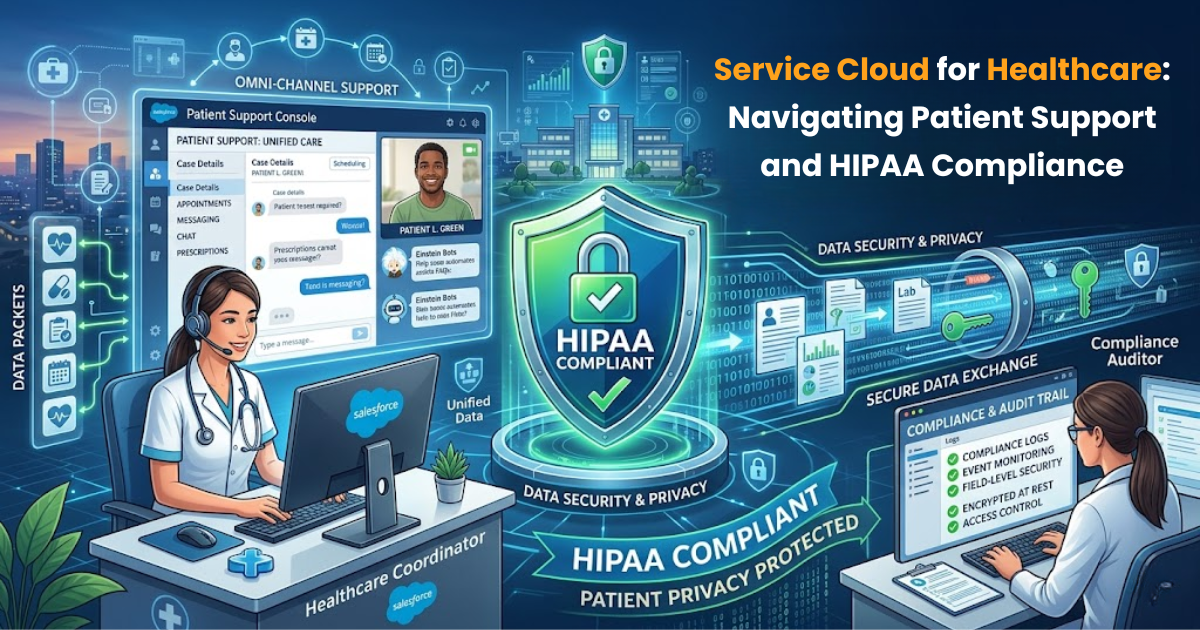
The healthcare industry faces a massive digital shift in 2026. Patient expectations now mirror retail experiences. People want fast, personalized, and digital support. However, healthcare providers must balance these needs with strict legal rules. Salesforce Service Cloud Consulting helps organizations bridge this gap. Using a cloud platform for medical data requires a deep technical strategy. This article explores how to build a patient support system that is both efficient and legally safe.
The Patient Support Crisis in 2026
Modern healthcare systems are struggling. A recent study shows that 74% of patients feel frustrated by fragmented communication. Many providers still use separate tools for scheduling, billing, and clinical notes. This fragmentation leads to long wait times and repeated questions.
Furthermore, the cost of data breaches in healthcare has reached an all-time high. In 2025, the average cost of a healthcare breach was $10.93 million. This is higher than any other industry. Providers need a system that secures Protected Health Information (PHI) while providing a smooth user experience. This is where Salesforce Service Cloud Consulting Services become essential.
The Technical Foundation of HIPAA Compliance
HIPAA compliance in the cloud is not a "set and forget" feature. It requires a specific technical configuration. Salesforce offers the Health Cloud and Service Cloud platforms with built-in security layers. However, the user must configure them correctly to meet federal standards.
1. Shield Platform Encryption
Standard encryption is often not enough for PHI. Salesforce Shield allows for "Encryption at Rest." This means the data is encrypted while it sits in the database. Even if a bad actor gains access to the physical server, they cannot read the files.
2. Event Monitoring
Compliance requires a clear record of who viewed what data. Event Monitoring tracks every user action. If an employee looks at a celebrity's medical record, the system logs it. Consultants set up alerts for suspicious behavior. This proactive monitoring stops data leaks before they grow.
3. Field-Level Security
Not every staff member needs to see every data point. A billing clerk does not need to see a patient’s lab results. Salesforce Service Cloud Consulting focuses on "The Principle of Least Privilege." We restrict access to sensitive fields based on the specific job role.
Transforming Patient Support Workflows
Once the security layer is solid, we focus on the patient experience. The goal is to create a 360-degree view of the patient.
1. Omni-Channel Integration
Patients use many ways to reach out. They use phone calls, SMS, web chat, and video calls. Service Cloud unifies these into one console.
Voice: Integrated telephony allows agents to see the patient record the moment the phone rings.
Chat: Secure web chat lets patients ask quick questions about appointments.
SMS: Automated reminders reduce "no-show" rates by up to 25%.
2. Intelligent Case Management
In healthcare, a "case" could be a refill request or a complex surgical follow-up. We use "Entitlements" and "Milestones" to ensure timely responses. If a high-priority request sits for too long, the system moves it to a manager. This ensures that no patient falls through the cracks.
The Role of AI and Automation
In 2026, Artificial Intelligence is no longer a luxury. It is a tool for survival. Salesforce Service Cloud Consulting Services now include the setup of "Agentforce" and Einstein AI.
1. Einstein Bots for Self-Service
Many patient queries are simple. "Where is my clinic?" or "How do I prep for my scan?" Einstein Bots handle these tasks instantly. This frees up human nurses for complex clinical calls. Research indicates that bots can handle up to 45% of routine inquiries in a medical setting.
2. Case Summarization
Medical histories are long. When a patient calls, a nurse might spend five minutes reading notes. Einstein AI creates a one-paragraph summary of the patient's entire history. This reduces "Average Handle Time" and improves accuracy.
3. Predictive Scheduling
AI looks at historical data to predict busy times. It suggests staffing levels based on flu seasons or local health trends. This ensures the call center always has enough staff to help patients.
Data Integration with EHR Systems
Salesforce is not a replacement for an Electronic Health Record (EHR) like Epic or Cerner. Instead, it acts as the "Engagement Layer." Connecting these systems is a top technical priority.
Experts use APIs to sync data between the EHR and Salesforce.
Patient Demographics: Names and addresses stay in sync.
Appointment Data: Patients can book online, and it appears in the clinical schedule.
Care Gaps: If a patient is due for a vaccine, Salesforce alerts the support agent to mention it during a call.
Managing Global Standards and Local Laws
While HIPAA is the standard in the US, global providers face other rules. GDPR in Europe and various state-level laws in the US add complexity. Salesforce Service Cloud Consulting ensures the platform adapts to these regional needs.
For example, "Data Residency" rules might require that data stays within a specific country. Salesforce Hyperforce allows providers to choose where their data is stored. This keeps the organization compliant with local sovereignty laws.
Why Choose Specialized Consulting?
Building a healthcare portal is different from building a retail site. The risks are higher. Mistakes can lead to legal fines or, worse, poor patient outcomes.
Professional Salesforce Service Cloud Consulting Services provide:
Business Associate Agreements (BAA): They ensure all vendors sign the necessary legal papers.
Clinical Workflow Expertise: They understand how doctors and nurses actually work.
Governance Frameworks: They create rules for how data moves through the system.
A recent report shows that hospitals using professional consulting see a 30% higher adoption rate of new software. This is because the tools are designed for the specific needs of medical staff.
Measuring Success in Healthcare Support
How do we know if the system is working? We track specific KPIs.
Metric | Goal | Impact |
First Contact Resolution | > 70% | Higher patient trust and lower costs. |
Patient Satisfaction (CSAT) | > 4.5/5 | Better patient retention and referrals. |
Average Speed to Answer | < 30 sec | Reduces patient anxiety and drop-offs. |
Self-Service Deflection | > 30% | Lowers the workload for clinical staff. |
The Future: Proactive Care Management
In the next few years, we will move from "Reactive" to "Proactive" support. Service Cloud will use IoT data from wearable devices.
If a patient's heart rate stays high for too long, the system will trigger a case. An agent will call the patient before an emergency happens. This "Hospital at Home" model relies entirely on the connectivity provided by Salesforce.
Conclusion
Navigating the world of healthcare support is a technical challenge. You must protect patient privacy while providing a modern experience. Salesforce Service Cloud Consulting provides the roadmap for this journey. By using encryption, AI, and smart integration, providers can transform their support centers.
The stats are clear. Patients want better digital tools. Providers need to stay compliant to avoid massive fines. With the right Salesforce Service Cloud Consulting Services, you can meet both goals. You create a system that is fast, smart, and safe. In 2026, this is the only way to lead in the healthcare industry. Your patients deserve a support system that is as advanced as the medicine you provide.
Comments
Log in or sign up to join the conversation.