

Previous USDA changes leave 2016/17 Ending Stocks Non-Event
Market Analysis
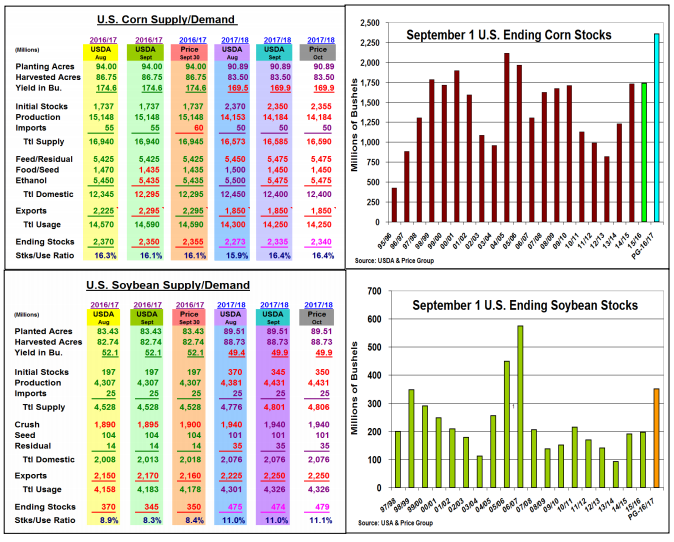
Traditionally, September’s grain stocks were nonevents. These reports generally confirmed the USDA’s and trade’s corn and soybeans old-crop ending stocks expectations that ended earlier that month. However, this began changing in the late 2000s with crop quality, crop size and crop development impacting these final stocks vs. the trade ideas. However, after the USDA’s numerous 2016/17 corn and soybean demand changes earlier this month, Friday’s ending stocks adjustments look to be very modest this year. Only, an unexpected soybean crop size decline or a big change in corn’s feed demand could shrift these ending stock levels dramatically.
Earlier this month, the USDA upped its overseas corn demand by 70 million bu. capturing much of this past summer’s stronger shipments with its 2.295 billion update. Despite record ethanol output, unexpected better bio-plant efficiencies and sluggish starch and HFC demand captured by the USDA’s industrial surveys sliced this domestic demand by 50 million bu. earlier this month. Given this summer’s higher pork and broiler slaughters and spring cattle placements boosting feedlot numbers by 4% vs. last summer, the USDA’s 10% higher feed demand seems on target. This means only a possible 5 million bu. jump in imports may boost stocks to 2.355 billion, the largest since 2005’s 2.114 billion level.
Strong late summer domestic and foreign demand also prompted the USDA to slice its old-crop ending stocks by 25 million earlier this month to 345 million. NOPA’s record August crush at 142.4 million, 5 million higher than 2007’s previous monthly record, suggests this demand will be revised upward. Despite a solid 98 million bu. August bean exports, strong rail shipments are likely needed to achieve latest 2.17 billion forecast. Overall, 2016/17’s stocks maybe up 5 million to 350 million, which isn’t any material change.
What’s Ahead
After an initial reaction to the September 30 quarterly stocks reports, the focus will likely return to this fall’s US country yield reports, the state of 2017/18 foreign demand and Mato Grasso’s rainfall forecast as this number 1 Brazilian province planting period that has gotten off to a slow start. This will likely keep corn & soybeans choppy until more is known about 2017 US harvest. Hold sales for now.


Comments
Log in or sign up to join the conversation.