


September brings a cluster of events that will shape the macro narrative into year-end. A Xi-Trump meeting, German state elections, a Federal Reserve decision with a new Summary of Economic Projections, and an ECB meeting that is not finished hiking. Each carries its own logic, but together they sketch the contours of the fourth quarter.
In our more frequent analysis, we noted that while the dollar had been dragged down by disappointing economic data and pushing of a Fed rate hike further out, we were cautious as the momentum indicators were over-extended. The tension has been resolved. The market took a hawkish message away from Fed Chair Warsh at his Jackson Hole speech, increasing the odds of not just a September hike but another one before year end. And the momentum indicators for the dollar turned higher. Even if the market has overreacted to Warsh's comments, the upside dollar correction has only just begun, it would appear.
Xi-Trump: Trade, Not FX
President Xi is coming to the US a couple of days after the UN General Assembly starts the new session on September 22. He is set to meet with President Trump in Washington on September 24. The headline meeting will focus on trade, not currency. Although the yuan is terribly undervalued, the Trump administration does not seem to have prioritized it in bilateral talks. Trade, China's shipment of rare earths, and alleged assistance to Iran and Russia appear more saliant, and that is where the political capital will be spent. Washington has still not renewed arms sales to Taiwan, which has been held in abeyance for the last several months.
Beijing will understand that as a signal regardless of how it is explained by the US domestically and to its allies. At the same time, the US is scaling back its role in joint military exercises with South Korea. Neither move is really about currency, but both tell Beijing something about the trajectory of US commitment in the region, and that context will hang over the trade conversation even when it is not named.
European Politics
German state elections this month carry real risk that the AfD wins outright in at least one Land. That would be a marker, not just a headline. Chancellor Merz has leaned on a familiar political device, blaming Chinese competition for the erosion of German industrial market share. The data only partially cooperates. The IFW estimates that roughly a third of Germany's lost market share traces to Chinese competition. The other two-thirds are homemade, the product of energy costs, underinvestment, and a manufacturing model built for a world that no longer exists. Blaming Beijing is politically convenient. It is not the whole story, and voters drifting to the AfD are responding to the homemade two-thirds as much as the imported third.
France's Macron is a lame duck, and Le Pen leads the polls. The question hanging over Paris and Frankfurt alike is whether Christine Lagarde takes a page from Mario Draghi's playbook and steps back into French domestic politics to challenge Le Pen directly. Draghi left the ECB and became prime minister of Italy at a moment of national emergency. Lagarde has the stature, the technocratic credibility, and, unlike most of her potential rivals, a claim to standing above the fray. Whether she wants the job is a separate question from whether she could win it.
If Lagarde departs, the succession fight at the ECB becomes immediate. Germany has a case to make. It is the largest economy in the currency union and has gone a full cycle without the top job. But the bid is complicated by the fact that Germany already holds significant positions in Brussels, including at the head of European Commission, and a German ECB president risks tipping the informal balance of institutional power that keeps the EU's largest members in rough equilibrium with one another.
That opens space for another idea now circulating in EU corridors, an Eastern European vice president. The eurozone has never had one. The question is not merit. It is whether the bloc's political culture is actually ready to place a citizen of a 2004 or 2007 accession country in the ECB's second chair, and what that would signal about how the union sees itself two decades on.
The Federal Reserve, European Central Bank, and the Bank of Japan
July's US jobs report was soft. Inflation gauges cooled. Retail sales declined. That combination made is seem unlikely the three hawkish dissenters from the prior meeting will have persuaded their colleagues to join them in supporting a hike. However, Fed Chair Warsh's speech at Jackson Hole saw the market swing the other way and has almost 15 bp of a possible 25 bp hike priced in for the mid-September FOMC meeting. The market may think again about the outlook if job growth is week and if the year-over-year pace of headline and core CPI falls for the third consecutive month.
The ECB sits in a different place entirely. New staff forecasts are likely to accompany a hike, and the door will stay open to another one before year-end. The market leans toward pricing a final move in December. The divergence is the story. The Fed has been reluctant to hike despite what appears to be full employment and a resilient economy, while the ECB keeps tightening, and that gap, not any single headline from Beijing, Berlin, or Paris, is what will drive the exchange rate through the fourth quarter.
The Bank of Japan meets against a backdrop of disappointing Q2 growth. Consumption contracted by 0.1% despite real wage gains, and capex shrank for the third quarter in the past four. Neither is the profile of an economy ready for sustained tightening. Policy still targets 2% core inflation, and Japan has not printed above target all year, a persistent undershoot that argues against urgency at the BOJ even as the yen has demanded attention elsewhere. Nevertheless, a rate hike in September and another before year-end seems to be the most likely scenario.
The yen's loss this year before the late-July intervention was modest, just north of 4%, which makes the scale of the response notable. The April-May and July interventions together may have amounted to something in the neighborhood of $150 billion. The US Treasury's involvement was the real surprise. Washington intervened through the Exchange Stabilization Fund for the first time in more than a quarter century, and it sold euros rather than dollars, a choice that breaks from the historical pattern where BOJ intervention has not reliably tracked moves in 10-year US rates.
The mismatch between the yen's actual depreciation and the size of the response suggests the intervention was as much about signaling and precedent as it was about the exchange rate itself. Japanese investors took advantage of the initial intervention-inspired bounce to acquire more foreign stocks and bonds, even speculative yen shorts in the CME futures market were reduced.
Bannockburn World Currency Index
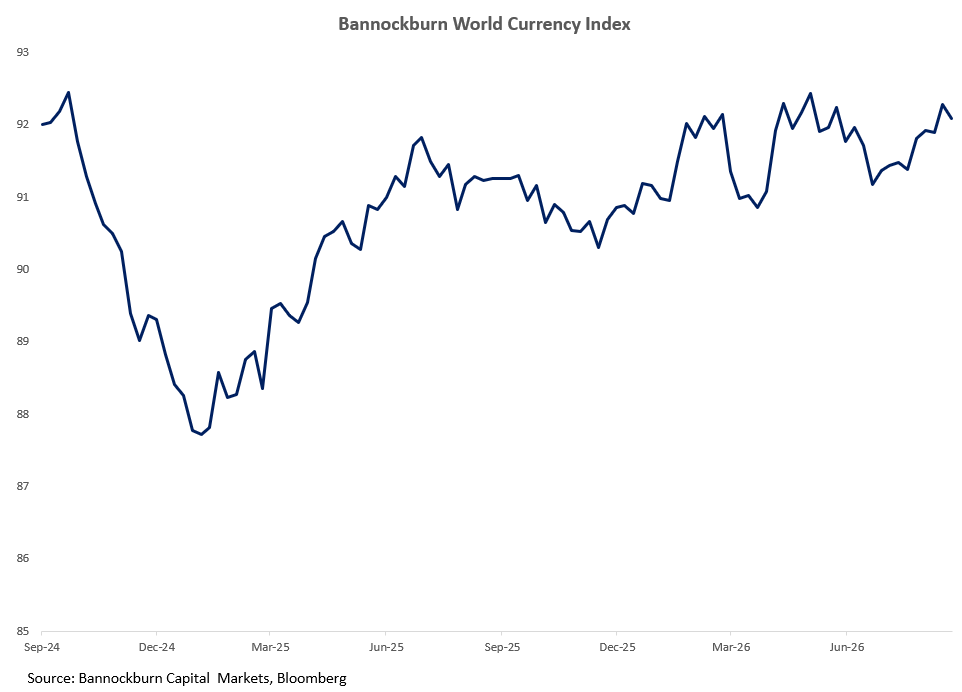
Bannockburn's World Currency Index is composed of the currencies of the dozen largest economies--half of which are from high-income countries and half from emerging markets. It edged up by 0.3% in August after a 0.65% gain in July. BWCI is up about 1.0% this year after a 3.7% advance last year, which was the first increase since 2020.
Turning to the components of the index, the greenback itself was unchanged, of course. It accounts for about a third of the index and dampens the volatility of the BWCI. Among the other G10 currencies, the yen was the only one that did not appreciate, despite the intervention in late July and the threat of more. It fell by about 1.7%. The Australian dollar was the best. It appreciated by about 2.0%. The trade war between the US and Canada, saw the Canadian dollar pare its in late August turnover. Still, it managed to rise by about 0.8% and bested the euro (almost 0.50%) and sterling (0.40%).
That dubious honor of the weakest component in the BWCI falls to the Russian ruble, which dropped by about 7.5% after it declined by nearly 1.2% in July. It was the underperformer in the index for the second consecutive month. The Indian rupee rupee was virtually flat. The Brazilian real fell by by about 2.4%, which reversed more than its July gain. It looks vulnerable ahead of the October presidential election. While the Brazilian real was the weakest in the Latam in August, the Mexican peso was among the strongest, and its 1.8% gain was the second best among the emerging market currencies in the BWCI. The Korean won rose by about 4.4% in August. It was the strongest member of BWCI. The central bank followed July's hike with another in late August.
Since around "Liberation Day" in April 2025, BWCI has been in a clear range between about 90.00 and about 92.00. It frayed the upper end reached almost 92.45 in May, matching its highest level since April 2024. It is trading slightly above 92.00 as August winds down. It dovetails with our general assessment that while the dollar's underlying fundamental support has weakened, the technical momentum indicators are over-extended. Just as the BWCI turned down in late August, we think the risk/reward favors a dollar bounce after broadly trending lower over the past couple of months.
U.S. Dollar: The combination of a net loss of jobs in July, softer inflation readings, and the US Treasury's efforts to suppress bond yields weighed on the dollar broadly in August. The Dollar Index fell for the second consecutive month for the first time this year. While the Fed funds futures market remains confident of a Fed rate hike before the end of the year, the risk of a second hike has been cut to less than 10% from about 50% at the end of July. The Atlanta Fed's GDP tracking model puts US Q3 growth at 4.6%, while the median forecast in Bloomberg's survey is 2.4%. Trade and inventory adjustments have weighed on GDP measures. Economic growth in the past three quarters has averaged slightly less than 1.40%, the slowest nine months since the first three quarters of 2022, which followed the recovery boom. However, excluding trade, inventories, and government, what is called final sales to private domestic parties, arguably gives a clearer signal of the state of the economy. In the past three quarters, it grew a little more than a percentage point higher to 2.45%. The 4.1% unemployment rate is the lower end of the Federal Reserve's estimated range of full employment. The manufacturing sector appears to be strengthening and the 30k jobs it added in H1 is the most in a six-month period since Q1 23. The administration continues to play its tariff card and there is speculation that it will soon levy another 7.5% tariff on China due to the distortions from its excess capacity. The 50% tariffs on Canada currently cover a small part of Canada's exports to the US ($20 bln of almost $410 bln goods exports in 2025 and $290 bln non-energy exports). Canada retaliated, with a range of 15%, 25% and 50% levies on around 700 US products, worth about $20 bln. Given the relative size, with the US economy 12x larger than Canada, the US would seem to dominate the escalation ladder. Yet it will disrupt regional economies, especially in US Northeast and upper Midwest, which in turn could impact the midterm elections in early November.
Euro: The euro rose by about 0.5% in the month through late August, which pared the year's loss to about 1.40%. Technical and fundamental considerations underscore the downside risks. First, the euro's more than 3.5-cent rally since late July stretched the momentum indicators. The correction that began in late August may extend into an outright technical correction that could see a return to the $1.15 area or a little lower after probe about $1.17 was turned back. Second, constructive fundamentals appear to have been discounted, but the political risks remain palpable. The swaps market has a rate hike at the September 10 central bank meeting almost fully discounted and nearly 75% chance of a hike in Q4. The staff updates their economic forecasts, and the risk seems to be for higher inflation next year. In June, the forecast was for CPI to fall to 2.3% from 3.0% this year. There are three state elections in Germany in September. The market seems ill-prepared for the possibility that the Afd breaks through the containment imposed by the other parties and secure a majority of seats in the September 6 contest for Saxony-Anhalt's unicameral legislature. However, if the Afd does not secure a majority, the CDU is even in more complicated pickle. It would need to cobble a coalition together that would likely have to include the far-left Die Linke, which could split the CDU and send reverberations through the national party. Chancellor Merz, who nipped at Merkel's heels for years, has seen his personal support and for the coalition government heads fall to near-record lows. Polls find that a majority of Germans do not expect Merz to complete his term (2029). The Afd challenges in the state elections could provide an extra push.
(As of August 28, indicative closing prices, previous in parentheses)
Spot: $1.1585 ($1.1384) Median Bloomberg One-month forecast: $1.1599 ($1.1493) One-month forward: $1.1600 ($1.1398) One-month implied vol: 5.4 (5.6%)
Japanese Yen: Japanese and Americans intervened to buy yen at the end of July. Their joint intervention failed to push the dollar below the low that the Bank of Japan achieved on its own its April/May intervention of JPY155. That area is now invested with greater technical significance. While the intervention succeeded in forcing speculation in the CME futures to cover about a third of its short yen position in the first two weeks after the intervention, Japanese investors took advantage of the yen's bounce to buy the most foreign stocks and bonds in two years in the subsequent two weeks. Many argue that the yen's weakness stems from the Bank of Japan being behind the curve in tightening monetary policy. Yet, the national core CPI has not been above the target this year. The economy expanded by 0.5% in Q1 26, which after contracting in H2 25 recouped the lost activity. While the efforts by the Japanese government have succeeded in encouraging businesses to give employees pay increases on top of inflation, it has not fueled an increase in household spending, which fell 3.3% year-over-year in June. Also, the BOJ's balance sheet has by almost 7.5 percentage points of GDP in the first half of the year, which is more than the combined reduction of the Federal Reserve, European Central Bank, and the Bank of England's balance sheets. Japan's two-year yield rose nearly 20 bp last month as the market become more confident of BOJ hikes. The swap market now has almost an 85% chance of a September hike discounted, double what it was at the end of July. The probability of a hike in Q4 has risen to a little above 50% from about 15% at the end of July. Nevertheless, arguably encouraged by firm US yields, the dollar is finishing August higher on the month. The dollar rose to JPY160.20, its highest level since the intervention in part of the broad dollar advance after Fed Chair Warsh's speech at Jackson Hole. As the market continues to probe for the official paint threshold, the next area maybe around JPY160.80.
Spot: JPY160.09 (JPY157.40) Median Bloomberg One-month forecast: JPY159.07 (JPY158.81) One-month forward: JPY159.72 (JPY157.04). One-month implied vol: 7.0% (9.1%)
British Pound: Sterling rose for the first time in back-to-back months this year in August. It rose by about 0.4% and reached $1.3675, its highest in six months. Sterling's gains were not facilitated by a change in expectations for the Bank of England. If anything, the chances of more than one hike in the remainder of the year were trimmed. The swaps market prices in little chance of a move at the September 17 meeting. The economy appears to be finding better traction. The preliminary composite August PMI rose it its best level in four months, and GfK's August measure of consumer confidence was the strongest in two years. Drama was limited in Prime Minister Starmer's first month at 10 Downing Street and the Labour Party is doing a little better in the polls. Still, the big challenge awaits: The run-up to the late October Autumn budget statement. In recent years, sterling struggled in September and fell in five of the past six years. In four of those years, the September loss was greater than 2%.
Spot: $1.3538 ($1.3483) Median Bloomberg One-month forecast: $1.3408 ($1.3378) One-month forward: $1.3540 ($1.3485) One-month implied vol: 5.6% (5.6%)
Canadian Dollar: The Canadian dollar weakened in May and June by almost 5.2%. It recovered in July and most of August and retraced around 75% of those losses. It had a four-week rally in tow when the trade negotiations with the US ended acrimoniously. Canada's economy is about a 1/12 of the United States, making it more vulnerable to the trade dispute. However, some northeast and northern Midwest states in the US may be negatively impacted, potentially impacting the US midterm elections. Canada's economy recovered in Q2, growing 3.3% at an annualized rate. The Q1 contraction (-0.1%) was revised away and the new estimate was for 0.3% growth. The trade shock poses a new economic risk. The swaps market downgraded the chances of a rate hike before the end of the year to a nearly 65% from about 85% before the trade conflict erupted, which we suspect is still too high. Canada is the only other country besides China that has retaliated against the US tariffs. The latest tariffs were implemented under Section 338 of the 1930 Trade Act. Many observers expected the legality of these tariffs to be challenged on the grounds that subsequent trade legislation has superseded that 1930 measure, which has never been used like this before. Canada did not only respond "dollar for dollar" with tariffs but also quickly cobbled together a fiscal package (worth about $5.4 bln) to help support Canadian business that would be hurt.
Spot: CAD1.3905 (CAD 1.4021) Median Bloomberg One-month forecast: CAD1.3994 (CAD1.4010) One-month forward: CAD1.3888 (CAD1.4005) One-month implied vol: 4.3% (4.0%)
Australian Dollar: The Australian dollar is one of the strongest currencies in the world this year. Through late August, it has appreciated by almost 7.3% against the US dollar, helped by three rate hikes in the first half, and the prospect of another before year-end. At 4.35%, its policy rate is the highest among the G10 countries. It is also one of four G10 countries with above 3% CPI. Inflation expectations are even higher, and household spending, capex, and private sector credit growth are robust. Moreover, the budget deficit is expected to widen to about 3.5% of GDP this year from 2.7% in 2025, while the economic growth is around 2%, leaving it will little spare capacity. The Reserve Bank of Australia threatens additional rate moves and after a higher-than-expected July CPI (3.5%) and strong household spending, the futures market moved to fully discount a rate hike before the end of the year. The odds of a hike in late September have risen to almost 50% from slightly more than 10% at the end of July. The Australian dollar's 3.5% rally here in Q3 has stretched the momentum indicators. We anticipate a pullback may extend back toward $0.7000.
Spot: $0.7164 ($0.7019) Median Bloomberg One-month forecast: $0.7104 ($0.7009) One-month forward: $0.7160 ($0.7015) One-month implied vol: 7.0% (7.3%)
Mexican Peso: The peso's rose by about 2.25% against the dollar in August and reached its best level since the run-up to the 2024 presidential election. The currencies that offer higher interest rates (greater carry) have significantly higher volatility. Brazil's Selic rate is at 14%, and Colombia's policy rate is at 12% compared with Mexico's 6.5% rate. The implied three-month volatility is over 15% for the Brazilian real and over 13% for the Colombian peso for example. At less than 1% of GDP, Mexico's current account is considerably smaller than Brazil and Colombia's, which are near 2.5%. Moreover, in the first half of the year, Mexico's exports of AI-related hardware (primarily computer servers and data processing equipment) surged to by around 170% to almost $83 bln and surpassed the traditional automotive and auto-parts sectors, with nearly $75 bln of exports. Worker remittances have sent another $30.6 bln of hard currency into Mexico in H1 (about $1 bln more than in H1 25). The biggest risk to Mexico comes from the pressure from Washington on tariffs and trade. President Sheinbaum's approval rating is off the 80% highs seen previously but it is hovering the 65%-70% area, which gives her space. Reports suggest she may support measures that reduce the use of cash in an attempt to curb tax evasion and corruption. As has been the case this year, the market has tended to be more pessimistic towards the peso than we feel warranted. The median forecast in Bloomberg's survey for year-end is MXN17.50. We expect the correction that began in recent days to lift the greenback toward. MAN17.15-MN17.20
Spot: MXN17.0360 (MXN17.3426) Median Bloomberg One-month forecast: MXN17.2680 (MXN17.39) One-month forward: MXN17.0765 (MXN17.4470) One-month implied vol: 6.3 (7.6%)
Chinese Yuan: While the US 10-year premium over China widened to more than 300 bp in August, which is nearly a record, and economic activity has disappointed, Beijing has facilitated the continued gradual appreciation of the yuan. The yuan has appreciated by nearly 4% this year against the dollar and all but a handful of the world's currencies so far this year. Given the production cost differentials, China's near monopoly on range of production, and China's low inflation, the yuan's appreciation is not sufficient address the domestic imbalances or stem the criticism especially from the US and Europe over the undervaluation of the yuan. China’s Ministry of Finance unveiled new measures in late August, aimed at boosting spending on big-ticket items such as vehicles and home renovations, with more action pledged for later in the year. Officials also raised the maximum interest-subsidy payout for qualifying consumer loans, lifting the per-individual cap from 3,000 yuan to 5,000 yuan (US$743). It also broadened the coverage of the loan interest-subsidy policy for micro, small and medium-sized enterprises to include working capital loans. Given the magnitude of the challenge, these measures, like the yuan's appreciation, seem too modest to have significant impact. On balance, we expect the yuan's gradual appreciation, which seems to be in place since April 2025 will continue, though ahead of the Xi-Trump meeting in late September, it may consolidate. Still, we suspect that the median forecast in Bloomberg's survey for the dollar to finish the year at CNY6.70 may be too modest.
Spot: CNY6.7290 (CNY6.7515) Median Bloomberg One-month forecast: CNY6.7494 (CNY6.7525) One-month forward: CNY6.7650 (CNY6.7525) One-month implied vol: 2.4% (2.3%)


Comments
Log in or sign up to join the conversation.