

Yesterday, the minutes of the ECB’s September meeting were released. What do they say about the ECB stance and what do they mean for the gold market?
After a short trip to Japan, we return to Europe. On Thursday, the European Central Bank issued the minutes from its September meeting. They were considered by the markets as dovish. This is because they showed that the officials were worried about the appreciation of the euro. Peter Praet, an executive board member and chief economist at the ECB, even called for “close monitoring” of the exchange rate.
Another important issue discussed during the meeting and revealed in the minutes, was a trade-off between different options for extending the asset buying. The asset purchases will expire in December, so the ECB will have to decide whether it should extend the program for longer but combined with a greater reduction in monthly volumes or whether it should adopt a shorter extension but with larger purchases. On Monday, Praet said that the relatively calm market conditions could encourage the ECB to extend its asset purchase program for a relatively longer period but with reduced monthly spending. Given Praet’s position in the ECB, it suggests that the bank is likely to choose the “lower but longer” scenario. It also implies that the timing of any interest rate hike is further postponed.
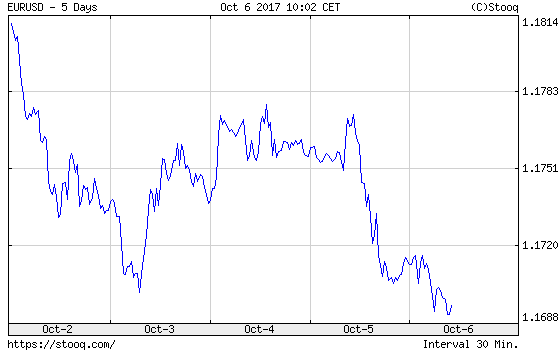
The minutes were, thus, dovish, which is not good news for the gold market. A more dovish ECB implies a weaker euro and a stronger greenback – the gold’s Nemesis. Indeed, the euro depreciated yesterday, as the chart below shows.
Chart 1: EUR/USD exchange rate over the last five days.
(Click on image to enlarge)
Anyway, markets expect that the ECB will cut its purchase volumes by a third to €40 billion a month until the middle of next year. Hence, if the bank slows the pace of buying more abruptly than the investors expect, while keeping the program for longer, the euro will depreciate even further. This is because a longer period will dampen the expectations on interest rates. It would be a negative scenario for the gold market. Will that happen? We will see as soon as October 26.

Comments
Log in or sign up to join the conversation.