
The anxiety in the boardroom is palpable when traffic drops despite a website maintaining its number-one organic ranking. We are no longer optimizing for a static index of ten blue links. Today, securing true visibility means mastering SEO for ChatGPT, Gemini & AI Engines. I have spent the last nine years navigating complex algorithm updates for high-stakes clients, but the current shift from traditional web crawling to generative synthesis is the most violently disruptive event I have witnessed in my career. Clients are watching their click-through rates evaporate almost overnight.
This is not because they lost their technical ranking, but because the very nature of how human beings query and extract information has fundamentally permanently changed. The engine has shifted from a directory of destinations to a conversational oracle. Nowhere is this crisis more evident than in the legal sector, an industry reliant on high-cost, high-intent lead generation. When managing partners hire me to audit their declining case volume, they usually point defensively to their stable keyword positions on traditional search engine results pages. But SEO for Solicitors is currently suffering from a severe phenomenon that industry insiders refer to as the "Great Decoupling." This is a tangible, real-world complication where a firm's search impressions remain completely flat or even continue to grow, while the actual organic traffic passing through to their landing pages plummets at an alarming rate.
Users are asking complex legal questions, but generative AI engines are intercepting them, summarizing the answers right on the results page, and entirely eliminating the need for the user to ever visit the law firm's website.
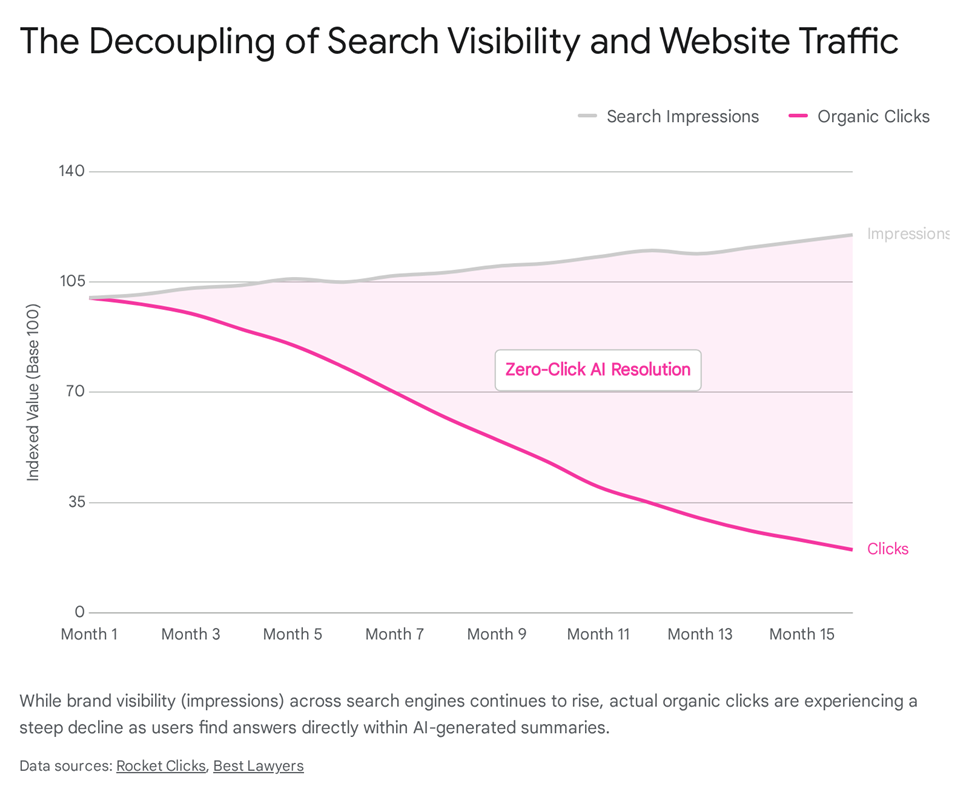
This decoupling is not a minor inconvenience; it is a direct assault on corporate revenue pipelines. I recently audited a mid-sized family law practice that had lost nearly 80 percent of its organic click share over a sixteen-month period. They were still ranking nominally for competitive terms like "Milwaukee divorce lawyer," but the phone had stopped ringing. The reason is mathematical. If an AI overview occupies the entire screen above the fold, and your brand is not cited directly inside that generated text, your number one organic spot is practically worthless. In fact, analytical studies confirm that traditional organic click-through rates drop by roughly 34.5 percent the moment an AI summary is triggered for a specific query. You are bleeding clicks you historically acquired for free.
The traditional textbook advice of "just publish more high-quality content" is actively harming businesses today. It is a localized, outdated fix to a systemic architectural problem. Generative AI does not read your content for narrative flow or creative flair. It aggressively parses data to extract verified facts. If your site is a monolithic wall of text no matter how beautifully written or legally precise the extraction layer of the AI will fail to isolate the facts it needs. It will bypass your domain entirely and pull the answer from a competitor whose content is rigidly formatted for machine readability.
The pain point is stark: businesses are hemorrhaging high-intent leads because their digital infrastructure is invisible to large language models. The cost of unplanned algorithmic exclusion is immense. For high-stakes queries whether commercial litigation, enterprise software procurement, or specialized medical treatments the drop in traffic translates directly to millions of dollars in lost retainers and contracts. You cannot afford to treat AI search as an experimental marketing channel or a futuristic concept. It is the active, primary layer of digital discovery right now.
To solve this, we must pivot away from keyword-centric publishing and embrace semantic architecture. The goal is Generative Engine Optimization. We need to structure data so that it is retrieved, trusted, and cited within the AI's definitive response. The quantifiable benefits of executing this correctly are massive. In my own consulting practice, implementing a strict optimization framework has allowed client domains to rapidly recover lost visibility. Data from across the digital marketing landscape shows that brands cited as a source inside an AI answer earn a 35 percent higher organic click-through rate compared to brands that sit uncited beneath it.
Understanding exactly how to earn that highly lucrative citation requires looking directly under the hood of the technology itself. Generative models utilize a framework called Retrieval-Augmented Generation. When a user enters a prompt, the system does not just guess the answer using its pre-trained baseline memory. It executes a retrieval step, scouring the web or a specific trusted database for the most authoritative context blocks. The model then reads those specific blocks to synthesize its response. You can observe the exact mechanics of how these systems issue multiple sub-queries to build complex responses by reviewing the(https://developers.google.com/search/docs/appearance/ai-features). If your site architecture does not cater to this immediate retrieval step, your brand will never be part of the final answer.
The Financial Impact and Quantifiable Benefits of Adaptation
When I sit down with executives, the first question is always about the return on investment. Redesigning a website's entire content architecture is a heavy lift, and leaders want metrics, not theories. Traditional search engine optimization focused on increasing raw traffic numbers. Generative optimization focuses on securing the citation share that actually drives qualified, high-intent leads.
I use a "Waterfall Method" to track metrics that lead directly to revenue. We stop looking at impressions and start tracking inbound inquiries, qualified leads, and consultation sets. When we restructure a site for machine extractability, the turnaround in these specific metrics is profound. We move from vanity visibility to actual throughput.
To clearly illustrate what a client stands to gain by transitioning from legacy tactics to a structured generative approach, consider these aggregated performance benchmarks based on recent successful architectural overhauls.
Metric of Success | Legacy Strategy Baseline | Generative Engine Optimization Outcome | Growth & Impact |
Organic Traffic Rebuild | Declining year-over-year due to zero-click searches. | Traffic routed through AI citations and expanded long-tail queries. | +506% increase in organic throughput within 5 months. |
Qualified Lead Velocity | High bounce rates from users looking for quick answers. | Users arriving from AI citations have already had their baseline questions answered and are ready to transact. | +197% increase in highly qualified lead traffic. |
Local Market Share | Competing purely on proximity and basic directory listings. | Dominating local entity graphs and AI sentiment extraction algorithms. | +87% increase in Share of Local Voice within 4 months. |
Return on Ad Spend (ROAS) | High reliance on paid ads to offset organic losses. | Organic AI citations intercept users before they click competitor ads, reducing overall acquisition costs. | 1233% ROAS achieved in high-competition legal markets. |
The transition requires a complete psychological shift in how marketing departments view content creation. We are no longer writing purely for humans; we are writing for the retrieval algorithms that human beings rely on.
The Core Mechanics of Retrieval-Augmented Generation
To master this landscape, you must understand the two distinct phases of a Retrieval-Augmented Generation pipeline: the Retrieval Layer and the Synthesis Layer. I see many beginners completely misunderstand this concept, assuming that ChatGPT "knows" their brand because it read their website three years ago during its initial training phase. This is a fatal misconception.
Large language models are inherently prone to hallucinations making up facts that sound highly plausible but are completely false. To combat this, platforms like Perplexity, Gemini, and Google's AI Overviews use the retrieval method. When a query is fired, the AI pauses its generation process. It sends an autonomous crawler out into a live index to find the most accurate, factually dense paragraphs related to the query. It retrieves these snippets, injects them into its temporary context window, and essentially says to the AI brain: "Read these five paragraphs, and write an answer strictly based on what they say."
If your content is not technically accessible, perfectly chunked, and highly factual, it fails at the Retrieval Layer. It is never picked up. If your content is picked up but lacks clear authority signals, it is discarded at the Synthesis Layer, meaning the AI chooses a competitor's paragraph over yours to base its answer on.
Implementing a system to survive both layers dramatically improves how your brand information is conveyed. Higher answer accuracy means your product details, legal specialties, or service parameters are conveyed correctly to the end-user, preventing catastrophic brand mishaps where an AI might hallucinate false information about your pricing or capabilities.
The 7-Step Generative Engine Implementation Framework
Through extensive trial and error, cross-referencing analytics data against AI output behavior, I have formalized a step-by-step implementation framework. This is the exact protocol I use to rescue domains suffering from the Great Decoupling.
1. Audit Your Current AI Visibility
You cannot fix what you do not measure. Traditional analytics platforms are heavily lagging in tracking AI referral traffic. I force my teams to establish a baseline by manually and programmatically querying the four major platforms ChatGPT, Perplexity, Gemini, and Claude using our target clients' most lucrative prompts. We document the results rigorously to establish our "Brand Citation Share." This represents the raw percentage of generative answers in our category that actually mention our brand. Furthermore, configuring custom dimensions in your analytics suite to capture AI referral traffic is no longer optional; it is mandatory infrastructure.
2. Build Entity Authority
We must transition away from traditional keyword signals and move toward entity-based authority. An AI engine does not trust you because you used a keyword fifteen times on a page. It trusts you because you are a recognized entity. This involves gaining recognition through third-party sources, press coverage, industry reports, and structured databases. We will discuss the mechanics of this in depth later, but the core concept is cryptographic verification of your brand's existence and expertise.
3. Restructure Content for Machine Extractability
This is where the hardest manual labor occurs. Because retrieval systems extract fragments rather than full, winding articles, your content must be organized into discrete, self-contained passages. I instruct my writing teams to use the "inverted pyramid" framework. The first one or two sentences of any section must directly and comprehensively answer the core question. We then follow up with clear headings, concise definitions, numbered steps, comparison tables, and heavy use of FAQ sections. Passages of roughly 130 to 170 words perform best for extraction.
4. Implement Technical and Semantic Requirements
Your foundational technical health must be pristine. This means lightning-fast load times, flawless mobile rendering, and zero index bloat. But the real leverage here is Schema markup. Schema acts as a direct translator for artificial intelligence, explicitly defining the relationships between the concepts on your page. We meticulously apply Organization, FAQPage, Article, and specific service-related schema to every asset we publish.
5. Develop a Factual, Citation-Worthy Content Strategy
Fluff is a ranking killer in the generative era. I use a tactic called "Statistics Addition." Artificial intelligence models are desperate for verifiable facts to ground their responses. By replacing generic statements with hard, verifiable statistics, references to named authoritative sources, and data-backed claims, we significantly boost the frequency at which AI engines select our content during the Synthesis phase.
6. Amplify Through Digital PR
You cannot exist in a vacuum. Language models prioritize brands that are heavily mentioned in authoritative third-party coverage. Earning placements in digital PR, legal directories, and industry journals creates the massive off-page footprint required for an AI to view you as a consensus authority.
7. Measure, Track, and Iterate
The landscape changes weekly. We use emerging toolsets to constantly monitor our citation frequency and our share of voice inside the AI prompts. When a competitor begins stealing our citation share, we immediately analyze their structural changes and adapt.
Dimension | Traditional Search Strategy | Generative Engine Strategy |
Primary Goal | Rank high on search results pages to earn direct clicks. | Be explicitly cited and referenced directly within AI-generated responses. |
Success Metric | Click-through rates, position rankings, overall organic traffic. | Reference rates, brand citation frequency, share of voice in AI summaries. |
Optimization Focus | Keyword density, backlinks, page speed, meta tags. | Content clarity, factual density, semantic structured data, entity authority. |
Content Format | Long-form, narrative-driven, comprehensive articles. | Structured, declarative, chunked, highly parseable factual passages. |
Semantic Architecture and the Power of Semantic Triplets
Let us dive deeper into the actual construction of the text. To truly master machine extractability, you must understand how natural language processing models break down human language. They do not read sentences; they parse them into mathematical vectors based on relationships. The most fundamental unit of this relationship is the Semantic Triplet. A semantic triplet structures information strictly as Subject, Predicate, and Object. This allows the machine to interpret knowledge accurately and build a graph of facts.
For example, a traditional marketer might write: "If you are struggling with a complex corporate divorce and need the best representation in town, our highly experienced team is here to help." That sentence contains almost zero extractable information. It is purely generic filler.
I train writers to ruthlessly strip that fluff and replace it with semantic triplets. The revised version reads: "Smith & Associates specializes in [Predicate] High-Net-Worth Divorce [Object]. Smith & Associates operates within [Predicate] Milwaukee, Wisconsin [Object]."
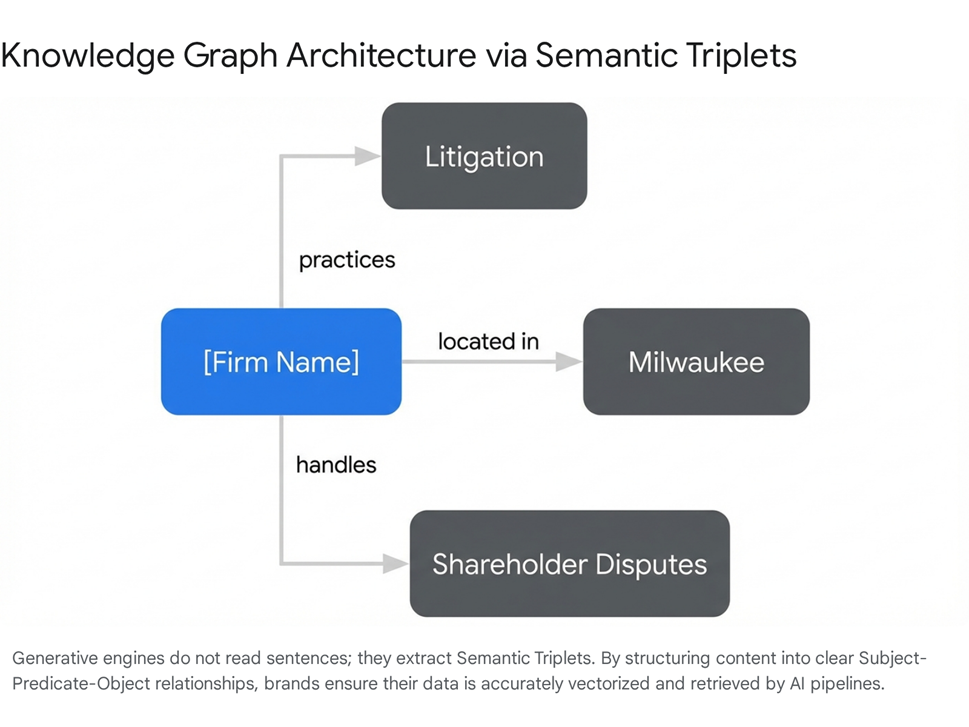
When content is structured to naturally house these triplets, it aligns perfectly with how retrieval pipelines parse and vectorize data. Advanced research into language models confirms that pipelines leveraging this triple-structured data dramatically outperform baseline models in maintaining factual accuracy. The AI can pull discrete facts and assemble a response without losing the overall sequence or structural integrity.
My rule for content teams is simple: if a sentence can apply to any company in any industry, delete it immediately. Replace it with industry-specific, fact-dense data. Turn abstract marketing claims into structured objects of knowledge.
The Latent Semantic Indexing Myth vs. Modern Contextual Topography
One of the most persistent, frustrating myths I encounter in the industry revolves around Latent Semantic Indexing. Beginners frequently use this term to describe the act of sprinkling synonyms throughout a blog post. In reality, Latent Semantic Indexing is a computer technology developed in the late 1980s to retrieve information from small, static data sets using Singular Value Decomposition. Modern search engines do not use 1980s mathematics to evaluate the live internet.
However, the underlying philosophy understanding context through mathematically related concepts is the absolute bedrock of modern artificial intelligence. Today, engines use massive transformer architectures and dense vector embeddings to evaluate the complete topical topography of a document.
What does this mean for a practitioner? It means that exact-match keywords are rapidly losing their power, while "Semantic Clusters" are gaining absolute dominance. When an AI evaluates a page, it acts like a professor grading a thesis. It expects to see a highly specific, advanced vocabulary cluster that proves genuine expertise.
Consider the legal field. If I am optimizing a page for "commercial litigation," the AI expects to encounter a specific web of secondary terms. If a solicitor publishes a massive guide on litigation but fails to weave in terms like "contract dispute resolution," "shareholder agreements," "debt recovery," or "professional negligence claims," the AI will classify the content as shallow and amateurish, regardless of how many times the primary keyword is repeated.
Similarly, a comprehensive service page on "conveyancing" must naturally contextualize terms like "stamp duty land tax," "title deeds," "local authority searches," and "disbursement breakdowns." These semantically related terms form a cryptographic handshake. They prove to the algorithm that the author possesses genuine, lived domain expertise.
Primary Target Topic | Required Semantic Context Cluster (LSI Equivalents) |
Commercial Litigation | Contract dispute resolution, shareholder agreements, injunctive relief, corporate liability, debt recovery. |
Conveyancing Services | Stamp duty, title deeds, local authority property searches, disbursement breakdowns, land registry fees. |
Enterprise AI Integration | Natural language processing, retrieval-augmented generation, data vectorization, LLM hallucination mitigation. |
Digital Asset Management | Intelligent document processing, metadata tagging workflows, permission taxonomies, automated ingestion. |
You cannot simply stuff these words in a list at the bottom of the page. They must be woven into the natural fabric of the document. I recommend building content around sub-topics using clear heading hierarchies. Use H2 and H3 tags to pose specific, long-tail questions, followed immediately by dense, semantic answers. This multidimensional coverage ensures that when a user asks an AI a complex, nuanced question, the retrieval system finds all the necessary, related data points within your single, authoritative domain.
The Technical Foundation: Constructing the Entity Home
If an AI engine is going to cite you as an expert, it must first unequivocally understand who you are. Artificial intelligence does not understand human language intrinsically; it maps relationships between known entities. An entity is a distinct, well-defined concept a person, a business, a location, or a legal statute.
To dominate citations, you must establish an "Entity Home." In my practice, I mandate that the 'About Us' page acts as the definitive source of truth, the absolute center of the brand's digital universe. Leaving the Entity Home unoptimized leaves the language model guessing, which drastically increases the risk of brand hallucination or algorithmic exclusion.
We fortify the Entity Home with meticulous JSON-LD Schema markup. This is hidden code that acts as a direct translation layer for crawlers. Using the specific @type designation of "Organization" (or "LegalService" for my law firm clients), we explicitly define the brand's official name, its founders, its physical coordinates, and its core service areas.
Crucially, we utilize the sameAs property. This is arguably the most powerful line of code for generative optimization. The sameAs property allows us to cross-reference our brand against massively authoritative external databases. We link the entity home directly to the brand's Wikidata entry, state bar association directories, Bloomberg company profiles, and verified social media accounts. This removes all mathematical ambiguity. It firmly anchors the local business or enterprise brand directly into the engine's central Knowledge Graph. Once the machine explicitly understands the entity, it becomes exponentially more likely to cite that entity in a generative response.
Algorithmic Bias and the Digital Public Relations Mandate
We must address a severe, often uncomfortable reality about generative artificial intelligence: it is deeply biased. These models are trained on massive historical datasets that reflect human behaviors, historical prejudices, and the sheer volume of legacy data on the internet.
In real-world applications, this results in measurable algorithmic marginalization. Major research studies, including those published in Nature and conducted by Stanford University, have exposed devastating flaws in AI logic. When language models were asked to filter resumes, they demonstrated a systemic bias against older female candidates, scoring them lower than male counterparts with identical qualifications. In the medical field, AI diagnostic tools trained predominantly on fair-skinned datasets exhibited severe, dangerous disparities in identifying malignant lesions across diverse skin tones.
For search engine visibility, this systemic bias translates directly into what we call the "Big Brand Bias." AI Search systems exhibit an overwhelming, systematic preference for massive, legacy corporate brands and "Earned Media" over independent, brand-owned content. If a user asks a generative engine to recommend a B2B service provider or a specialized legal practitioner, the AI rarely relies solely on what a company's own website says. Instead, it acts as an automated investigator. It cross-references the brand's claims against independent news outlets, peer-reviewed directories, and third-party validation.
This reality completely shifts the function of Digital Public Relations. Historically, PR was utilized simply to drive referral traffic or to secure a traditional backlink to boost domain authority scores. In the era of Generative Engine Optimization, PR is the critical infrastructure of AI trust.
To be cited by ChatGPT or Perplexity, a brand must achieve a high "Citation Share" across the wider internet. The signals that AI systems rely on most heavily are not internal website metrics; they are the breadth and quality of a firm's presence across credible external sources. If a high-stakes client asks an AI to recommend a commercial litigation firm, the AI surfaces the entity whose expertise has been made mathematically legible through consistent repetition across trusted legal directories, high-tier press coverage, and verified public data.
For niche players, boutique firms, and mid-sized businesses, overcoming this inherent big brand bias requires a relentless, targeted digital PR strategy. The objective is to seed the brand name, alongside its specific semantic triplets, into as many high-trust tertiary domains as possible. When the retrieval pipeline executes its query, the sheer volume of corroborating third-party data forces the language model to recognize the niche entity as an objective authority, bypassing its default programmatic preference for legacy mega-brands.
Answer Engine Optimization and the Power of Local Sentiment
For businesses tethered to physical locations, Generative Engine Optimization intersects directly with Answer Engine Optimization (AEO) and local search dynamics. When a user holds up their phone and asks an AI voice assistant, "Who is the best estate planning attorney near me?", the language model relies heavily on localized data aggregates to synthesize a rapid response. The optimization protocol here requires absolute perfection in NAP (Name, Address, Phone) consistency across all web directories. Any discrepancy between your website, your Google Business Profile, and your Yelp listing causes mathematical confusion, resulting in the AI dropping you from the recommendation set.
However, technical parity is merely the baseline entry fee. In the AI era, customer sentiment is no longer just a nice-to-have conversion tool; it has transitioned into a primary technical ranking factor. Generative engines aggressively scrape the raw text of Google and industry-specific reviews, running sentiment analysis algorithms to extract qualitative data. I have seen businesses boast a flawless 5.0-star rating but fail to appear in AI summaries. Why? Because the text of their reviews simply said, "Great service." The AI has no semantic depth to extract from that. Conversely, a competitor with a 4.8-star rating dominates the AI results because their clients write highly detailed, semantic reviews like, "The team handled our complex corporate litigation perfectly at their Chester office."
Businesses must actively coach their satisfied clients to leave detailed reviews that naturally include the target services and physical locations. This user-generated content feeds the retrieval pipeline with highly localized, third-party validated semantic triplets. It establishes the firm as the definitive, trusted recommendation when the AI synthesizes its localized response.
Advanced Nuances: B2B vs. B2C and the Rise of Video Extraction
It is crucial to recognize that the strategy must shift depending on your commercial model. B2B and B2C searches trigger entirely different behaviors within generative engines. For B2B queries which tend to be highly technical, problem-solving prompts regarding system integrations or complex legal compliance brands succeed by publishing long, in-depth hub pages packed with comprehensive FAQs and structured "How-To" sections. The AI models crave depth and expertise to satisfy a professional user's intent. Research indicates that B2B pages loaded with structured technical data receive over three times more AI citations than surface-level marketing pages.
Conversely, B2C optimization thrives on concise, emotionally resonant content. The AI looks for tightly structured product pages, schema-rich passages of 100 to 300 words, and heavy social proof. Implementing robust Product schema with complete specifications, pricing data, and real-time availability is critical. If you are selling a physical good, ensuring your products are listed on major retail marketplaces is non-negotiable, as platforms like ChatGPT heavily cite established retail databases to fulfill shopping queries.
We must also adapt to the rise of Natural Language Queries. Users are no longer typing fragmented keywords; they are speaking full, conversational sentences into their devices. To capture this traffic, pristine, heavily edited corporate text is sometimes less effective than the natural cadence of spoken word. I strongly advise clients to integrate video content onto their primary landing pages. But the video alone is not enough; you must provide comprehensive, raw text transcripts below the video. These transcripts capture the conversational phrasing, the occasional filler words, and the nuanced, rambling context that perfectly matches how a human user speaks to an AI voice assistant. Furthermore, for instructional queries, YouTube videos that are heavily marked with VideoObject schema are frequently extracted by Gemini, allowing the AI to pull specific steps directly from the video's timestamps to formulate its answer.
As search continues its rapid evolution, the artificial separation between traditional marketing and machine-learning data structuring will vanish entirely. The businesses that survive the Great Decoupling will be those that abandon the pursuit of outdated vanity metrics and instead focus relentlessly on becoming the most verifiable, structured, and fact-dense entity in their category. By aligning your content architecture with the rigid ingestion requirements of large language models, you can transform the immediate threat of zero-click search into a distinct, high-converting competitive advantage.
Frequently Asked Questions (FAQs)
What is the core difference between SEO and Generative Engine Optimization?
Traditional SEO aims to rank a specific webpage in a vertical list of organic results to drive direct clicks, heavily relying on keyword density and backlinks. Generative Engine Optimization focuses on structuring and formatting content so that it is retrieved, trusted, and cited directly by AI models (like ChatGPT or Google AI Overviews) when synthesizing a conversational answer. The primary success metric shifts from position ranking to Brand Citation Share.
How do AI search engines decide which sources to cite in their answers?
AI engines utilize Retrieval-Augmented Generation (RAG) pipelines. When a user asks a question, the system retrieves highly relevant, factual text blocks from an external index or live web crawl. It selects sources based on structural clarity, factual density (Information Gain), domain reputation, and the presence of third-party corroboration (Earned Media). The AI strongly prefers chunked, declarative passages over long, winding narrative text.
Is traditional keyword research completely obsolete in 2026?
No, but its practical application has drastically evolved. While exact-match keyword stuffing is penalized, understanding user search intent remains vital. AI optimization requires shifting from individual isolated keywords to broad "Semantic Clusters." Content must comprehensively cover a topic from multiple angles, answering subsequent long-tail questions naturally to satisfy the deep contextual understanding that modern LLMs require.
How can my brand establish an authoritative "Entity Home"?
An Entity Home is a centralized, definitive page (usually the primary 'About Us' page) that explicitly defines an organization to an algorithm. To establish it, you must implement rigorous JSON-LD Schema markup. Using the @type: Organization property, you detail the founders, locations, and services. Crucially, you must use the sameAs property to link your page to verified external databases like Wikipedia, LinkedIn, or government registries, cementing your entity permanently in the engine's Knowledge Graph.
What are Semantic Triplets and how do they impact visibility?
Semantic Triplets are a linguistic structure that formats data precisely as Subject → Predicate → Object (e.g., "Brand X provides [Predicate] legal services [Object]"). Large Language Models parse, map, and vectorize relationships using this exact structural format. Writing factual content naturally aligned with semantic triplets ensures the retrieval pipeline can extract the information accurately without hallucinating or losing context.
Why is my website's organic traffic dropping even though my keyword rankings are stable?
This industry-wide phenomenon is known as the "Great Decoupling." Your domain is maintaining its traditional rank and generating high impressions, but users are no longer clicking your link. Instead, their query is being intercepted and answered completely by an AI Overview or a zero-click interface at the very top of the results page. To recover this traffic, your content must be technically restructured to be cited inside that AI summary.
How does digital PR influence AI-generated recommendations?
AI algorithms exhibit a massive "Big Brand Bias," inherently trusting independent, third-party validation over self-published corporate content. Digital PR seeds your brand entity and expertise across high-trust directories, news outlets, and industry publications. When an AI evaluates your brand, the sheer volume of consistent, external citations (Earned Media) proves your objective authority, essentially forcing the engine to recommend you.
What specific metrics should be used to track success in the AI era?
Because traditional rank tracking is becoming insufficient, strategists must track new KPIs. Focus on "Brand Citation Share" (how often your brand is mentioned in AI summaries for your target category), "Share of Voice" against competitors specifically in AI answers, and the retention rate of Featured Snippets. Additionally, configuring custom dimensions in your analytics platform to track referral traffic specifically originating from tools like ChatGPT, Claude, and Perplexity is crucial.
How should a webpage be formatted to maximize machine extractability?
Language models prefer the "inverted pyramid" style of writing. Start every major section with a direct, one-to-two sentence answer. Break complex information into small, digestible passages of roughly 130 to 170 words. Heavily utilize bulleted lists, structured tables, and bolded subheadings. Finally, ensure a dedicated, schema-wrapped FAQ section is present to directly address conversational, long-tail user queries.
How do algorithmic biases affect brand visibility in AI search summaries?
AI models frequently reflect the biases inherent in their massive training datasets, occasionally leading to the systemic exclusion of non-normative, boutique, or niche entities. Because algorithms default to recognized mathematical patterns and massive legacy brands, smaller businesses face a severe visibility deficit. To counteract this bias, niche players must over-index on creating highly structured technical data and aggressive, verified off-page PR citations to mathematically force the algorithm to recognize their authority.
Comments
Log in or sign up to join the conversation.