
SEO Expert USA: How the Right SEO Strategy Turns Search Visibility Into Real Business Growth
Choosing the right SEO partner can be difficult. Almost every agency promises better rankings, more traffic, and stronger online visibility, but the real question is much simpler:
Will the SEO strategy actually help your business attract the right people and turn search visibility into meaningful opportunities?
For businesses competing in the United States, SEO has become much more than adding keywords to a website. Search visibility now depends on technical website health, useful content, local relevance, search intent, authority, user experience, and the ability to compete across increasingly complex search results.
That is why working with the right SEO Expert USA can make a meaningful difference.
MSEOExpert focuses on building SEO strategies around the actual problems a business is facing rather than applying the same checklist to every website. Whether the goal is improving organic visibility, strengthening local search performance, optimizing an e-commerce store, or building a stronger long-term search presence, the strategy needs to start with understanding the business first.
Why SEO Is Still One of the Most Valuable Growth Channels
Many businesses begin SEO because they want to rank for a few important keywords.
But rankings alone are not the real objective.
A website can rank for hundreds of keywords and still generate very few qualified leads. On the other hand, a smaller website with strong search intent alignment can attract visitors who are actively looking for the exact service or product being offered.
Effective SEO connects three things:
What people are searching for + what the business offers + what the website communicates.
When those three elements are aligned, search traffic becomes much more valuable.
This is where professional SEO Services USA can help. Instead of focusing on rankings in isolation, a comprehensive SEO strategy looks at the complete search journey.
That may include:
Technical SEO
On-page SEO
Content optimization
Local SEO
Google Business Profile optimization
Internal linking
Off-page SEO
Link building
E-commerce SEO
Keyword and competitor research
Conversion-focused website improvements
SEO audits
Search intent optimization
The goal is not simply to bring more people to a website. The goal is to bring more relevant people.
What Makes a Good SEO Expert Different?
One of the biggest challenges businesses face is finding an SEO professional who can look beyond individual keywords.
A strong SEO strategy starts with questions such as:
What products or services generate the most revenue?
Which customers are most valuable?
What locations does the business actually serve?
What are competitors doing better?
Which pages already have search visibility?
Which pages are underperforming?
Are technical problems limiting organic performance?
Are visitors landing on the right pages?
Does the content match search intent?
Is the website converting traffic into inquiries?
This approach changes the conversation from:
“How can we rank this keyword?”
to:
“How can search visibility create more qualified business opportunities?”
That difference matters.
A professional SEO strategy should also be transparent. Businesses should understand what is being worked on, why certain changes are recommended, and which improvements should be prioritized.
SEO Starts With Finding the Real Problem
A common mistake is to start changing website content before understanding what is actually wrong.
For some businesses, the biggest issue is technical.
For others, the website may have good technical health but weak content, poor search intent alignment, limited local relevance, or insufficient authority.
Sometimes the problem is even simpler: the website is targeting keywords that do not reflect what potential customers actually search.
An SEO audit helps uncover these issues.
A proper audit can examine areas such as:
Technical SEO
Search engines need to be able to crawl, interpret, and index a website properly. Technical SEO can identify issues involving site architecture, indexing, page performance, redirects, internal linking, structured data, duplicate URLs, and other technical elements.
On-Page SEO
Each important page should communicate its topic clearly.
That includes:
Title tags
Meta descriptions
Headings
Content structure
Internal links
Image optimization
Search intent
Topical relevance
Content Quality
The best content is not simply written around a keyword.
It should answer the questions people actually have and help them make a decision.
Local SEO
Businesses serving specific markets need to build local relevance through their website, Google Business Profile, citations, reviews, location information, and service-area signals.
Authority
A website competing in a difficult market may also need a stronger off-page strategy, including relevant mentions, quality backlinks, digital PR opportunities, and relationship-driven link building.
Why Search Performance Should Be Evaluated Over Time
SEO rarely tells the full story through a single day's numbers.
Search visibility develops over time.
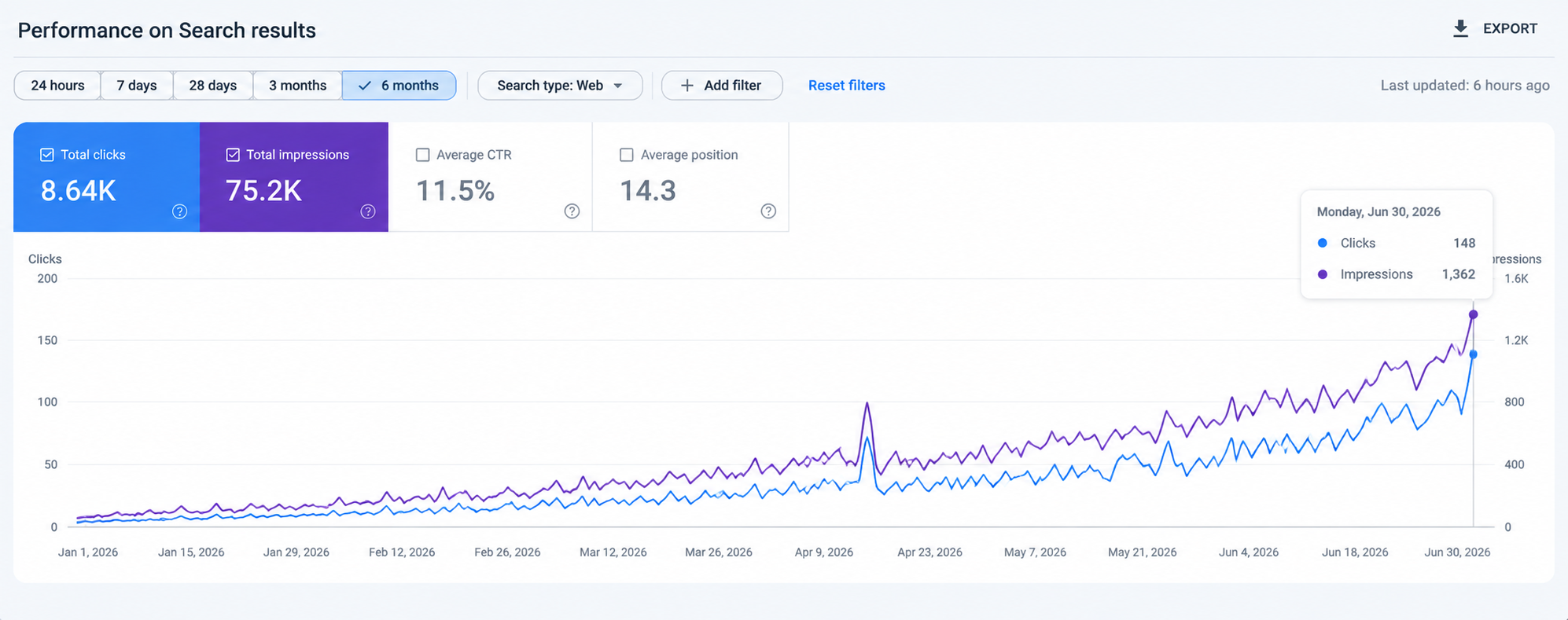
The six-month performance snapshot you shared illustrates why tracking trends is important. The report shows 8.64K clicks, 75.2K impressions, an 11.5% average CTR, and an average position of 14.3 over the selected six-month period.
More importantly, the chart shows a generally upward trend in both impressions and clicks.
That kind of data provides more useful information than simply saying a website “ranks.”
For example:
If impressions are increasing, the website is appearing for more searches.
If clicks are increasing alongside impressions, more searchers are choosing the website.
If CTR improves, the search result may be becoming more compelling for users.
And if average position improves over time, important pages may be moving closer to stronger search visibility.
This is why a good SEO process relies on measurement, interpretation, and refinement, not assumptions.
The Difference Between Traffic and Qualified Traffic
Getting traffic is not difficult if the only goal is to generate visits.
Getting the right traffic is much more valuable.
Imagine two businesses.
Business A receives 10,000 monthly visitors but most of those visitors are looking for general information unrelated to its services.
Business B receives 2,500 visitors, but many are searching for specific commercial services and are ready to contact a provider.
Business B may generate significantly more business from a smaller amount of traffic.
This is why keyword selection should be based on intent.
Informational searches can help build awareness.
Commercial searches can introduce potential buyers to a service.
Transactional searches can bring people who are closer to taking action.
A skilled SEO strategy considers all three.
Building a Stronger SEO Strategy for U.S. Businesses
The U.S. market is competitive across almost every major industry.
Businesses may be competing against established national brands, specialist agencies, local businesses, directories, marketplaces, publishers, and other websites for the same search results.
That means a generic SEO strategy is rarely enough.
A strong U.S. SEO campaign should consider:
Geographic targeting
Where are customers located?
A business serving Oklahoma will have different local search opportunities from a business targeting Tennessee or Indiana.
Industry competition
A dental practice, contractor, healthcare provider, law firm, e-commerce brand, and SaaS company will not have the same search landscape.
Service-specific intent
Different services deserve different landing pages.
A page targeting “SEO services” should not try to rank for every possible niche and location.
Content depth
Pages should demonstrate relevance and provide genuinely useful information.
Website structure
Important commercial pages should be easy for both users and search engines to discover.
Conversion paths
A visitor should know what to do next.
That might be:
Request an audit → book a consultation → contact the business → request a quote → purchase a product
SEO becomes more valuable when the path from search to action is clear.
Why E-Commerce SEO Requires a Different Approach
E-commerce websites face a unique set of SEO challenges.
An online store can have hundreds, thousands, or even millions of potential URLs.
Products change.
Categories change.
Inventory changes.
Filters create additional URLs.
Products can become unavailable.
Duplicate content can appear across similar pages.
This makes e-commerce SEO much more complex than simply optimizing product descriptions.
MSEOExpert provides E-commerce SEO Services USA designed to address the specific challenges of online stores.
An e-commerce SEO strategy may involve:
Product page optimization
Category page optimization
Technical SEO
Internal linking
Site architecture
Search intent
Product and category content
Schema opportunities
Indexation
Duplicate-content management
Website performance
Conversion-focused optimization
The most valuable e-commerce pages are often the ones closest to a buying decision.
That means category pages, product pages, and commercial landing pages deserve special attention.
Local SEO Can Be a Major Opportunity for Service Businesses
For local businesses, appearing in traditional organic results is only one part of the search journey.
Customers may also discover a business through Google Maps and local search results.
That makes Local SEO particularly important for businesses such as:
Contractors
Dentists
Healthcare providers
Home-service companies
Professional services
Local retailers
Regional businesses
A strong local SEO strategy can include:
Google Business Profile optimization + local website optimization + citations + reviews + location relevance + service-page optimization
The goal should always be accurate, useful, and trustworthy local information.
Businesses should never create fake offices, fake addresses, or misleading location pages simply to capture additional keywords.
Sustainable SEO is built around real business activity and genuine customer intent.
SEO for Specialized Industries
Different industries have different search behaviors.
For example, a healthcare organization needs to communicate information differently from an e-commerce store.
A dental practice may need strong service pages and local optimization.
A contractor may need individual service pages and location-focused visibility.
An e-commerce brand may need product and category optimization.
That is why specialized SEO can be useful.
MSEOExpert can build strategies around areas such as:
Dental SEO
Helping dental practices improve visibility around relevant treatments, services, and local searches.
Healthcare SEO
Helping healthcare businesses improve website structure, service visibility, content, and local search presence.
Contractor SEO
Helping contractors improve visibility for service-related searches through Local SEO, service pages, technical SEO, and website optimization.
The underlying SEO principles remain the same, but the strategy should reflect how customers in each industry search and make decisions.
What Businesses Should Look for in an SEO Partner
Before hiring an SEO company, ask practical questions.
Do they understand your business?
An SEO strategy should reflect your actual customers, services, products, competition, and market.
Can they explain their recommendations?
You shouldn't need an SEO degree to understand why an important change is being recommended.
Do they focus on meaningful metrics?
Impressions, clicks, rankings, conversions, engagement, and qualified leads can all tell different parts of the story.
Do they provide a clear process?
You should know what happens during the audit, strategy, implementation, reporting, and ongoing optimization stages.
Do they make unrealistic promises?
Be cautious of guarantees such as:
“We'll rank you #1 on Google in 30 days.”
Search performance depends on many variables, including competition, website quality, industry, content, authority, technical health, and changes in search systems.
A credible SEO partner should focus on the work and measurable improvements rather than unsupported guarantees.
SEO Is a Process, Not a One-Time Fix
A website can improve significantly and still need ongoing SEO.
Competitors publish new content.
Search behavior changes.
Google changes its systems.
Websites grow.
Products change.
New services are introduced.
That is why SEO should be viewed as an ongoing process.
A practical cycle looks like this:
Audit → Strategy → Optimization → Content → Authority → Measurement → Refinement
The data then helps determine what should happen next.
Some pages may need stronger content.
Others may need technical improvements.
Some keywords may deserve new landing pages.
Certain service pages may need stronger internal linking.
And some opportunities may not be worth pursuing at all.
That continuous prioritization is what separates strategic SEO from simply publishing more content.
Why MSEOExpert Focuses on Practical SEO
The goal of SEO should not be to make a website look optimized.
It should be to make the website more relevant, discoverable, useful, and commercially effective.
MSEOExpert's approach brings together technical SEO, on-page optimization, off-page strategy, Local SEO, website improvements, e-commerce SEO, content, search intent, and conversion-focused thinking.
For a business owner, that means SEO is not just about rankings.
It is about answering a much more important question:
Can potential customers find us when they are looking for what we offer?
And once they find us:
Does our website give them a reason to take the next step?
When those two pieces work together, SEO becomes a genuine business-growth channel.
Ready to Build a Stronger Search Presence?
Whether your website needs a technical SEO review, Local SEO strategy, improved service pages, e-commerce optimization, or a broader search strategy, the first step is understanding where the biggest opportunities are.
MSEOExpert works with businesses looking to improve organic visibility, search relevance, local presence, and qualified traffic through practical SEO strategies.
The right SEO strategy starts with the right questions, the right priorities, and a clear understanding of what your customers are searching for.
Comments
Log in or sign up to join the conversation.