

After opening the day in green, share markets in India witnessed positive trading activity throughout the day and are presently trading above the dotted line. Sectoral indices are trading on a mixed with stocks in the pharma sector and stocks in the realty sector leading the losses, while stocks in the pharma sector are trading in green.
The BSE Sensex is up by 370 points (up 1.1%) and the NSE Nifty is trading up by 110 points (up 1%). Meanwhile, the BSE Mid Cap index is trading up by 1.2%, while the BSE Small Cap index is trading up by 1.5%. The rupee is trading at 67.35 to the US$.
In news from stocks in the automobiles sector. Tata Motors announced that it is working on close to a dozen electric and hybrid vehicle solutions in the commercial vehicle space and is simultaneously moving towards a dedicated electric vehicle platform in the passenger vehicle front.
The company is planning to develop a 320 volts battery with a range of 300 plus kilometers which will deliver faster acceleration, efficiency, including fast charging. Notably, the company is also setting up an electric mobility business vertical.
Having edged ahead of Mahindra to bag the L1 tender for EESL's 10,000 electric vehicle contract, the company was able to deliver on the contract in the short span of four months, claimed Tata Motors. The company has also bagged 60% of electric bus order from the Ministry of Heavy Industries for plying in major cities.
At the time of writing, Tata Motors share price was trading up by 1.5%.
Is India Prepared to Meet the Ambitious Battery Car Target?
Currently, electric vehicle sales are low in India, rising 37.5% to 22,000 units in the year ended 31 March 2016 from 16,000 in 2014-15. Only 2,000 of these were cars and other four-wheelers, according to automobile lobby group Society of Indian Automobile Manufacturers (Siam).
The government wants to see 6 million electric and hybrid vehicles on Indian roads by 2020 under the National Electric Mobility Mission Plan 2020.
The government is targeting to have all cars propelled by electric engine by 2030. The target is more daunting than in many advanced countries.
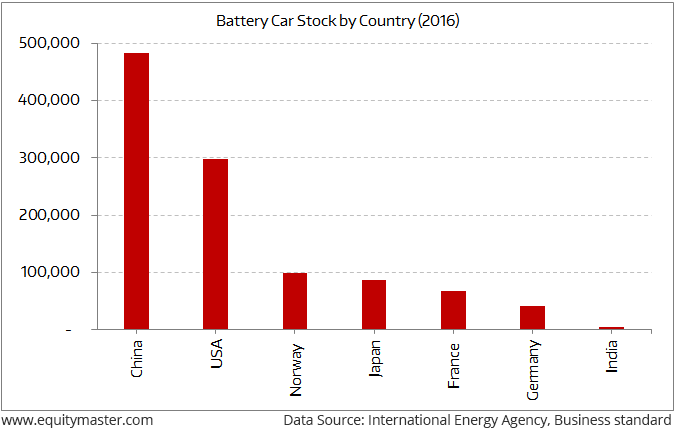
According to the industry, the 2030 target would require eight to ten times the global stock of such vehicles. India would need to sell more than 10 million electric cars in 2030, compared to 5,000 electric vehicles India had on the road in 2016.
As you can see from the chart above, India is barely visible compared to other developed countries when it comes to battery cars.
As an article in Business Standard suggests, such a big jump in scale for the auto industry in 13 years seems difficult. The basic infrastructure is missing. There are not enough charging stations. For this massive shift, the charging stations will need to be as ubiquitous as petrol pumps.
Another issue is the price of the lithium-ion battery, which constitutes 30% to 40% of the cost of the car. For this plan to succeed, the price of the battery needs to come down.
The auto industry is already facing regulatory headwinds. The shift from BS-IV emission norms to BS-VI has been two years ahead of schedule without an intermediate stage. The government, if it is serious about such ambitious targets, should offer the necessary infrastructure support and do its bit for a smooth transition.
Moving on to news from stocks in the agriculture sector. Sugar stocks are in focus today after the government unveiled a bailout package for the sugar industry.
Notably, sugar prices have dropped to their lowest in 28 months. As a result, mills now owe nearly Rs 220 billion to cane growers, which could leap to a record Rs 250 billion in the current 2017-18 season.
Large surpluses have led to a sharp fall in prices that in turn have made it difficult for mills to pay the country's 50 million cane growers on time.
To alleviate this, the government approved a bailout package of Rs 80 million for the sector. The Minimum Selling Price (MSP) for sugar has been set at Rs 29 per kg.
As of now, the average price of sugar is in the range of Rs 25.6-26.2 per kg, which is below the cost of production.
Apart from the latest bailout package, the government has doubled sugar import duty to 100% and has done away with export duty to check sliding domestic prices. It has also asked mills to export 2 million tonnes of sugar.
Last month, the government had announced a Rs 15 billion production-linked subsidy for sugarcane farmers to help millers pay cane payments.



Comments
Log in or sign up to join the conversation.