

After opening the day on a flat note, share markets in India witnessed choppy trades and are presently trading marginally higher. Sectoral indices are trading on a positive note with stocks in the power sector and metal sector witnessing maximum buying interest.
The BSE Sensex is trading up 31 points (up 0.1%) and the NSE Nifty is trading up 7 points (up 0.1%). The BSE Mid Cap index is trading up by 0.4%, while the BSE Small Cap index is trading up by 0.5%. The rupee is trading at 64.53 to the US$.
Part of the volatility in the Indian share markets is seen on the back of recent geopolitical risks. While the Sensex is perched near 30,000 mark, it has been trading on a choppy note since last week. Most of this came on the back of geopolitical tensions in Syria and North Korea. The tensions were further intensified after the US military dropped America's most powerful non-nuclear bomb on ISIS target in Afghanistan.
Such geopolitical risks have regularly flared up over the last few years. Add to this, the worries about the Eurozone economy, Brexit, etc. and we have a perfect cocktail of black swan events.
These risks can lead to a change in sentiments. They could cause a major reversal in foreign institutional investors (FII) sentiment and have its consequences on the stock markets.
The latest edition of the Vivek Kaul's Inner Circle (requires subscription) discusses the implications of geopolitics and explains how can you best cope with the above geopolitical uncertainty.
In other news, World Economic Outlook (WEO) - the International Monetary Fund's (IMF) flagship publication - has revised upwards India's growth forecast for FY17 to 6.8%. This is against the fund's January estimate of 6.6% and just ahead of China's 6.7% for 2016.
The upward revision comes as the IMF sees an acceleration of activity in India. As per IMF, the acceleration in activity in India will result from the implementation of important structural reforms.
On the policy actions in India, the IMF called for gainful employment for the abundant pool of labor.
One shall note that we have a big unemployment crisis which can derail the growth of the Indian economy. And the situation of unemployment over the past many years has hardly changed, as can be seen from the chart below:
Marginal Change in Unemployment Over the Past Decade
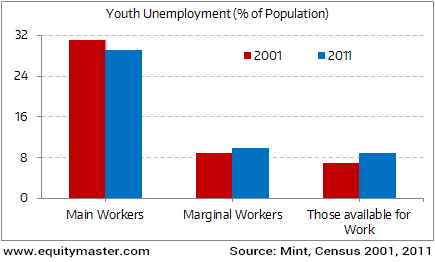
As per Vivek Kaul's analysis, a little over 12 million individuals will keep joining the workforce every year in the years to come. This works out to around one million a month. And at this rate, the Indian workforce is expected to be larger than that of China by 2030.
The demographic dividend benefits a country if the government is able to create the right environment in which jobs are created. And from what we see, we are failing miserably on this front.
But this is not the only crisis hitting India's economy now. To know more, refer to Vivek's special report.

Comments
Log in or sign up to join the conversation.