

Share markets in India are presently trading marginally higher.
The BSE Sensex is trading up by 25 points, up 0.06%, at 40,619 levels.
Meanwhile, the NSE Nifty is trading up by 32 points.
UltraTech Cement and Shree Cement are among the top gainers today. ICICI Bank and GAIL are among the top losers today.
The BSE Mid Cap index is trading up by 0.2%
The BSE Small Cap index is trading up by 0.1%
On the sectoral front, stocks from the basic materials sector and telecom sector are witnessing most of the buying interest.
On the other hand, stocks from the finance sector and the consumer durables sector, are witnessing selling pressure.
US stock futures are trading mixed today with Nasdaq Futures trading up by 21 points (up 0.2%), while Dow Futures trading down 40 points (down 0.1%).
Gold prices are trading down by 0.3% at Rs 50,940 per 10 grams.
The rupee is trading at 73.3 against the US$.
Retail Inflation at Eight-Month High; Factory Output Shrinks
In news from the macroeconomic space, India's retail inflation jumped to an eight-month high of 7.3% in September, primarily driven by higher food inflation, which rose to double-digit levels. Food inflation rose to 10.7% in September from 9.1% in the preceding month, driven by higher prices of vegetables, fish, meat, pulses, eggs and spices.
The inflation rate based on the Consumer Price Index (CPI) was at 6.7% in August and 4% in September last year. Core inflation, which excludes impact of food and fuel inflation, however, softened to 5.7% in September from 5.8% in August.
Retail prices continue to soar above the central bank's 2-6% target band because of disruptions in supplies of food, especially vegetables, amid the pandemic and higher fuel prices.
On Friday, the Reserve Bank of India (RBI) kept policy rates unchanged as inflation continued to remain high. RBI Governor Shaktikanta Das said inflation will ease gradually towards the target in the third and fourth quarter of the fiscal with Kharif arrivals, even though prices of pulses and oilseeds are likely to remain firm due to elevated import duties.
It has projected CPI inflation to average at 5.4% in October-December and 4.5% in January-March.
Meanwhile, factory output continued to decline for the sixth consecutive month in August, recording an 8% contraction, mainly due to degrowth in manufacturing, capital goods, and consumer durables output but showed sequential improvement from 10.8% contraction in the previous month indicating economic activity is gradually gaining pace after the government eased the lockdown restrictions.
Factory output is measured by the Index of Industrial Production (IIP), which is considered the closest approximation for measuring economic activity. The cumulative growth in April-August was (-)25%.
Manufacturing sector output, which accounts for more than three-fourths of the entire index, saw a decline of 8.6% in August. Mining activity that accounts for over 14%, fell 9.8%. Power output contracted 1.8%. Consumer durables and consumer non-durables output, indicators for consumption demand, contracted 10.3% and 3.3%, respectively, in August. The output of capital goods contracted by 15.4% during August.
Note that high inflation rates are a matter of worry for the economy as well as the market as they cripple RBI's ability to keep rates lower for a longer time. The RBI mainly factors in retail inflation while deciding on the key interest rate.
However, the RBI is likely to continue to infuse liquidity through Open Market Operations (OMOs) and Targeted Longer-Term Refinancing Operations (TLTROs) which is likely to keep a tab on yields and the spreads.
How this pans out in the coming months remains to be seen. Meanwhile, we will keep you updated on all the developments from this space.
Sovereign Gold Bond Scheme 2020-21 Series VII Open for Subscription
The Sovereign Gold Bond Scheme 2020-21 Series VII which opened on October 12 will be open for subscription till to October 16.
The bond scheme was launched in November 2015 by the Reserve Bank of India (RBI) on behalf of the central government with an objective to reduce the demand for physical gold and shift a part of the domestic savings used for the purchase of gold into financial savings.
Sovereign Gold Bonds (SGBs) are denominated in multiples of grams of gold with a basic unit of 1 gram and have a tenor of eight years, with investors having the option to exit after the fifth year on interest payment dates.
SGBs can be purchased at scheduled commercial banks (except small finance banks and payment banks), Stock Holding Corporation of India (SHCIL), designated post offices, and recognized stock exchanges such as the NSE and the BSE.
According to a statement released by the RBI, the issue price for the sovereign gold bond has been fixed at Rs 5,051 per gram of gold. A discount of Rs 50 on the nominal value will be offered to investors applying online. For such investors, the issue price of gold bond will be Rs 5,001 per gram of gold. The payment against the application can be made through digital mode.
This is about 1.3% lower than Rs 5067 per gram that they paid for the last issue in September.
Note that gold prices have moved up by 28.2% over the last one year. The yellow metal is considered a hedge against inflation and a weakening dollar. With the flood of money by governments and central banks expected to stoke inflation, investors are buying gold.
Data from the RBI and Association of Mutual Funds of India (AMFI) showed that investors bought gold worth Rs 101.3 billion in the first six series of sovereign gold bonds in the first five months of the current financial year and pumped Rs 39 billion into gold exchange-traded funds (ETFs). In the same period last year, they had bought gold bonds worth Rs Rs 57.4 billion and gold ETFs worth Rs 750 million.
SGBs can be considered as an alternative to fixed deposits as the extra interest, tax-free maturity status of sovereign gold along with likely price appreciation in gold makes it a product that beats fixed deposit returns post-tax. While capital gains tax is exempt if held until maturity, the product fetches 2.5% as interest in addition to the gains. Gold ETFs are taxed like debt funds.
The bonds are restricted for sale to resident individuals, Hindu Undivided Families (HUFs), trusts, universities and charitable institutions.
SGBs will be issued in five more tranches in the 2020-21 fiscal year. The Sovereign Gold Bond Scheme (SGB) 2020-21 Series VIII will open for subscription during November 9 to November 13. The issue price will be announced a few days before the subscription opens.
We will keep you updated on all the news from this space. Stay tuned
Speaking of the precious yellow metal, how lucrative has gold been as a long-term investment in India?
The chart below shows the annual returns on gold over the last 15 years...
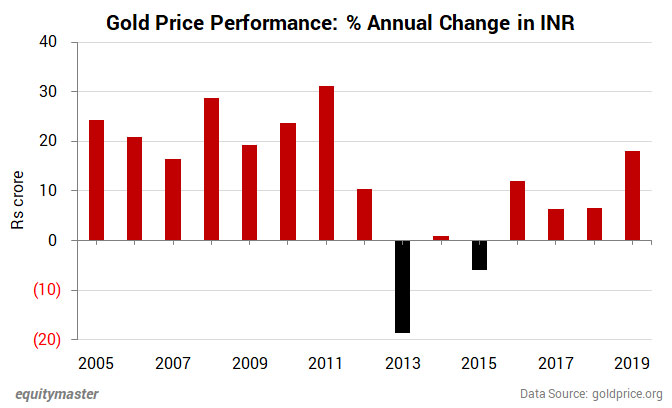
As you can see, barring just two years - 2013 and 2015, gold has delivered positive returns in 13 of the last 15 years.
The recent price volatility in the bullion market has rattled many traders. Even with the recent volatility in prices, gold remains among the best performing commodities this year to combat the fallout from the coronavirus pandemic.



Comments
Log in or sign up to join the conversation.