

After opening the day marginally higher, share markets in India have traded flat and are trading marginally above the dotted line. Sectoral indices are trading on a mixed note with stocks in the pharma sector and stocks in the metal sector trading in green, while stocks in the energy sector are leading the losses.
The BSE Sensex is trading up by 42 points (up 0.1%), and the NSE Nifty is up by 6 points (up 0.1%). Meanwhile, the BSE Mid Cap index is trading up by 0.3%, while the BSE Small Cap index is trading up by 0.4%. The rupee is trading at 64.14 to the US$.
In news from the IPO space. According to Livemint, biscuits maker - Anmol Industries Ltd plans to list in 2018 and has begun work on an initial public offer (IPO). The company plans to file offer documents with the regulator soon.
The Kolkata based company has already appointed bankers for the process and plans to raise over Rs 10 billion through the offer, which would see the company valued at about Rs 40-50 billion.
The company has a turnover of over Rs 12 billion and sells over 30 variants of biscuits, cakes and cookies through over 2500 distributors. It also exports a range of biscuits to countries in Asia, Africa, Europe, the Middle East and the Caribbean Islands.
Several food and beverage companies have tapped the IPO market in the last few years in order to raise funds, retire debt and allow exits to private equity investors.
These include Indore-based Prataap Snacks Ltd, which sells potato crisps and a variety of savouries under the brand name Yellow Diamond which recently raised over Rs 4.8 billion.
IPOs Underperform Broad Market Indices
2017 will undoubtedly be considered as the year of IPOs. The IPO activity is headed for a record. They have garnered more than Rs 650 billion, surpassing the previous record of Rs 375 billion in 2010. This year, the demand has exceeded expectations.
What if one had invested in all the IPOs? How have the IPOs performed in 2017? And, have they outperformed the indices?
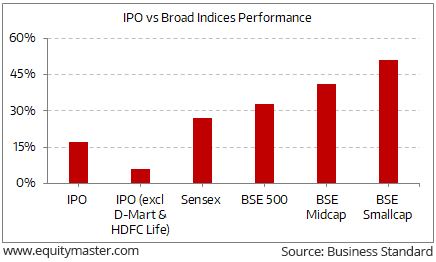
According to an article in Business Standard, an investor who bet on the 33 IPOs of 2017 (on a weighted average basis) has seen the value of investment rise by 17%. However, compared to broad market indices, the underperformance is a bitter disappointment.
Below chart clearly shows the underperformance of IPOs.
Interestingly, if you take the Avenue Supermarts (D-mart) and HDFC Life out of the equation from the IPOs above, the gains drop to a meager 6%. Compared to this, the Sensex has gained 27%, while the small-cap index surged more than 50%.
What is the reason for this underperformance?
One of the key reasons IPOs have touched the altitude is due to a surge in the Indian equity market backed by liquidity and increasing investor demand for financial assets. Private equity investors and promoters took advantage of the absurd demand and came out with sky-rocket valuations. This is what we call a valuation bubble in the IPO market.
During such times, it is imperative to be critically selective when investing in IPOs. Carefully analyse each company for its own merits and don't give in to the hype surrounding the public offering.
That's Ankit Shah's approach at Equitymaster Insider. He keeps an eagle-eye on the developments in the IPO space and updates his readers on the big-ticket IPOs.
Moving on to news from the commodities space. Oil price is gaining momentum as it traded at its highest levels since mid-2015.
The international benchmark Brent crude, spiked as a pipeline run by Waha Oil Company that carries crude to Libya's Es Sider terminal exploded Tuesday, reducing output by 70,000-100,000 barrels a day.
Futures in New York and London touched the highest levels in more than two years after reports of the explosion came through.
Output in Libya, where oil fields have endured sporadic shutdowns and disruptions due to protests, power blackouts and fighting, rose to about 1 million barrels a day this year, the highest level in four years. Any drop in production will ease pressure on OPEC-led efforts to drain a glut.
Note that crude oil prices have been on a rising trend this year. However, this is not good news from India's perspective.
Comments
Log in or sign up to join the conversation.