

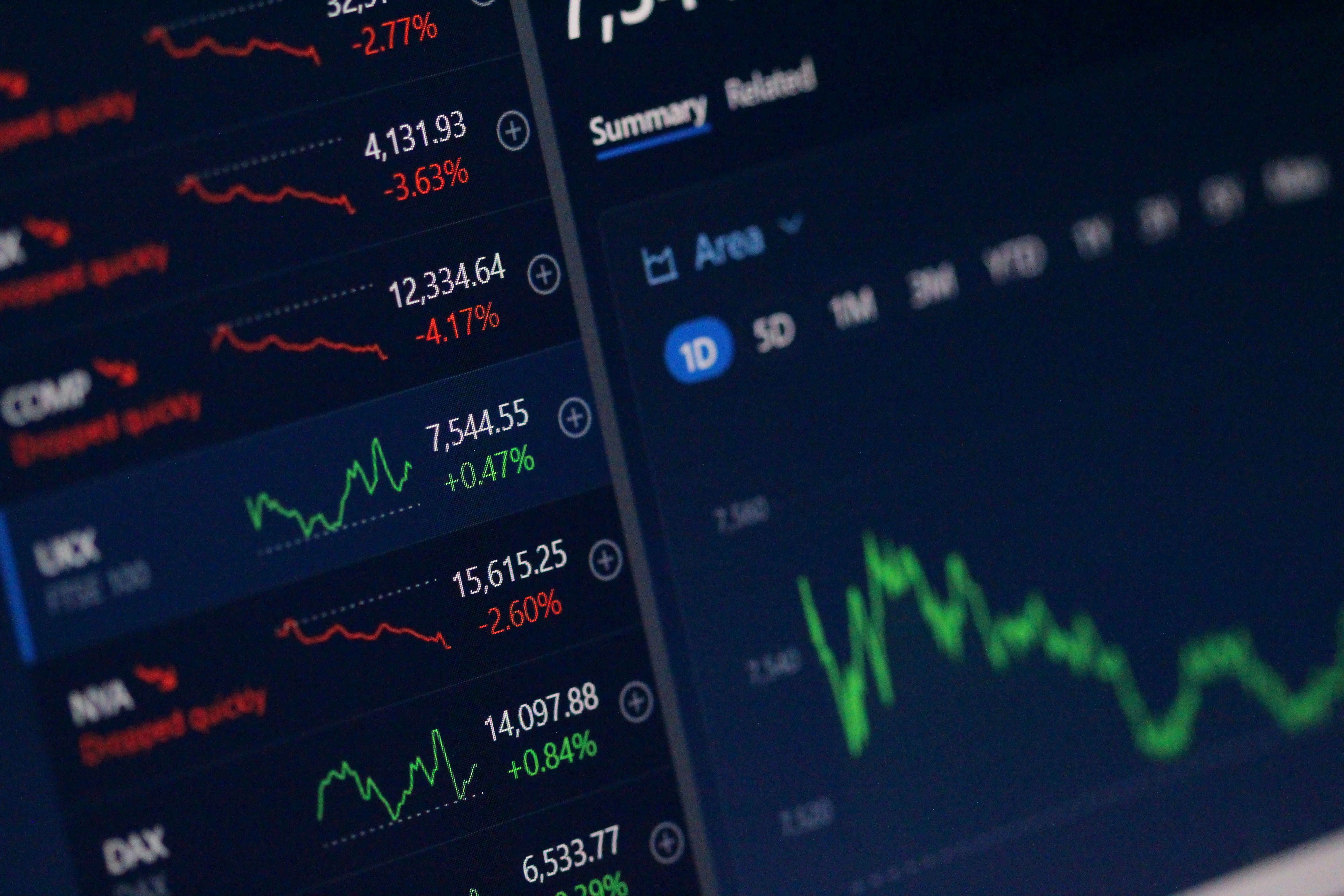
Photo by Anne Nygård on Unsplash
Asian markets traded lower on Friday as surging oil prices continue to stoke inflation fears.
US stock market ended lower on Thursday, after Iranian strikes on two oil tankers sent crude prices surging toward $100 per barrel, further exacerbating inflation fears.
Here's a table showing how US stocks performed on Thursday:
Stock/Index | LTP | Change ($) | Change (%) | Day High | Day Low | 52-Week High | 52-Week Low |
|---|---|---|---|---|---|---|---|
Alphabet | 303.21 | -5.21 | -1.69% | 308.64 | 300.84 | 350.15 | 142.66 |
Apple | 255.76 | -5.05 | -1.94% | 258.95 | 254.18 | 288.61 | 169.21 |
Meta | 638.18 | -16.68 | -2.55% | 653.5 | 636.9 | 796.25 | 479.8 |
Tesla | 395.01 | -12.81 | -3.14% | 406.5 | 394.65 | 498.82 | 214.25 |
Netflix | 94.31 | -0.57 | -0.60% | 95.4 | 93.87 | 134.12 | 75.01 |
Amazon | 209.53 | -3.12 | -1.47% | 211.71 | 208.15 | 258.6 | 161.43 |
Microsoft | 401.91 | -2.98 | -0.73% | 406.12 | 401.71 | 555.45 | 344.79 |
Dow Jones | 46677.85 | -739.42 | -1.56% | 47242.52 | 46662.23 | 50512.79 | 36611.78 |
Nasdaq | 24533.58 | -431.42 | -1.73% | 24809.27 | 24522.24 | 26182.1 | 16542.2 |
Source: Equitymaster
At present, the BSE Sensex is trading 891 points lower, and the NSE Nifty is trading 303 points lower.
HUL, Trent, Bharti Airtel among the top gainers today.
Tata Steel, Bharat Elec, and Tech Mahindra, on the other hand, are among the top losers today.
The Nifty Midcap 100 index is trading 1.7% lower, and the Nifty Smallcap 250 index is trading 1.6% lower.
Sectoral indices are trading negatively today, with stocks in the metal sector and services sector witnessing selling pressure.
The rupee is trading at Rs 92.3 against the US dollar.
Max Financial Gets Board Nod For QIP
At its meeting held on 12 March 2026, the board of Max Financial Services approved raising up to Rs 20 billion (bn) through a Qualified Institutional Placement (QIP).
The funds will primarily be used to support the funding requirements of its key subsidiary, Axis Max Life Insurance, to drive business growth and expansion. The remaining amount will be utilised for general corporate purposes.
Additionally, the board approved an increase in the company's authorised share capital from ?70 crore to Rs 0.75 bn.
KPI Green Expands Renewable Energy Capacity
KPI Green Energy Limited has commissioned an additional 35 MWp of solar capacity, taking its total operational IPP capacity to 589 MWp. With ongoing projects, the company plans to add 1,582 MWp more, which will expand its total IPP portfolio to 2.17 GWp.
The company recently started power generation from its 200 MW Khavda solar project in January 2026 under a long-term agreement with Gujarat Urja Vikas Nigam Limited. It has also begun early power injection from its 92.15 MWp hybrid wind-solar project, while additional solar and hybrid projects are currently under construction and expected to be completed by October 2026.
Meanwhile, its subsidiary Sun Drops Energia Limited has signed an agreement with Gujarat Urja Vikas Nigam Limited to develop a 445 MW / 890 MWh battery energy storage system (BESS) project, marking the company's entry into large-scale energy storage and strengthening its renewable energy portfolio.
ACME Solar Enhances Grid with BESS
ACME Solar Holdings Ltd has commissioned 142.67 MW / 481.49 MWh of Battery Energy Storage System (BESS) capacity in Phase-1 through its subsidiaries, out of a planned 585 MW / 2,011.24 MWh BESS capacity. The company's overall portfolio is expected to require around 17 GWh of BESS installations in multiple phases across different states.
The BESS units are located in Rajasthan and are connected to the existing Inter-State Transmission System (ISTS) network. Initially, these systems will operate on a merchant basis, earning revenue by storing electricity during low-demand hours and supplying it during peak demand periods.
Over time, the storage systems will be integrated with the company's Firm and Dispatchable Renewable Energy (FDRE) projects and operate under long-term power purchase agreements (PPAs) of up to 25 years. These systems will help improve grid reliability by balancing electricity supply and demand and supporting better power utilization.



Comments
Log in or sign up to join the conversation.