

Although the benchmark indices opened lower, they traded negatively throughout the session and ultimately closed red.
Indian equity benchmarks, Sensex and Nifty50, slumped for the second session in a row as Prime Minister Narendra Modi's urge to reduce energy consumption, foreign travel, and gold purchases stoked worries about deeper economic repercussions due to the West Asia war.
At the closing bell, the BSE Sensex closed lower by 1,456 points (down 1.9%)
Meanwhile, the NSE Nifty closed 436 points lower (down 1.8%)
NTPC, SBI, and Bharti Airtel are the top gainers today.
Tech Mahindra, HCL Tech, and TCS, on the other hand, were among the top losers today.
The GIFT Nifty was trading at 23,441, lower by 346 points at the time of writing.
The BSE 150 Midcap index is trading 2.5% lower, and the BSE 250 SmallCap index is trading 2.9% lower.
Sectoral indices were trading negatively today, with stocks in the realty sector and the IT sector witnessing selling pressure.
The rupee is trading at Rs 95.6 against the US$.
Gold prices for the latest contract on MCX are trading 0.3% lower at Rs 1,51,956 per 10 grams.
Meanwhile, silver prices were trading 0.1% higher at 2,62,404 per 1 kg.
6 reasons why Indian share markets are falling:
#1 PM Modi's Austerity Call
Narendra Modi asked people to spend carefully and avoid unnecessary use of petrol, diesel, gas, and gold purchases for a year. This worried investors that consumer spending may slow down, causing shares of jewellery, travel, and hotel companies to fall.
#2 US-Iran Tension Keeps Markets Nervous
The conflict between the United States and Iran is still uncertain despite ceasefire talks. Investors fear fresh tensions could increase oil prices again and negatively affect the global economy.
#3 Rising Crude Oil Prices
Crude oil prices have remained above $100 per barrel for a long period, creating pressure on India's economy. Expensive oil increases inflation, raises import costs, and weakens overall economic growth.
#4 Weak Indian Rupee
The Indian rupee has fallen to a record low against the US dollar due to high oil prices and foreign money outflows. A weaker rupee makes imports more expensive and adds pressure on inflation and the stock market.
#5 Foreign Investors Selling Indian Stocks
Foreign investors have been continuously pulling money out of the Indian stock market.This heavy selling has reduced investor confidence and pushed stock prices lower.
#6 Strong US Dollar and Higher Bond Yields
The US dollar and US bond yields have risen sharply, making US investments more attractive.As a result, foreign investors are moving money away from emerging markets like India, which is hurting market sentiment.
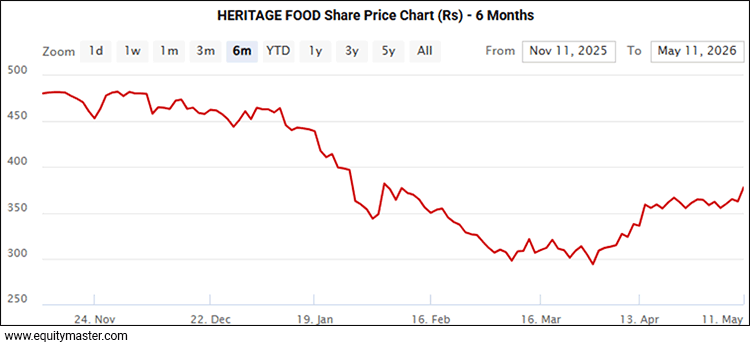
Heritage Foods Q4 FY26 Results
Shares of Heritage Foods came into focus after the company reported its Q4 FY26 results.
Revenue from operations rose 10.4% year-on-year to Rs 11.58 billion, compared to Rs 10.49 billion last year. Sequentially, revenue increased 3.4%.
The company's EBITDA declined 34.6% to Rs 0.52 billion from Rs 0.80 billion a year ago. EBITDA margin also dropped to 4.5% from 7.6% in the corresponding quarter last year.
The company's net profit fell 37% to around Rs 0.24 billion in the March quarter, compared to Rs 0.38 billion in the same period last year. On a quarter-on-quarter basis, profit declined 31%.
Anant Raj Q4 FY26 Results
Shares of Anant Raj came into focus after the company reported its Q4 FY26 results.
The company's net profit increased 23.57% to Rs 1.47 billion in Q4FY26, compared to Rs 1.19 billion in the same quarter last year.
Revenue also rose 19.64% to Rs 6.47 billion from Rs 5.41 billion year-on-year.
For the full financial year FY26, net profit climbed 30.39% to Rs 5.55 billion, compared to Rs 4.26 billion in FY25.
Annual revenue increased 21.92% to Rs 25.12 billion from Rs 20.60 billion in the previous year.



Comments
Log in or sign up to join the conversation.