

Although the benchmark indices opened lower, they traded negatively throughout the session and ultimately closed red.
Indian equity benchmarks, Sensex and Nifty50, extended their decline to the third session as traders remained worried about the unfolding situation in the Middle East amid US-Iran tension.
At the closing bell, the BSE Sensex closed lower by 1,122 points (down 1.4%)
Meanwhile, the NSE Nifty closed 385 points lower (down 1.6%)
Bharti Airtel, Infosys, and Tech Mahindra are among the top gainers today.
Tata Steel, Bajaj Finance, and NTPC, on the other hand, were among the top losers today.
The GIFT Nifty was trading at 24,992, lower by 292 points at the time of writing.
The BSE MidCap index ended 1.5% lower, and the BSE SmallCap index ended 2.1% lower.
Sectoral indices are trading negatively today, with stocks in the metal sector and the realty sector witnessing selling pressure.
The rupee is trading at Rs 92.2 against the US$.
Gold prices for the latest contract on MCX are trading 1.5% higher at Rs 163,525 per gram.
Meanwhile, silver prices were trading 3.1% higher at 2,73,700 per 1 kg.
Six reasons why Indian share markets are falling:
#1 West Asia Conflict
The fighting in West Asia has made investors nervous. Iran, the US and Israel are carrying out fresh attacks, increasing fears that the conflict could spread further. For India, higher oil prices due to the war may cause inflation, a weaker rupee, and slower economic growth.
#2 Crude Jumps
Brent crude oil prices have risen to around $82 per barrel and have increased sharply in recent days. Rising oil prices are bad news for India because it imports most of its oil. Higher oil costs can increase inflation, widen the fiscal and trade deficits, and weaken the rupee.
#3 Weak Global Cues
Global markets are also under pressure, adding to negative sentiment. South Korean, Japanese, Chinese and Hong Kong markets are trading sharply lower, and US markets also closed in the red. Weak global trends often affect Indian markets as well.
#4 FII Selling
Foreign investors sold Indian shares worth over Rs 3,295 crore on Monday. Continuous selling by overseas investors leads to money flowing out of the country. This reduces liquidity in the market and puts pressure on stock prices.
#5 Weak Rupee
The rupee fell sharply to a record low of 92.18 against the US dollar. The fall is mainly due to rising oil prices and global tensions. A weaker rupee makes imports more expensive and can increase inflation.
#6 VIX Rises
The India VIX, which measures market fear and volatility, jumped 22 percent to 20.83. A higher VIX means investors expect bigger price swings in the market. This shows that uncertainty and nervousness are currently very high.
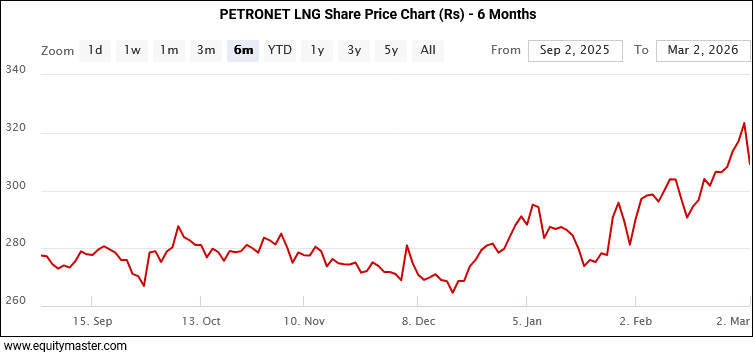
Qatar Production Halt Hits Petronet LNG
According to media reports, shares of Petronet LNG came into focus after the company issued a force majeure notice to QatarEnergy regarding its LNG tankers.
The heavy selling started after Qatar stopped gas supplies because production was disrupted by an Iranian drone attack.
This has significantly reduced gas availability for Indian industries. Qatar is the biggest supplier of natural gas to India and plays a major role in meeting the country's import needs.
Separately, Petronet LNG informed gas marketers that Qatar has suspended its LNG production. The attacks have also almost stopped oil and LNG shipments passing through the Strait of Hormuz. This has raised concerns about further supply disruptions.
Tejas Networks Expands Optical Networking Portfolio
Tejas Networks on Tuesday, 3 March 2026, announced the launch of its new TJ1600-D3, a next-generation WDM optical transport solution designed to handle the rapidly growing demand for high-speed data center connectivity across the world.
The platform runs on advanced digital signal processors and modern chipsets, offering very high capacity, strong reliability, and improved energy efficiency for telecom operators and enterprises. It supports different traffic modules with flexible speeds per wavelength and delivers large overall system capacity.
The TJ1600-D3 also comes with backup controllers, cooling fans, and power units, along with support for both AC and DC power. Built in a compact 3-RU design, it is designed to provide stable and reliable network performance.



Comments
Log in or sign up to join the conversation.