

Although the benchmark indices opened higher, they traded positively throughout the session and ultimately closed red.
Indian equity benchmarks, Sensex and Nifty50, extended losses in the last half to end sharply lower as Brent crude rose to an over one-year high on rising US-Iran tension. At the closing bell, the BSE Sensex closed lower by 1,097 points (down 1.4%)
Meanwhile, the NSE Nifty closed 315 points lower (down 1.27%)
Bharat Elec, Sun Pharma, and Infosys are among the top gainers today.
HDFC Bank, SBI, and Bajaj Finserv, on the other hand, were among the top losers today.
The GIFT Nifty was trading at 24,574, lower by 222 points at the time of writing.
The BSE MidCap index ended 1.5% lower, and the BSE SmallCap index ended 2.1% lower.
Sectoral indices are trading mixed today, with stocks in the power sector and the industrial sector witnessing buying. Meanwhile, stocks in realty sector and the banking sector witnessed selling pressure.
The rupee is trading at Rs 91.7 against the US$.
Gold prices for the latest contract on MCX are trading 0.1% higher at Rs 159.850 per gram.
Meanwhile, silver prices were trading 0.8% higher at 2,64,350 per 1 kg.
Four reasons why Indian share markets are falling:
#1 Escalating Geopolitical Tensions:
Ongoing conflict between the US, Israel, and Iran has made investors cautious. Rising worries about energy supply disruptions and higher crude prices are fueling inflation concerns and slowing global growth expectations.
#2 Weak Global Cues:
Asian markets, including South Korea's Kospi, are trading lower, while US markets closed in the red on Thursday. Weak global performance is adding pressure on domestic markets.
#3 FII Outflows:
Foreign investors continued to sell Indian shares, offloading Rs 3,752.52 crore on Thursday. In March so far, FIIs have sold nearly Rs 16,000 crore, keeping markets under pressure.
#4 Higher Crude Prices:
Brent crude jumped about 5% on Thursday to a 20-month high of $86.28 per barrel. The 16% rise since the conflict is moderate and prices may fall once tensions ease.
#5 Selling in Banking Shares:
Banking stocks fell sharply, dragging Bank Nifty down over 2%, with major lenders like HDFC, ICICI, SBI, and Axis Bank losing 2-3%. Rising crude prices push inflation up, delaying rate cuts and weighing on banks.
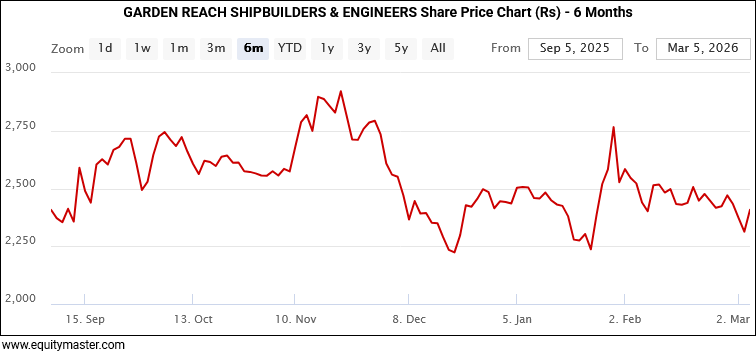
Garden Reach Shares Jump on Defence MoU
In the news from the defence sector, shares of Garden Reach Shipbuilders & Engineers came into focus after it signed a MoU with Kalyani Strategic Systems Ltd. to jointly develop and promote indigenous advanced naval systems, unmanned platforms and maritime capabilities
Under the partnership, the two companies will work together on several maritime and defence technologies. This includes ship propulsion and mechanical systems for naval and commercial vessels, integrated platform management systems, steering and stabiliser systems, and various deck equipment.
The collaboration will also focus on developing unmanned platforms such as Unmanned Surface Vessels (USVs) and Autonomous Underwater Vehicles (AUVs). Both companies plan to jointly explore and pursue business opportunities in India as well as in selected international markets.
Standard Engineering Tech Gains on Export Deal
Shares of Standard Engineering came into focus after the company entered into a distribution agreement with API Pharma Pharmaceutical Trading, United Arab Emirates (UAE) to export its manufactured products in the Middle East region.
Standard Engineering Technology has entered a target-based conditional distribution agreement with API Pharma Pharmaceutical Trading to supply its products and services to customers in the Middle East. The aim of the deal is to strengthen the company's presence in the region, expand its customer network, and boost exports, contributing to higher foreign revenue.
The agreement will help the company grow its footprint across sectors like pharmaceutical manufacturing, biopharmaceuticals, life sciences, food and beverages, and other process industries. It includes an initial three-year performance period with specific annual and cumulative targets. If these targets are met, the agreement could continue for up to ten years.
The company noted that it has built commercial safeguards and periodic reviews to address any geopolitical developments in the region.



Comments
Log in or sign up to join the conversation.