

After opening the day in the red, share markets in India have continued to slide and are presently trading deep in the red. All sectoral indices are trading on a negative note, with stocks in the realty sector and stocks in the capital goods sector leading the gains.
The BSE Sensex is down by 540 points (down 1.5%) and the NSE Nifty is trading down by 155 points (down 1.4%). Meanwhile, the BSE Mid Cap index is trading down by 2.3%, while the BSE Small Cap index is trading down by 3%. The rupee is trading at 63.95 to the US$.
In news from stocks in the banking sector. Yes Bank share price is in focus today after the bank said it will raise US$ 600 million by issuing five year notes.
The bank priced its five-year dollar bonds s at 130 basis points over the five-year US Treasury yield. The fund raising is the first foreign currency bond offering by the lender.
The bonds will be listed on the London Stock Exchange International Securities Market, the Singapore Exchange Securities Trading, and the India International Exchange IFSC.
With the current development, Yes Bank is set to join the ever-growing list of Indian companies opting to raise funds via bond issues.
At the time of writing, Yes Bank share price was trading down by 1.4%.
Increasing Bond Issues by Indian Companies
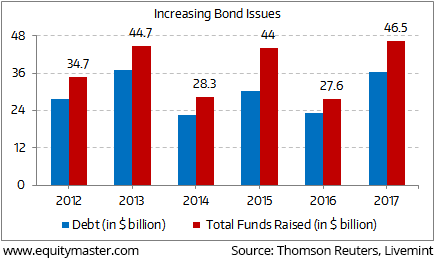
Indian companies raised a record US$ 46.5 in debt and equity in 2017, the highest amount in the last decade.
The stock markets reached dizzying heights in 2017 thanks to strong foreign inflows. But it is the bond market that has witnessed a strong revival. Foreign debt raised by Indian companies surged ten-folds to US$ 41 billion in 2017. This is the highest ever infusion of foreign funds in the domestic debt markets in the last 15 years. At US$ 23 billion, foreign investments in government securities and corporate paper took the cake. This was followed by dollar denominated bonds that attracted around US$ 16 billion of foreign investments whereas funds of US$ 2 billion were mopped up by masala bonds. Masala Bonds are rupee-denominated borrowings by Indian entities in the overseas markets.
Interesting to note that the Indian debt market was in the spotlight even before Moody's sovereign rating upgrade in November last year. The upgrade has further pushed down the borrowing costs for Indian companies resulting in narrowing down of the credit spreads. Recently, Power Finance Corporation raised US$ 400 billion of debt through 10-year dollar bonds priced at just 157.5 basis points above the US treasury. Factors such as economic stability, abundant global liquidity and diversification needs of investors have stoked demand for Indian bonds in the overseas markets.
Moving on to news from the GST space. The government postponed the implementation of the e-way bill requirement for movement of consignments in the goods and services tax (GST) regime after technological glitches led to disruption in trade.
The e-way bill, an electronic documentation tracking the movement of goods, was mandatory for all inter-state movement of goods from 1 February.
The GST Council had mandated that E-way bill for inter-state movement of goods will come into force from February 1, and states would have time till June 1 to move ahead with intra-state E-way bill.
However, more than 16 states decided to implement it from 1 February itself, leading to technical glitches.
Businesses had two weeks trial time before the system was due for rollout in February, but policymakers chose to defer implementation to avert technical glitches causing disruption in supply chain at a time GST revenue has started stabilising.
Once implemented, e-way bill is needed for all movement of goods valued at more than Rs 50,000. within or outside a stat.
Every coin has two sides. GST is no exception. It has had its fair share of chaos in the months immediately post its implementation from 1 July 2017. Many businesses reported depressed earnings due to the transition to GST.
Our colleague Vivek Kaul has studied the finer aspects of the GST and predicted what could go right and wrong.
Comments
Log in or sign up to join the conversation.